
Tokyo National Museum (東京国立博物館)
Japan’s oldest museum, for Japanese and Asian art
Check first
| Opening hours | 9:30–17:00 (until 20:00 on Fridays, Saturdays and Sundays before a Monday holiday) |
|---|---|
| Last admission | 30 minutes before closing |
| Admission | Collection galleries: adults ¥1,000, university students ¥500. Free for high school students and under, under-18s and those aged 70 and over (bring ID showing age). Special exhibitions are charged separately |
| Closed | Mondays (open on public holidays, closed the next weekday) and the year-end period. Occasional extra closures |
| Booking | Not needed for the collection galleries (official online tickets available, no time slot). Check each special exhibition’s page |
| Best time to visit | Right after opening. At busy times the ticket window can take 30 minutes or more, so online tickets are quicker. Open into the evening on Fridays and Saturdays |
| Time needed (approx.) | 1.5–2 hours for the Honkan alone; half a day for several galleries |
| Access notes | About 10 min on foot from the Park Exit of JR Ueno Station or the South Exit of Uguisudani Station. Enter by the Main Gate. No parking. Wheeled suitcases cannot be taken inside |
| Checked / official site | Checked on 16 November 2026 Official website |
What is the Tokyo National Museum (東京国立博物館)? | History
The Tokyo National Museum (東京国立博物館) is a national museum on the north side of Ueno Park (上野恩賜公園), which collects, conserves and displays art and archaeological artefacts from Japan and Asia. It traces its origins to an exhibition held by the Ministry of Education Museum at Yushima Seido (湯島聖堂), a hall for Confucius built in the late 17th century, in 1872, making it Japan’s longest-established museum.
Its collection galleries, called the “Tohaku Collection” (東博コレクション展), show around 3,000 works at any one time, including National Treasures and Important Cultural Properties, with frequent rotations.
Highlights
The Honkan and Japanese art
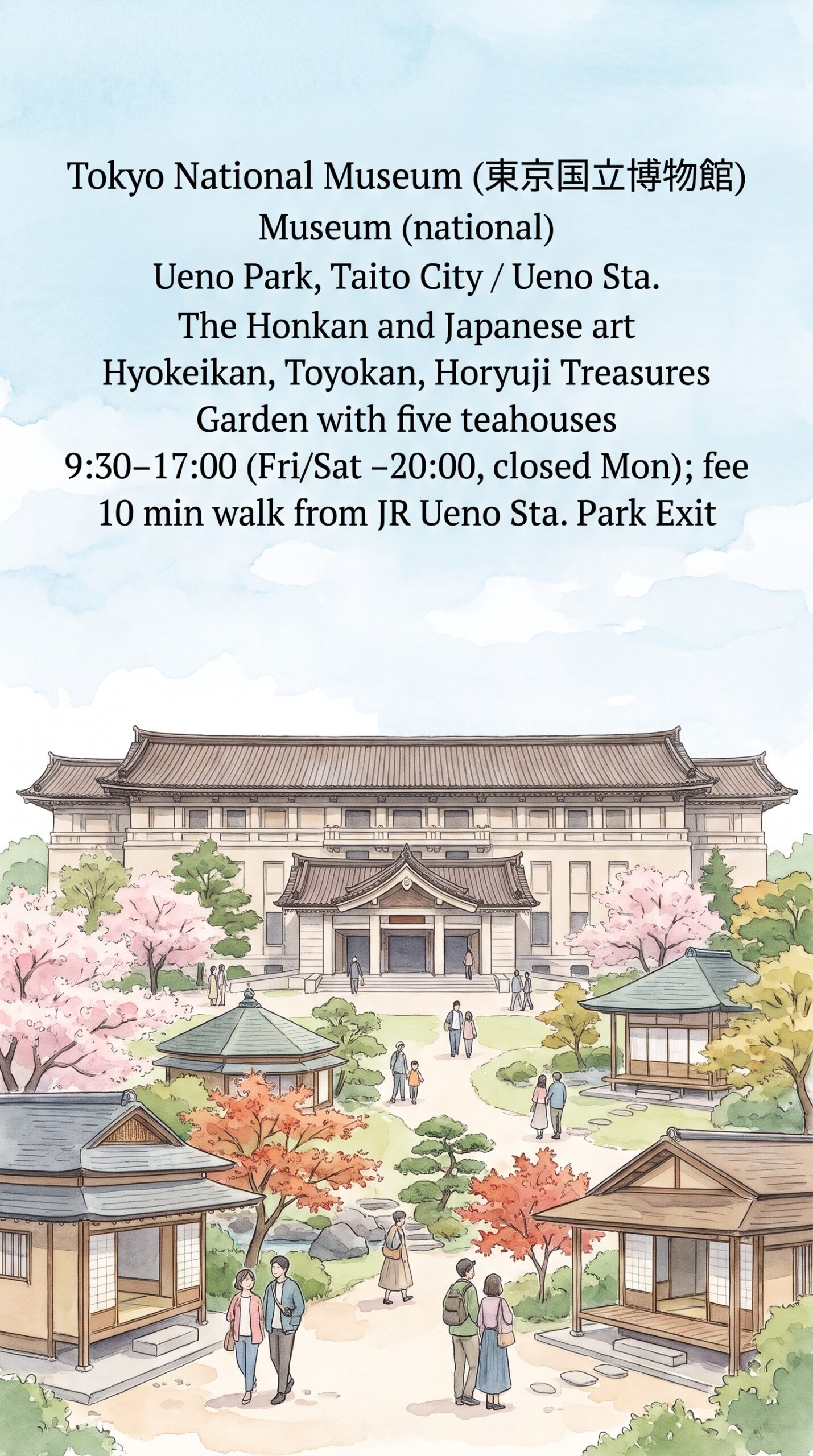
The Honkan (本館), facing the Main Gate, stands in place of the original main building, which was damaged in the Great Kanto Earthquake, the quake that struck the Tokyo region in the Taisho era (early 20th century). That earlier building was designed by Josiah Conder (ジョサイア・コンドル), a British architect who came to Japan in the Meiji era (late 19th century) and laid the foundations of modern Japanese architecture. The present Honkan is an Important Cultural Property. Inside you can follow Japanese art by period and theme: Buddhist sculpture, painting, swords, ceramics, kimono and more.
Buddhist statues from Kamakura’s temples
Buddhist statues and crafts from the temples and shrines of Kamakura, the seat of a samurai government from the late 12th to the early 14th century, can be seen at the Kamakura Museum of National Treasures (鎌倉国宝館).
Hyokeikan, Toyokan and the Gallery of Horyuji Treasures
Besides the Honkan, the grounds hold the Toyokan (東洋館) for Asian art, the Gallery of Horyuji Treasures (法隆寺宝物館) for treasures from Horyuji Temple, a temple in Nara said to have been founded in the early 7th century, and the Heiseikan (平成館), mainly used for special exhibitions. The Hyokeikan (表慶館), a Western-style building planned to mark the wedding of the Crown Prince (later Emperor Taisho) and designated an Important Cultural Property, opens only for exhibitions and events. The grounds also hold the “Kuromon” (黒門, Black Gate), the former front gate of the residence in Edo (the old name of Tokyo) of the Ikeda lords of Tottori, the feudal family that ruled today’s Tottori Prefecture from the 17th to the 19th century, and an Important Cultural Property.
The garden and teahouses
North of the Honkan is a garden set around a pond with five teahouses. It is bright with cherry blossoms in spring and autumn leaves in autumn, and has unusual trees and wild plants, a legacy of the museum’s former natural history department (天産部). The garden may close for weather or maintenance.
Hands-on displays and facilities for families
In the Heiseikan’s archaeology gallery you can ring a replica bronze bell (dotaku, 銅鐸), a ritual bell used in Japan about 2,000 years ago. On the first floor of the Honkan, “Gateway to Japanese Art” (日本美術のとびら) is a hands-on room where you can get to know Japanese art through video and digital displays. The first floor of the Heiseikan has a Family Space for preschool children and their parents. Pushchairs and wheelchairs can be borrowed inside the museum.
Access and opening hours
It is about 10 minutes on foot from the Park Exit of JR Ueno Station or the South Exit of Uguisudani Station (鶯谷駅), and about 15 minutes from Ueno Station on the Tokyo Metro Ginza and Hibiya lines, Nezu Station (根津駅) on the Chiyoda Line, or Keisei Ueno Station (京成上野駅). On the Taito City loop bus “Tozai Megurin”, get off at the “Tokyo Kokuritsu Hakubutsukan-mae” (東京国立博物館前) stop. Visitors to the galleries enter by the Main Gate. There is no parking for cars or bicycles.
Opening hours and closing days change by weekday and time of year, so check the table above. There are also occasional extra closures and gallery closures. The museum is closed on Tuesday, December 15, 2026 for facility maintenance. Some galleries are also closed: Honkan Galleries 17–20 and the Toyokan from Monday, November 30 to Thursday, December 31, 2026 for exhibition environment work; Honkan Galleries 2–3 from Monday, December 14, 2026 to Sunday, April 25, 2027; and Honkan Gallery 4 from Monday, October 26, 2026 to Sunday, April 25, 2027. Wheeled suitcases cannot be taken inside, and bags are checked at the Main Gate.
Best time to visit
With the displays mostly indoors, it suits rainy or hot days. At busy times buying a ticket at the Main Gate window can take 30 minutes or more, so getting an official online ticket in advance speeds up entry. It stays open into the evening on Fridays and Saturdays, which works well for an evening visit. There is so much on display that one or two hours is often not enough, so decide which galleries to see first. Even when the Honkan or a special exhibition is crowded, the Toyokan is usually calmer. Queues can form at the Main Gate for bag checks, so allow some extra time.
Nearby spots
The museum stands inside Ueno Park, linked to the centre of the park across the fountain plaza. You can spend a full day combining it with the park’s galleries, the zoo and Shinobazu Pond (不忍池).
Summary
The Tokyo National Museum, Japan’s longest-established museum dating from 1872, shows around 3,000 works of Japanese and Asian art and archaeology at any time on the north side of Ueno Park. Build your visit around the Honkan, and if time allows continue to the Toyokan or the Gallery of Horyuji Treasures.
Basic Information
| Name | Tokyo National Museum (東京国立博物館) |
| Address | 13-9 Ueno-koen, Taito City, Tokyo |
| Opening hours | 9:30–17:00 (until 20:00 Fri & Sat and on Sundays before a Monday holiday; last entry 30 min before closing) |
| Closed | Mondays (next weekday if a holiday), Tuesday, December 15, 2026 (facility maintenance), year end (closed December 26–31, 2026; from December 22 to 25 only the Gallery of Horyuji Treasures and Kuroda Memorial Hall are open; reopens January 1, 2027, 12:00–20:00) |
| Admission | Collection galleries: adults ¥1,000, university students ¥500 (free for high school students and under, under-18s, over-70s) |
| Access | About 10 min walk from JR Ueno Station (Park Exit) or Uguisudani Station (South Exit) |
| Parking | None |
| Phone | 050-5541-8600 (Hello Dial) |
| Official website | https://www.tnm.jp/?lang=en |
Information checked on November 26, 2026 (closing days, temporary closures and gallery closures) / Official source checked: Tokyo National Museum official website, Visitor Information
Google Map
Nearby sights

In the same park (a short walk)

Head on from Tokyo to Kamakura
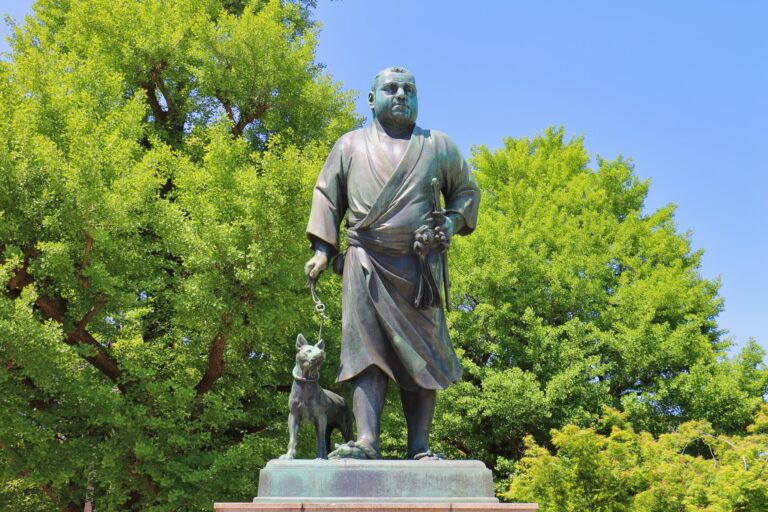
From Ueno, JR reaches Kamakura in about 1 hour 10 minutes. Change to the Yokosuka Line at Tokyo Station. Temples, shrines and the sea: discover the old capital in our Kamakura Travel Guide.