
Kan’ei-ji Temple (寛永寺)
The Tokugawa shoguns’ family temple, founded by Tenkai
Check first
| Konponchudo hours | Gates open 9:00–17:00; ceiling painting viewing in the inner hall 10:00–16:00 (last entry 15:40) |
|---|---|
| Admission | Grounds and outer hall free; inner hall (ceiling painting) 500 yen, free for high school students and younger |
| Closed | Open daily (the inner hall is closed on some days for events or group visits) |
| Booking | Not needed |
| Best time to visit | Mornings, when it is quieter |
| Time needed (approx.) | 30 min |
| Access notes | About 7 min on foot from the South Exit of JR Uguisudani Station (鶯谷駅), up the Shinzaka slope on the right, behind (north of) the Tokyo National Museum |
| Checked / official site | Checked on 16 November 2026 Official website |
What is Kan’ei-ji Temple (寛永寺)? | History
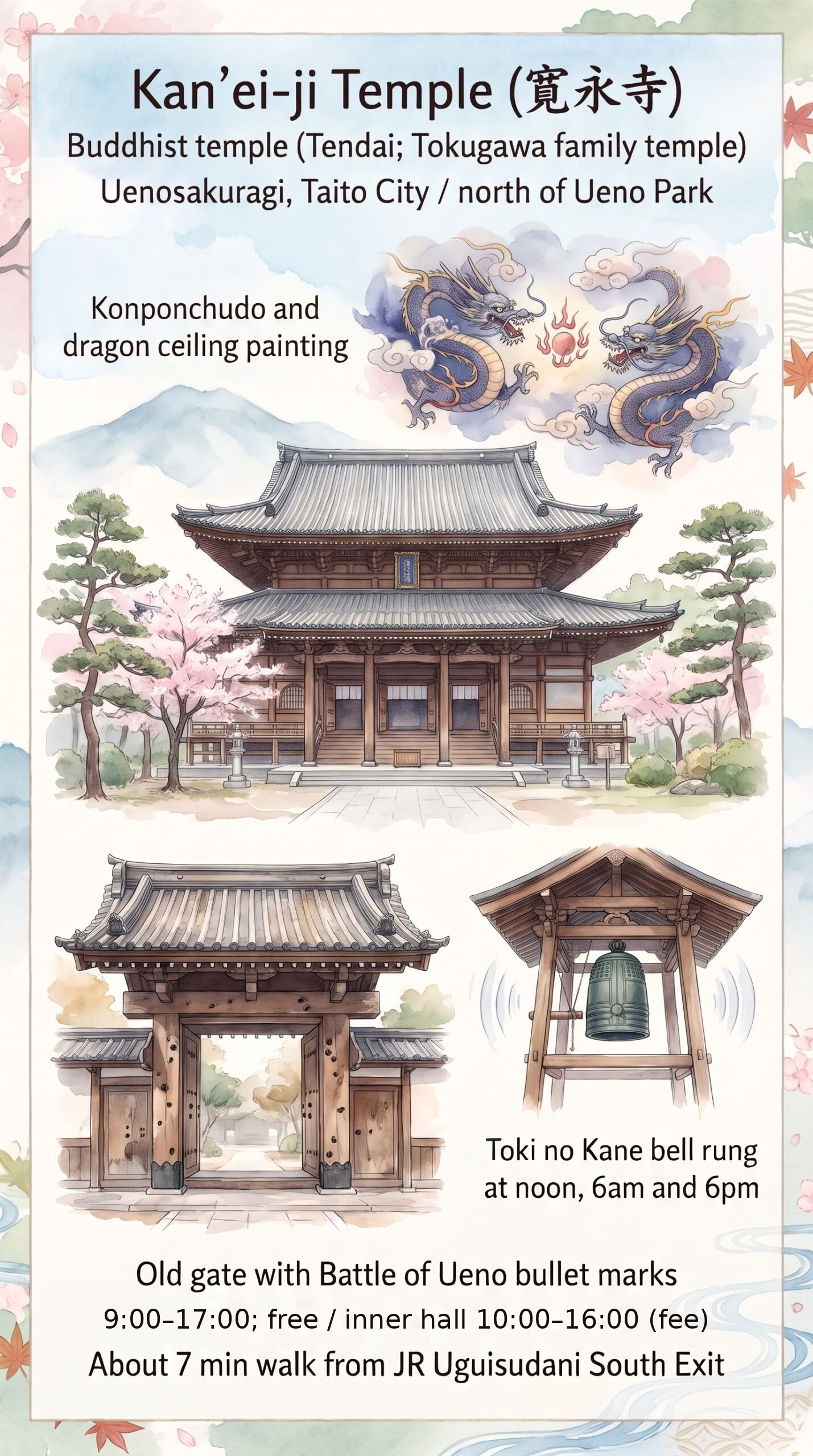
Kan’ei-ji Temple (寛永寺) stands on the north side of Ueno Hill, behind the Tokyo National Museum, with its main hall, Konponchudo; formally named Toeizan Kan’ei-ji (東叡山寛永寺), it belongs to the Tendai school (天台宗), a branch of Buddhism brought from China in the 9th century. It was founded in the early 17th century by Tenkai (天海), a monk who advised the first three shoguns (the military rulers of Japan), and became the family temple of the Tokugawa shoguns, the warrior family that ruled Japan from Edo (now Tokyo) from the 17th to the 19th century. It was built northeast of Edo Castle, guarding the “kimon” (鬼門), the direction from which misfortune was believed to enter, to pray for the stability of the Tokugawa shogunate and the peace of the people, and was modeled on Enryakuji (延暦寺) on Mount Hiei in Kyoto. It became a family temple of the shoguns after the mausoleum of the 4th shogun Tokugawa Ietsuna (徳川家綱) was built here in the late 17th century. In the Battle of Ueno (上野戦争) at the end of the Edo period (late 19th century), when new government forces fought the Shogitai (彰義隊) loyal to the old shogunate, many halls burned, and most of the grounds became Ueno Park.
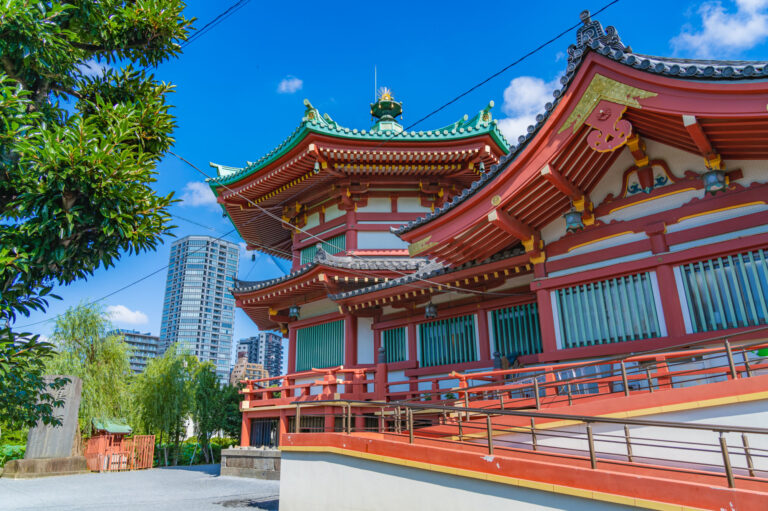
The whole of Ueno Hill, including today’s Ueno Park (上野恩賜公園), was once the temple’s grounds. Bentendo Hall (弁天堂) on Shinobazu Pond (不忍池), dedicated to Benten, a goddess of music and good fortune, is also one of the temple’s halls. The temple is named after the Kan’ei era (寛永, early 17th century) in which it was founded, and its mountain name, Toeizan, means “Mount Hiei of the East.” Mount Hiei, near Kyoto, is home to the head temple of the Tendai school.
Highlights
Konponchudo
The present main hall, Konponchudo (根本中堂), was moved here from Kita-in Temple (喜多院), where Tenkai served as head priest, in Kawagoe (川越), Saitama. Its main image is a Yakushi Nyorai (薬師如来), the Buddha of healing, said to have been carved by Saicho (最澄), who founded the Tendai school in the 9th century; it is a hidden Buddha and an Important Cultural Property. The original Konponchudo stood near today’s Grand Fountain in Ueno Park from the late 17th century and burned in the Battle of Ueno. In 2025, for the temple’s 400th anniversary, the dragon ceiling painting “Eigaku Soryu” (叡嶽双龍) by Japanese-style painter Tezuka Yuji (手塚雄二) was dedicated. You take off your shoes and go up the stairs at the front left, carrying your shoes in a bag. Sitting on the tatami of the inner hall, you can look straight up at the two dragons filling the ceiling, painted so that their eyes seem to follow you wherever you are. The painting can also be seen from the outer hall. When you pay the viewing fee, you receive a one-page leaflet. The main image cannot be seen, but other statues such as the Twelve Heavenly Generals stand at the eye level of visitors. If your timing is right, you may arrive during the monks’ sutra chanting. Photography is not allowed inside the hall, and there is no heating or air conditioning, so dress for the season. Goshuin (御朱印) temple stamps are available at the counter inside the hall or beside the temple office on the grounds. The inner hall is closed on some event days, so check the schedule on the official website.
An old Tendai temple in Kamakura
Kamakura also has temples of the same Tendai school as Kan’ei-ji; Sugimoto-dera Temple (杉本寺) is said to be the oldest temple in the city.
Temple buildings on Ueno Hill
Buildings linked to the temple are still scattered through Ueno Park. Kiyomizu Kannon-do (清水観音堂), a hall with a stage modeled on Kiyomizu-dera in Kyoto, the former Kan’ei-ji five-story pagoda (now inside Ueno Zoo) and the former main residence gate, the Kuromon (旧本坊表門), are Important Cultural Properties; bullet marks from the Battle of Ueno remain on the gate. The “Toki no Kane” (時の鐘) bell in the bell tower near Ueno Seiyoken (上野精養軒), a long-established Western-style restaurant in the park, is a Kan’ei-ji bell set up in the late 17th century, and it is still struck three times a day, in the morning, at midday and in the evening. The 17th-century haiku poet Matsuo Basho (松尾芭蕉) wrote, “Clouds of blossoms / is that bell from Ueno / or Asakusa?” In front of Konponchudo there is a separate belfry. The Ueno Daibutsu (上野大仏) lost its head in the Great Kanto Earthquake and its body to wartime metal collection, so only the face remains. The mausoleums of six shoguns are also here, but they are not open to the public.
Access and opening hours
The temple is about 7 minutes on foot from the South Exit of JR Uguisudani Station. It lies north of the Tokyo National Museum, and from Ueno Station you can walk through Ueno Park. From the Park Exit of JR Ueno Station it is about 15 minutes on foot through Ueno Park.
The temple gates and the ceiling painting in the inner hall have separate viewing hours, so check the table above. Kan’ei-ji’s buildings are scattered around Ueno Park, so visiting several of them means a fair amount of walking. No booking is needed. Allow about 30 minutes for Konponchudo and the ceiling painting.
Best time to visit
For a quiet walk around the temple, mornings are a good choice. The temple stands away from the bustle of Ueno Park.
Nearby spots
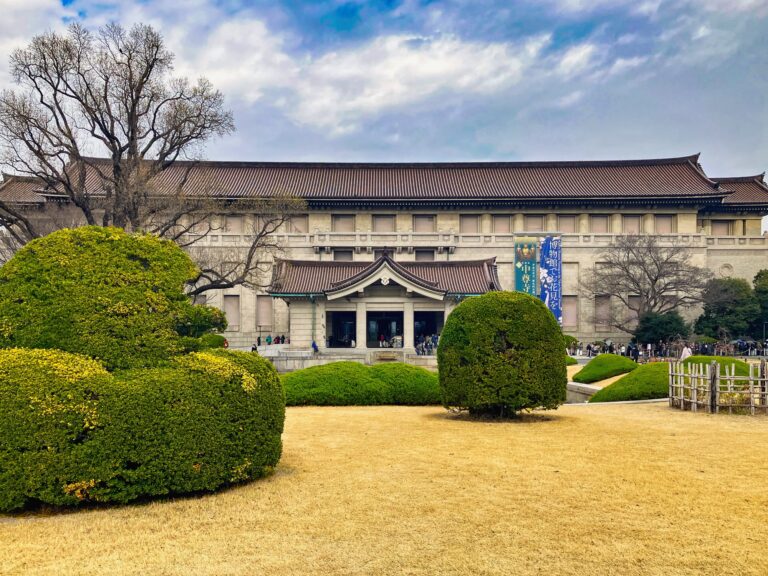
Kan’ei-ji is just north of the Tokyo National Museum and combines with Ueno Park and Shinobazu Pond & Bentendo, where one of its halls stands.
Summary
Kan’ei-ji was founded by Tenkai in the early 17th century and became the family temple of the Tokugawa shoguns in the late 17th century. It is north of the Tokyo National Museum and fits into a walk around Ueno Park.
Basic information
| Name | Toeizan Kan’ei-ji (東叡山寛永寺) |
| Address | 1-14-11 Ueno-sakuragi, Taito City, Tokyo |
| Hours | Gates open 9:00–17:00 (Konponchudo and temple office); ceiling painting viewing in the inner hall 10:00–16:00 (last entry 15:40) |
| Admission | Grounds and outer hall of Konponchudo free; inner hall (ceiling painting) 500 yen, free for high school students and younger (student ID may be requested) |
| Access | About 7 min walk from JR Uguisudani Station (South Exit) |
| Phone | 03-3821-4440 |
| Official website | https://www.kaneiji.jp/ |
Information checked on November 26, 2026 (gate opening and closing times) / Official source checked: Toeizan Kaneiji Temple official website
Google Map
Nearby sights

About 5 min on foot

About 10 min on foot

About 20 min on foot

Head on from Tokyo to Kamakura
From Ueno, JR reaches Kamakura in about 1 hour 10 minutes. Change to the Yokosuka Line at Tokyo Station. Temples, shrines and the sea: discover the old capital in our Kamakura Travel Guide.