
Odaiba Marine Park (お台場海浜公園)
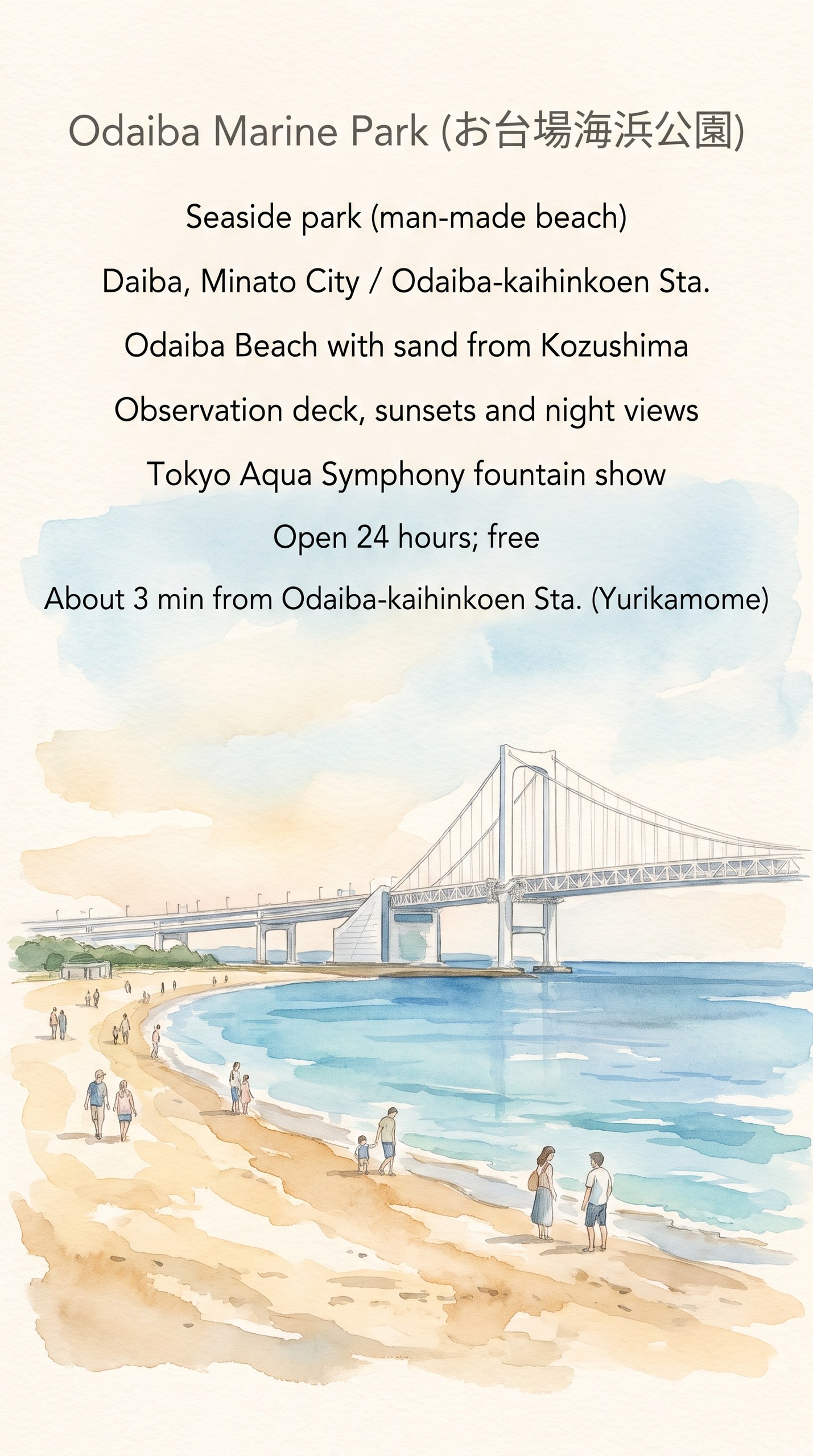
A beach of Kozushima sand facing Rainbow Bridge
Quick facts
| Hours | Open 24 hours, all year. Showers and lockers in the Marine House from 9:00 (closing time varies by season) |
|---|---|
| Last entry | None |
| Fees | Free (showers, lockers and parking are paid) |
| Closed | Never (use restricted on event days) |
| Reservations | Not needed (no reservation for the fountain show either) |
| Best time to visit | Late afternoon into the evening (sunset, night view and fountain show) |
| Time needed (approx.) | 1–2 hours |
| Access notes | About 3 min on foot from Odaiba-kaihinkoen Station or Daiba Station (Yurikamome), about 10 min from Tokyo Teleport Station (Rinkai Line). Also Toei Bus route Umi 01 |
| Checked / official info | Checked on Nov 19, 2026 Kaijo Koen Navi (Tokyo Port Terminal Corporation) |
What Is Odaiba Marine Park (お台場海浜公園)? | History and Origins
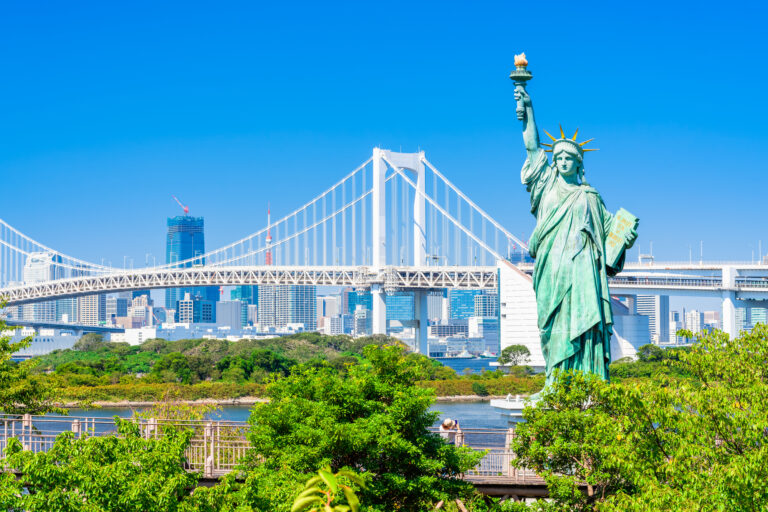
Odaiba Marine Park (お台場海浜公園) is a Tokyo Metropolitan seaside park on an inlet of Tokyo Bay. It has a man-made sandy beach called Odaiba Beach (おだいばビーチ), a rocky shore, a waterfront promenade and the observation deck where the Statue of Liberty stands. The park is always open, and entry is free.
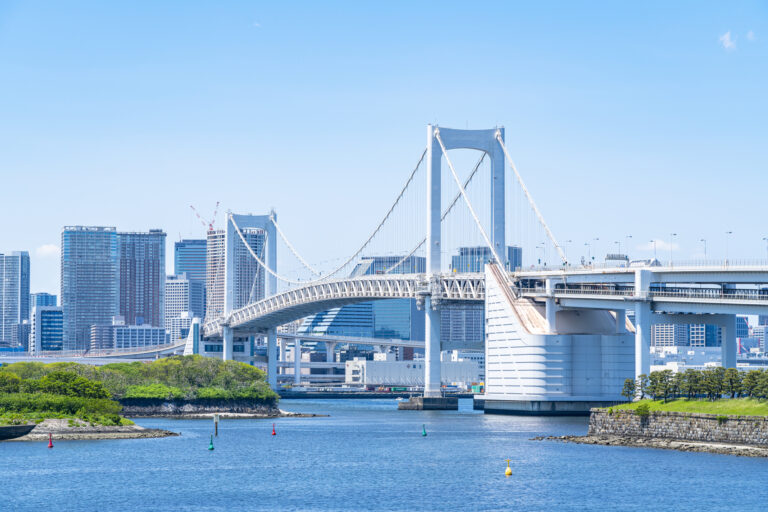
The name Odaiba comes from Daiba (台場), the cannon-battery islands that the Edo shogunate, the samurai government of the Tokugawa family, built in Tokyo Bay in the mid-19th century to guard against attack from the sea. The park wraps around the inlet together with Daiba Park (台場公園), which opens one of those batteries, the Third Daiba, to visitors. From the beach you can see its green island outline.
Highlights
Odaiba Beach and Its Sand from Kozushima
Odaiba Beach is a man-made beach about 800 m long. Its white sand was brought from Kozushima (神津島), one of the Izu Islands (伊豆諸島) that stretch into the sea south of Tokyo. Swimming is not allowed, but you can paddle at the water’s edge, play in the sand, explore the rock pools and dig for clams. The waves are gentle, and small children wade in the shallows and pick up shells.
No clam-digging tools are lent out, and asari clams with shells 2.5 cm or smaller may not be taken. Fishing is allowed only in marked spots on the rocky shore, and ground-baiting and casting are prohibited. There is no play equipment on the beach; Minato City Odaiba Rainbow Park (港区立お台場レインボー公園), which has some, is next door to the east. Many families bring a change of clothes, towels, a bucket and a spade.
A swimming beach in Kamakura
Unlike man-made Odaiba Beach, where swimming is not allowed, Yuigahama Beach (由比ヶ浜) in Kamakura is a sandy shore about 890 m long where a swimming beach opens every summer.
The Observation Deck and Waterfront Sunsets and Night Views
From the observation deck you can see Rainbow Bridge (レインボーブリッジ), Tokyo Tower (東京タワー), the Statue of Liberty (自由の女神像), the high-rises of central Tokyo, and even the old battery sites and former breakwater of Shinagawa Daiba (品川台場). Even without going down to the sand, you can stroll the boardwalk and promenade along the shore. Stay from before sunset and you can watch from the beach as the evening sky turns into the night view of Rainbow Bridge and the towers across the water. After dark, the lights of yakatabune (屋形船), traditional pleasure boats with tatami-matted cabins, and other boats move across the bay.
Tokyo Aqua Symphony Fountain Show
In 2026 a fountain show called Tokyo Aqua Symphony (東京アクアシンフォニー) began on the water in front of the park. Jets of water up to about 150 m high move in time with music and light, and you can watch for free without booking. There are several shows a day, and the times change with the season, so check the official schedule before you go. Shows are cancelled on days with strong wind and the like. The deck in front fills up and can make viewing hard, while the lower level tends to be less crowded.
The Marine House, the Moyai Statue and Kawazu Cherry Trees
The Marine House near the beach has a shop, a snack bar and marine sports equipment rental, along with paid hot showers and lockers. Panels on the history of Daiba line the stairway corridor on the 3rd and 4th floors. There is a free foot-wash area in the park for when you come up off the sand, and a nursing room in the management office.
On the lawn stands a Moyai statue (モヤイ像) presented by Niijima (新島), another of the Izu Islands. Kawazu cherry trees (河津桜), an early-flowering variety, are planted on the former breakwater and usually bloom around February; some visitors photograph them with the Statue of Liberty. The former breakwater also has a memorial to the people who died in the Great Kanto Earthquake (関東大震災), which struck Tokyo in 1923, and in the war, and whose bodies drifted ashore here.
Access and Opening Hours
The nearest stations are Odaiba-kaihinkoen (お台場海浜公園) and Daiba (台場) on the Yurikamome (ゆりかもめ), an automated transit line linking Shimbashi with Odaiba and Toyosu. Both are about a 3-minute walk away. Tokyo Teleport Station (東京テレポート駅) on the Rinkai Line (りんかい線) is about 10 minutes on foot. You can also come by Toei Bus (route Umi 01) from Monzen-nakacho Station. The park has a Central Parking lot and a North Entrance Parking lot.
For opening hours and closures, see the Quick facts table; entry is free. The showers and lockers in the Marine House have set hours, and closing time changes with the season. On event days, such as fireworks displays, use of the park and the water may be restricted. Allow about 1–2 hours to walk the beach and the promenade and take in the views.
The park has changes in level and some stairs, but there are slopes as well. With a stroller or wheelchair, take care on the sandy areas. Fires (including barbecues), kites, beach umbrellas and drones are prohibited; small sunshade tents for two or three people are allowed.
Best Time to Visit
From before sunset into the evening you can see the view change from sunset to night and then catch the fountain show. Summer weekends and public holidays get busy in the daytime, and cars sometimes queue for the parking lots before noon. There is little shade, so the beach gets hot on summer afternoons. At night the beach side is dark, the sea breeze chills you quickly, and windy or cold days are common. Your feet sink into the sand, and sand gets into sandals.
Nearby Spots
You can combine the park with the Statue of Liberty inside it and the Rainbow Bridge promenade, a footpath on the bridge’s lower deck that you can cross on foot.
Summary
Odaiba Marine Park is a seaside park where a man-made beach of sand from Kozushima and an observation deck look out on Rainbow Bridge and Tokyo Bay. It is free and always open, so you can time your visit to the evening views or the fountain show.
Basic Information
| Item | Details |
|---|---|
| Name | Odaiba Marine Park (お台場海浜公園) |
| Address | 1-4 Daiba, Minato City, Tokyo (management office) |
| Highlights | Man-made beach of sand from Kozushima, Rainbow Bridge and Tokyo Bay from the observation deck, evening and night views, Tokyo Aqua Symphony fountain show, Moyai statue and Kawazu cherry trees |
| Things to do | Paddling, rock pools and clam digging, walking the promenade, watching the fountain show, fishing on the rocky shore |
| Hours | 24 hours (Marine House showers and lockers: Apr–Sep 9:00–19:00 / Oct–Mar 9:00–18:00 / Dec 29–Jan 3 9:00–16:00) |
| Closed | Open all year (use of the park and water restricted on event days) |
| Admission | Free (hot shower: 200 yen for 5 min; locker: 300 yen per use) |
| Access | Yurikamome Odaiba-kaihinkoen Sta. / Daiba Sta., about 3 min walk / Rinkai Line Tokyo Teleport Sta., about 10 min walk |
| Parking | Central Parking and North Entrance Parking (400 yen for the first hour, then 200 yen per 30 min; North Entrance only: 2,000 yen maximum within 24 hours) |
| Restrooms | Yes (in the park). Nursing room in the management office |
| Phone | +81-3-5531-0852 (Odaiba Marine Park Management Office) |
| Official website | https://www.tptc.co.jp/park/01_02 |
Information checked on November 26, 2026 (closing days, Marine House hours and fees, and parking fees) / Official source checked: Odaiba Seaside Park official website
Google Map
Nearby sights

Inside the same park
About 15 min on foot from Odaiba-kaihinkoen Station to the Daiba-side entrance

Head on from Tokyo to Kamakura
From Odaiba-kaihinkoen Station, the Yurikamome and the JR Yokosuka Line reach Kamakura in about 1 hour 15 minutes. Change from the Yurikamome to the JR Yokosuka Line at Shimbashi. Temples, shrines and the sea: discover the old capital in our Kamakura Travel Guide.