
teamLab Planets TOKYO (チームラボプラネッツ TOKYO)
A museum you walk barefoot, knee-deep in water and art
Quick facts
| Hours | 8:00–22:00 (Dec 31–Jan 2: 8:00–20:30; subject to change) |
|---|---|
| Last entry | 1 hour before closing (usually 21:00) |
| Fees | Variable pricing. Adults from 3,800 yen; age 3 and under free |
| Closed | Occasional temporary closures (check the official website); closed Thu, Dec 3, 2026 and Thu, Jan 14, 2027 |
| Reservations | Required (date and time slot; no tickets sold on site. Official ticket store) |
| Best time to visit | After dark for the lights of the moss garden in the Garden area |
| Time needed (approx.) | 2 hours (3 hours with children) |
| Access notes | About 3 min on foot from Exit 1A of Shin-toyosu Station (Yurikamome), about 5 min from Shijo-mae Station, about 10 min from Exit 7 of Toyosu Station (Tokyo Metro Yurakucho Line). No dedicated parking |
| Checked / official info | Checked on Nov 19, 2026 Official website |
What Is teamLab Planets TOKYO (チームラボプラネッツ TOKYO)? | History and Origins
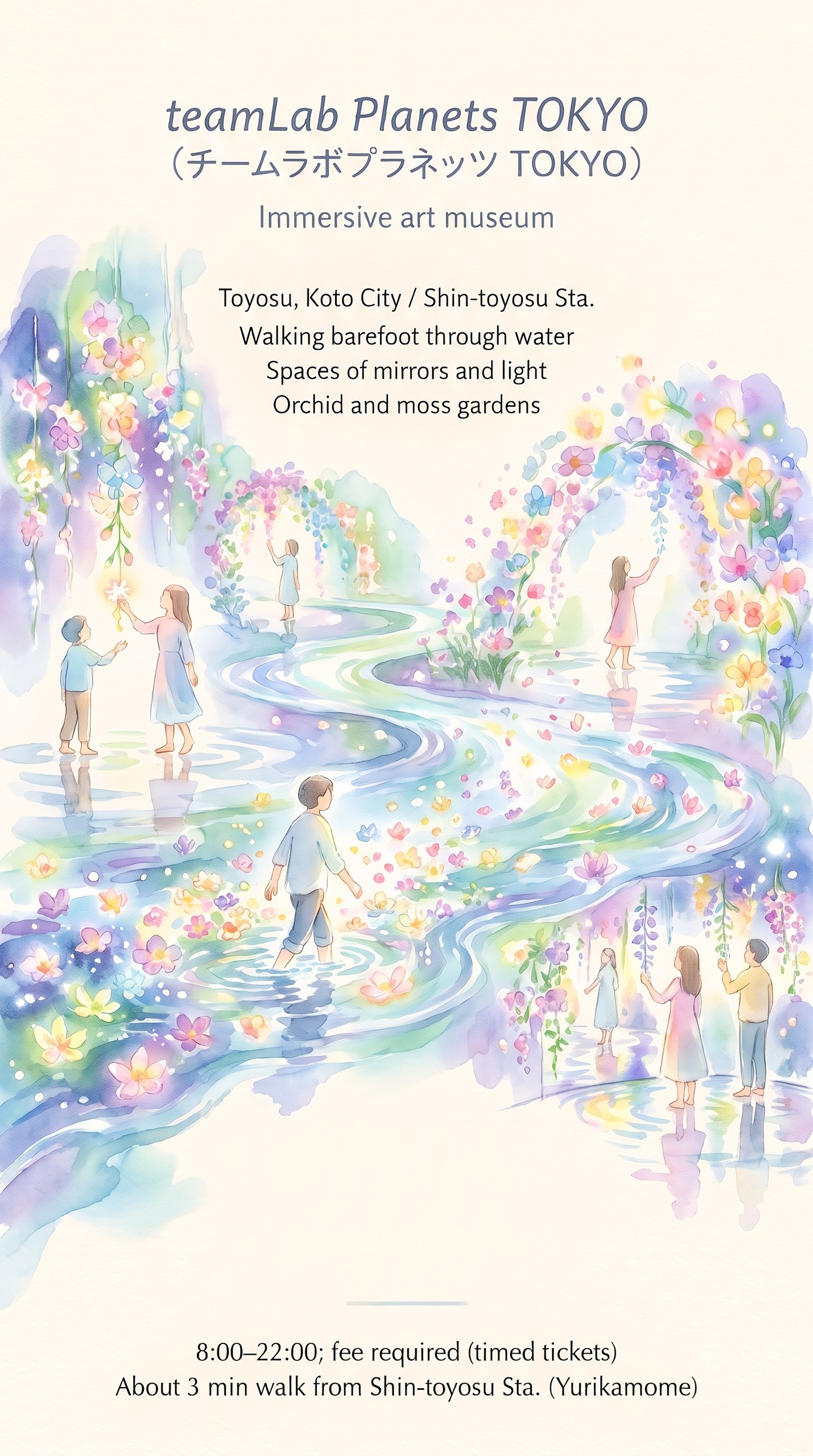
teamLab Planets TOKYO DMM (チームラボプラネッツ TOKYO DMM) is a walk-through museum in Toyosu where you go barefoot through the works of the art collective teamLab (チームラボ). There are works you wade through in knee-deep water, a space of light surrounded by mirrors, and gardens made with real flowers and moss, and the images and light change with the movements of the people inside.
The museum opened in 2018, and its official run is currently scheduled to last until the end of 2027.
Highlights
The Water Area, Walked Barefoot through Water
After a short briefing at the entrance, you take off your shoes and socks and leave them with your bags in a free locker. The Water area, home to the water works, is walked barefoot, and in some works even adults wade in up to about the knee. Holding a handrail, you climb a slope with ankle-deep water running down it, and at the top a waterfall of light appears. In a work where you walk through milky white water, koi carp swimming around your feet scatter into flowers when they bump into people, and the kinds of flowers change with the seasons.
Many visitors wear trousers that roll up to the knee or shorts, and shorts are also lent free of charge. Towels for drying your feet are lent free where you leave the water area.
Spaces of Mirrors and Light
In one work, countless points of light hang in a dark room surrounded by mirrors, so the lights seem to stretch on without end, and the walkway is narrow. In a dark room covered with soft cushions your feet sink in. In another work you sit or lie on a mirrored floor and look up at images of flowers blooming and falling across the whole dome. Because some rooms have mirrored floors and walls, wrap skirts and shorts are provided to prevent skirts from being reflected.
The Garden Area with Orchids and a Moss Garden
In the outdoor Garden area, real orchids hang in mid-air; as people approach, the flowers rise, and their scent drifts through the space. In the moss garden stand egg-shaped forms that sway and make a sound when touched, and their light spreads to the forms around them. The light shows only after dark, so the garden looks different by day and by night. It stays open in light rain, but may close in heavy rain or strong wind.
Mossy stone steps in Kamakura
Here you walk through a moss garden where the forms you touch send out sound and light. At Sugimotodera Temple (杉本寺) in Kamakura, by contrast, the moss-covered stone steps leading to the main hall are closed to walkers to protect the moss and are kept as a view to look at.
Athletics Forest, Added in the Expansion
An expansion in 2025 added Athletics Forest (運動の森), where you move across swaying platforms, bars in mid-air and rolling balls, along with a work where pictures you draw come to life and one where you catch extinct animals with a smartphone. You can now visit the areas in any order; when moving from the Water area to the Garden, you first go back to your locker. Visitors with children say it is easier to leave the wet Water area until last.
Access and Opening Hours
The nearest station is Shin-toyosu (新豊洲) on the Yurikamome (ゆりかもめ), an automated transit line linking Shimbashi with Odaiba and Toyosu, about 3 minutes on foot from Exit 1A. Shijo-mae Station (市場前駅) is about 5 minutes away, and Exit 7 of Toyosu Station (豊洲駅) on the Tokyo Metro Yurakucho Line about 10 minutes. There is no dedicated parking.
Opening hours vary by period, and the museum closes earlier over the New Year holidays. Last entry is 1 hour before closing, and there are occasional temporary closures, so check the hours and closing days in the Quick facts table and on the official website. Tickets are booked for a specific date and time slot and are not sold on site. Prices vary by day, and children aged 3 and under enter free. Children under 13 cannot enter alone, and one adult aged 18 or over must accompany every three children. At busy times a line forms outdoors before the booked time, and even with a reservation you may wait to get in.
Most visits take about 2 hours; with children, or to see every work, allow about 3 hours. Strollers cannot be taken into the exhibition, but baby carriers can be used. There are baby-changing tables, and nursing is possible in the first-aid room. Photography is allowed, but not flash, long selfie sticks or tripods. Eating, drinking and smoking are not allowed inside. Dark sections and sections with strong light have bypass routes that skip the work. On the grounds there is a ramen shop for visitors and a greenhouse where orchids used in the works are nursed back to health.
Best Time to Visit
The lights of the moss garden in the Garden area show only after dark. At busy times the drawing tools may all be in use and other people end up in your photos, and staff speak to visitors who linger too long. The water temperature is adjusted to the season and the water is filtered and circulated, but walking around while still wet can leave you cold.
Summary
teamLab Planets TOKYO is a museum where you experience artworks barefoot, walking through water, mirrored spaces and gardens of flowers and moss. Entry is by timed reservation and tickets cannot be bought on site, so book through the official ticket store once your dates are set.
Basic Information
| Item | Details |
|---|---|
| Name | teamLab Planets TOKYO DMM (チームラボプラネッツ TOKYO DMM) |
| Address | 6-1-16 Toyosu, Koto City, Tokyo |
| Highlights | Works walked through in knee-deep water, space of light surrounded by mirrors, garden of real moving orchids, moss garden lights (after dark), Athletics Forest |
| Things to do | Walk barefoot through water, lie on a mirrored floor under a dome of flowers, bring your own drawing to life, catch extinct animals with a smartphone |
| Hours | 8:00–22:00 (last entry 1 hour before closing = 21:00). Dec 31–Jan 2: 8:00–20:30. Subject to change by period |
| Closed | Occasional temporary closures (check the official website); closed Thu, Dec 3, 2026 and Thu, Jan 14, 2027 |
| Admission | Variable pricing (differs by day). Adults (18 and over): from 3,800 yen / junior high and high school students: 2,800 yen / children (4–12): 1,500 yen / age 3 and under: Free / disability discount: from 1,900 yen / Premium Pass: 12,000 yen |
| Reservations | Required (date and time slot; no tickets sold on site) |
| Access | Yurikamome Shin-toyosu Sta. Exit 1A, about 3 min walk / Shijo-mae Sta., about 5 min walk / Tokyo Metro Yurakucho Line Toyosu Sta. Exit 7, about 10 min walk |
| Parking | No dedicated parking |
| Restrooms | Yes (inside). Baby-changing tables; nursing in the first-aid room |
| Official website | https://www.teamlab.art/jp/e/planets/ |
Information checked on November 26, 2026 (opening hours (year-end and New Year)) / Official source checked: teamLab Planets TOKYO DMM official website
Google Map
Nearby sights

1 stop on the Yurikamome (Shin-toyosu to Shijo-mae)
1 min walk from Shin-toyosu Station to the park entrance

Head on from Tokyo to Kamakura
From Shin-toyosu Station, the Yurikamome and the JR Yokosuka Line reach Kamakura in about 1 hour 30 minutes. Change from the Yurikamome to the JR Yokosuka Line at Shimbashi. Temples, shrines and the sea: discover the old capital in our Kamakura Travel Guide.