
Kokyo Gaien National Garden (皇居外苑)
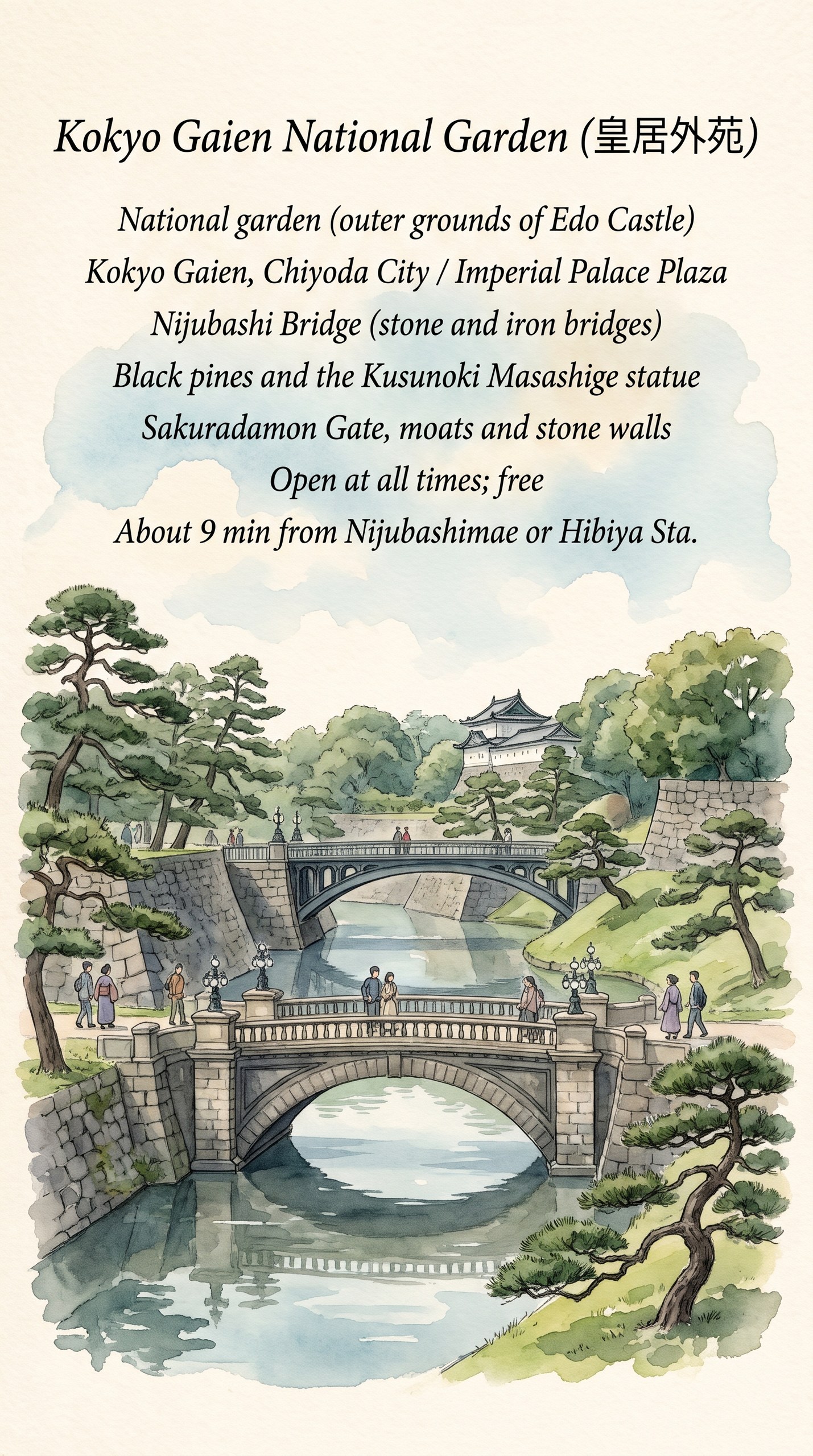
Black pines and gravel facing Nijubashi and the castle moats
Quick facts
| Hours | Open at all times (access may be restricted during state events) |
|---|---|
| Last entry | None |
| Fees | Free |
| Closed | None |
| Reservations | Not needed. For the Imperial Palace tour that crosses Nijubashi Bridge, check with the Imperial Household Agency in advance |
| Best time to visit | Avoid times when tour-bus groups arrive. On calm, sunny days the stone bridge is reflected in the water |
| Time needed (approx.) | 30 min (around Nijubashi Bridge) |
| Access notes | About 9 min from Nijubashimae and Hibiya stations and about 15 min from Tokyo Station to the Nijubashi viewpoint. Exit numbers are not given officially; free wheelchair loan (up to 2 hours, return by 16:00) |
| Checked / official info | Checked on Nov 19, 2026 Official website (Ministry of the Environment, Kokyo Gaien) |
What Is Kokyo Gaien National Garden (皇居外苑)? | History and Origins
Kokyo Gaien National Garden (皇居外苑) is a national garden on the east side of the Imperial Palace (皇居), the home of Japan’s emperor, managed by the Ministry of the Environment. At its center is the Imperial Palace Plaza (皇居前広場), an expanse of lawns dotted with black pines and fine gravel. Around it remain the moats, stone walls and gates of Edo Castle (江戸城), a castle first built in the 15th century and home to the shoguns, the military rulers of Japan, during the Edo period (17th to mid-19th century). The grounds were once part of the Imperial Family’s gardens and opened to the public in 1949; you can enter free at any time.
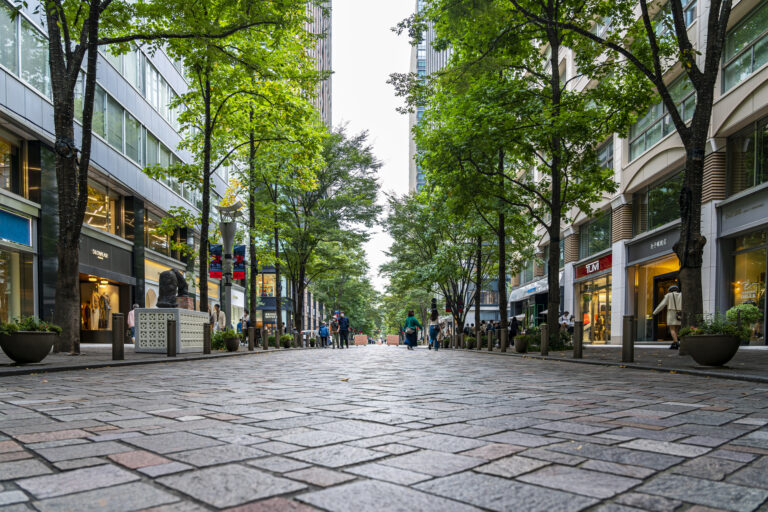
In the Edo period, the area of today’s plaza was lined with the residences of daimyo, the samurai lords who ruled Japan’s provinces. In the Meiji era (1868–1912) the residences were cleared, trees were planted, and the land became a large open plaza. Turn your back to Nijubashi Bridge (二重橋) and you see the office towers of Marunouchi (丸の内), the business district beside Tokyo Station, rising beyond the pines.
Highlights
Nijubashi Bridge (Seimon Stone Bridge and Seimon Iron Bridge)
Nijubashi Bridge spans the moat on the route from the Imperial Palace Plaza through the palace’s main gate to the palace buildings. Seen from the plaza, the arched stone bridge in front is the Seimon Ishibashi (正門石橋), or Main Gate Stone Bridge, and the bridge behind it is the Seimon Tetsubashi (正門鉄橋), or Main Gate Iron Bridge. People usually call the pair Nijubashi, but strictly the name belongs to the iron bridge at the back. That bridge was once called Gejobashi (下乗橋), and its old wooden version had a two-level structure, with the bridge girders supported on an intermediate frame in two tiers; this “double” (niju) structure gave the bridge its name. The bronze railings in front of Nijubashi carry a pattern of acanthus leaves. From a little farther away or along the moat you can compare the two bridges, and on calm, sunny days the stone arches are reflected in the water, forming a shape like a pair of spectacles. Guards stand at the main gate.
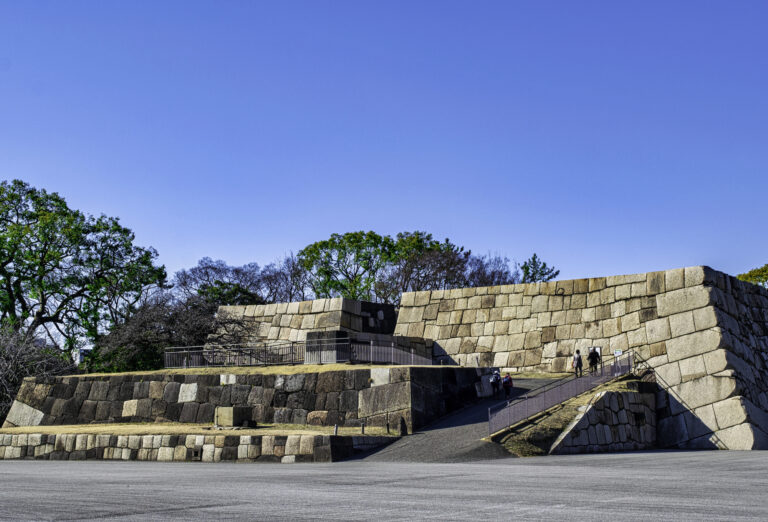
Normally you cannot cross Nijubashi Bridge; you view it from outside. It opens to the public only for events such as the New Year Greeting (a New Year event when the public enters the palace grounds to receive the emperor’s greeting) and the welcome of foreign state guests, and during the Imperial Palace tours run by the Imperial Household Agency (宮内庁), the government agency in charge of Imperial Family affairs. Tour participants gather near Kikyomon Gate (桔梗門), and across the Kikyo-bori Moat (桔梗濠) you can see the Sakurada Tatsumi Watchtower (桜田巽櫓), a lookout building that guarded a corner of the castle.
Statue of Kusunoki Masashige
On the south side of the plaza, beside the Hibiya-bori Moat (日比谷濠), stands a statue of Kusunoki Masashige (楠木正成), a 14th-century warrior who fought on the emperor’s side. The Sumitomo family (住友家), founders of what later became the Sumitomo group, donated it to mark the 200th anniversary of the Besshi Copper Mine (別子銅山), which they operated. It was made by Takamura Koun (高村光雲), a sculptor of the Meiji era, together with others from the Tokyo School of Fine Arts (東京美術学校), the national art school of the time.
Sakuradamon Gate and the Stone Walls Lit Up at Night
Sakuradamon Gate (桜田門) is a gate of Edo Castle designated a national Important Cultural Property as Kyu-Edojo Soto-Sakuradamon (旧江戸城外桜田門), the Outer Sakurada Gate of former Edo Castle. At night the statue of Kusunoki Masashige, the Wadakura Bridge (和田倉橋), Sakuradamon Gate and the stone walls are lit up.
Nanko Rest House and Wadakura Fountain Park
Nanko Rest House (楠公休憩所), named after Kusunoki Masashige and known as “Nanko”, is a free rest area where you can bring your own food and drinks, with no reservation needed. It is open during the daytime every day; the hours are in the table. It lends wheelchairs free of charge (see the table for the conditions), has a stamp for Japan’s 100 Fine Castles (日本100名城), a stamp rally of castles across the country, and hands out walking maps at the information desk. Wadakura Fountain Park (和田倉噴水公園) also has a free rest area where you can bring food and drinks, and its fountains are lit up at night.
Access and Opening Hours
The Imperial Palace Plaza, with its view of Nijubashi Bridge, is about a 9-minute walk from Nijubashimae Station on the Tokyo Metro Chiyoda Line, about 9 minutes from Hibiya Station on the Toei Mita Line, about 10 minutes from Sakuradamon Station on the Tokyo Metro Yurakucho Line, and about 15 minutes from JR Tokyo Station. There is no parking for general visitors.
Kokyo Gaien is free to enter at any time, with no reservation needed. When security is tightened for state events, access may be restricted. Allow about 30 minutes if you only want to see the area around Nijubashi Bridge and the statue of Kusunoki Masashige. Most of the plaza is covered in fine gravel that crunches underfoot. A paved path about 2 m wide, made of compacted gravel, runs to Nijubashi Bridge and Nanko Rest House as a barrier-free route, but wheelchair and stroller wheels easily get stuck in the gravel, so take extra care when stopping for photos. Some public restrooms are locked at night for security. Smoking, drones, running on footpaths, model shoots or commercial filming without a permit, and cosplay are all prohibited in the garden.
Best Time to Visit
The area in front of Nijubashi Bridge gets crowded when tour-bus groups arrive; come outside those times for a calmer visit. The plaza has little shade, so in summer prepare for strong sun and heat. In winter, migratory birds come to the moats, and on winter mornings puddles are sometimes frozen. In autumn some trees turn red, the ginkgo trees along Gyoko-dori Avenue (行幸通り), a tree-lined avenue running straight from Tokyo Station to the Imperial Palace, usually turn yellow from mid-November, and the lawns change color too. The lawns are normally closed at night, and on days when herbicide is sprayed, visitors are asked to stay off them during the day as well.
Nearby Spots
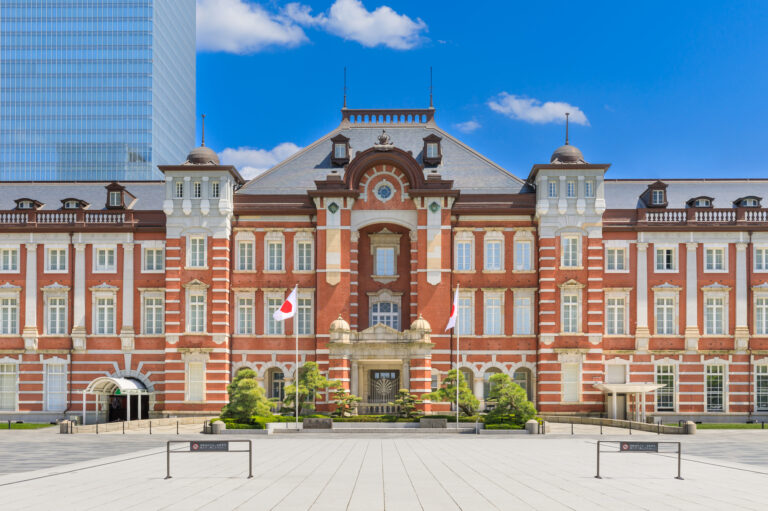
The Otemon Gate (大手門) of the East Gardens of the Imperial Palace (皇居東御苑), a garden open on the site of the main enclosures of Edo Castle, is close by, so you can combine the two for a walk around the Edo Castle remains. Walk along Gyoko-dori Avenue toward Tokyo Station and the Marunouchi side of Tokyo Station (東京駅丸の内駅舎), the red-brick station building, comes into view straight ahead.
Summary
Kokyo Gaien National Garden is a national garden, free to enter at any time, where you can see Nijubashi Bridge from the Imperial Palace Plaza, framed by the moats and stone walls of Edo Castle. The gravel plaza has little shade, so dress for the season.
Basic Information
| Item | Details |
|---|---|
| Name | Kokyo Gaien National Garden (皇居外苑; Nijubashi Bridge and Imperial Palace Plaza) |
| Address | 1-1 Kokyogaien, Chiyoda City, Tokyo (Kokyo Gaien Management Office) |
| Highlights | Nijubashi Bridge (Seimon Stone Bridge and Seimon Iron Bridge), Imperial Palace Plaza dotted with black pines, statue of Kusunoki Masashige, Sakuradamon Gate (Kyu-Edojo Soto-Sakuradamon, Important Cultural Property), moats and stone walls |
| Things to do | View Nijubashi Bridge from the plaza, see its reflection on a calm day, walk on the gravel, see the Kusunoki statue and stone walls lit up at night, rest at Nanko Rest House and collect the 100 Fine Castles stamp |
| Hours | Open at all times (restrictions during special security for state events). Nanko Rest House 10:00–16:00 |
| Closed | Open every day (restrictions during special security). Nanko Rest House also open every day |
| Admission | Free |
| Access | Tokyo Metro Chiyoda Line Nijubashimae Sta., about 9 min walk / Toei Mita Line Hibiya Sta., about 9 min / Tokyo Metro Yurakucho Line Sakuradamon Sta., about 10 min / JR Tokyo Sta., about 15 min (all to the Imperial Palace Plaza with its view of Nijubashi Bridge) |
| Notes | Nijubashi Bridge normally cannot be crossed (only during the New Year Greeting, Imperial Palace tours and similar). Gravel plaza with a paved path about 2 m wide. Little shade in summer. No smoking, no drones. Running only on designated roadway sections, not on footpaths. Commercial and model shoots need a permit; no cosplay. Lawns closed at night (all day on herbicide days) |
| Parking | None |
| Restrooms | Public restrooms (some locked at night for security) |
| Phone | +81-3-3213-0095 (Kokyo Gaien Management Office) |
| Official website | https://www.env.go.jp/garden/kokyogaien/english/index.html |
Information checked on November 27, 2026 (opening hours, closing days and Nanko Rest House hours) / Official source checked: Ministry of the Environment, Kokyo Gaien National Garden, visitor guide
Google Map
Nearby sights

1 stop on the Tokyo Metro Chiyoda Line (Nijubashimae to Otemachi)

about 9 min walk

about 15 min walk

Head on from Tokyo to Kamakura
From Tokyo Station, the JR Yokosuka Line reaches Kamakura in about 1 hour. Temples, shrines and the sea: discover the old capital in our Kamakura Travel Guide.