
Jindaiji Temple (深大寺)
Eastern Japan’s oldest National Treasure Buddha, among springs
Quick facts
| Hours | Grounds about 6:00–17:00 (may vary by season). Shakado Hall (National Treasure) 9:30–16:00. Amulet and goshuin counter 9:30–16:00 |
|---|---|
| Last entry | Grounds until the gates close; Shakado Hall until 16:00 |
| Fees | Free. Viewing the National Treasure is also free (donations accepted for a new hall). Goshuin: 500 yen each |
| Closed | No regular closing days (Shakado Hall sometimes closes for cleaning or display work) |
| Reservations | Not needed |
| Best time to visit | Weekday mornings. The approach and soba shops get crowded around lunchtime on weekends |
| Time needed (approx.) | 1 hour for the grounds and Shakado Hall; half a day with soba and Jindai Botanical Gardens |
| Access notes | Far from the stations, so take a bus. From Chofu Station (Keio Line), stop 14, Keio Bus 調34 about 15 min to the last stop “Jindaiji,” then 1 min on foot. From the South Exit of JR Kichijoji Station, stop 6, Odakyu Bus 吉04 about 30 min to “Jindaiji,” then 3 min on foot. No parking for general visitors. Traffic restrictions around the temple 10:00–16:00 on weekends and holidays |
| Checked / official info | Checked on Nov 21, 2026 Official website (Japanese) |
What Is Jindaiji Temple (深大寺)? | History and Origins
Jindaiji Temple (深大寺) is a temple of Tendai, a school of Japanese Buddhism, set in woods in Chofu (調布), a western suburb of Tokyo. Spring water runs through its grounds, and soba (buckwheat noodle) restaurants line the approach. According to temple tradition, the monk Manku Shonin (満功上人) founded it in the early 8th century, and it is said to be the second-oldest temple in Tokyo after Senso-ji Temple (浅草寺). The name comes from Jinja Daio (深沙大王), a water god.
Legend says that Manku’s parents were brought together after praying to Jinja Daio, and this founding story is why Jindaiji is known as a temple for finding a good match. Most of today’s buildings were rebuilt after a fire in the mid-19th century. The main gate survived it and is the oldest building on the grounds.
Highlights
The Thatched Gate and the Springs
Stone steps at the end of the approach lead up to the Sanmon gate (山門), built in the late 17th century under a thick thatched roof. Beyond it stands the Main Hall, which enshrines Amida Nyorai (阿弥陀如来), the Buddha of the Pure Land paradise and the temple’s principal image. Springs rise all around the temple. Behind Jinja-do Hall (深沙堂), which honors Jinja Daio, is the spring tied to the temple’s beginnings, and the Fudo Falls (不動の滝) at Fudo Hall were chosen as one of Tokyo’s 57 noted springs. Small channels run beside the approach, so you walk to the sound of water.
The Hakuho Buddha in Shakado Hall
Shakado Hall (釈迦堂) houses a gilt-bronze statue of Shaka Nyorai (銅造釈迦如来倚像), the historical Buddha, made in the late 7th century (the Hakuho period of Japanese art). It is said to be the oldest Buddhist statue designated a National Treasure in eastern Japan. The figure sits on a seat with both feet down, and it was found in 1909 under the altar platform of Ganzan Daishi Hall; no one knows where it came from. The hall is built of reinforced concrete to protect the statue from fire and theft and is raised off the damp ground, and you view the statue through glass at the front. The temple’s old bronze bell, cast in the late 14th century and an Important Cultural Property, is also kept inside.
Kamakura’s oldest temple
Kamakura also has a Tendai temple: Sugimoto-dera Temple (杉本寺), said to be the oldest temple in Kamakura and traditionally founded in the 8th century. At the top of its mossy stone steps, its hall enshrines three statues of the eleven-headed Kannon, the Buddhist figure of compassion, as its principal images.
Ganzan Daishi Hall and Kaisando Hall
Ganzan Daishi Hall (元三大師堂) enshrines a statue of Ganzan Daishi (元三大師), also called Ryogen (良源), a 10th-century monk who served as head of the whole Tendai school, and people come here to pray for protection from misfortune. The statue is a hidden image kept out of sight on ordinary days. Steep steps beside the hall climb to Kaisando Hall (開山堂), dedicated to the temple’s founding monk, where you can look down on the grounds through the trees.
Local Food and Things to Do
About 20 soba restaurants line the temple approach, serving Jindaiji soba made with the local spring water. One account says it began when monks made soba from buckwheat flour that nearby farmers offered to the temple and served it to visitors. Shinpen Musashi Fudoki-ko (新編武蔵風土記稿), a 19th-century survey of the region, called its taste “truly superb.” Many of the shops close on Mondays, so check the day if soba is part of your plan.
Goshuin (御朱印) Temple Stamps
Goshuin are handwritten temple seals collected in a special book. At Jindaiji you receive them at the amulet counter, and there are usually three: Muryoju (Amida Nyorai, the principal image), the National Treasure Hakuho Buddha, and Ganzan Daishi. In busy seasons the wait is long, and you may be given a pre-written sheet instead of having it written in your book.
Access and Opening Hours
Jindaiji is a long way from the nearest railway stations, so you reach it by bus. From Chofu Station on the Keio Line, a Keio Bus bound for Jindaiji takes about 15 minutes to the last stop, “Jindaiji,” 1 minute from the temple; buses also run from Tsutsujigaoka Station (つつじヶ丘駅). From Kichijoji Station (吉祥寺駅) on the JR Chuo Line, an Odakyu Bus takes about 30 minutes, and from Mitaka Station (三鷹駅) about 25 minutes; get off at “Jindaiji” and walk 3 minutes. The similarly named “Jindaiji Iriguchi” (深大寺入口) stop is not at the temple and is about an 8-minute walk away.
From Shinjuku Station, take a Keio Line limited express to Chofu and change to the bus: about 45 minutes in total. From Tokyo Station, either take the JR Chuo Line Rapid to Shinjuku and follow the same route, or ride the Chuo Line Rapid to Kichijoji and change to the bus; both take about 1 hour 10 minutes.
The grounds open earlier than Shakado Hall and the goshuin counter, so arriving at dawn will not get you in to see the National Treasure. Entry is free, and until the new hall for the statue, Hakuhoin (白鳳院), is finished, you can view the National Treasure freely; the temple accepts donations toward its construction. Shakado Hall sometimes closes for cleaning or display work, so check the official website before you go. The grounds are compact, and about 1 hour is enough to see them and Shakado Hall. There is no parking for general visitors, and traffic around the temple is restricted in the daytime on weekends, so the bus is the easier choice. The main gate has stone steps, but the South Gate and East Gate have ramps, and there are two wheelchair-accessible restrooms on the grounds.
Best Time to Visit
Weekends and holidays bring crowds to the approach and the soba shops, with queues at lunchtime, so weekday mornings suit a calmer visit. From late April into early May, the temple’s “nanja-monja” tree (Chinese fringe tree) is covered in white flowers; May brings fresh green leaves and autumn brings colored foliage. Every year on March 3 and 4, the Yakuyoke Ganzan Daishi Grand Festival comes with a daruma market. Daruma are round red good-luck dolls, and in front of Ganzan Daishi Hall monks paint the eyes in with bonji, an old Indian script used in Buddhism: one letter for a new start on a new doll, and another on a doll whose wish has come true.
Nearby Spots
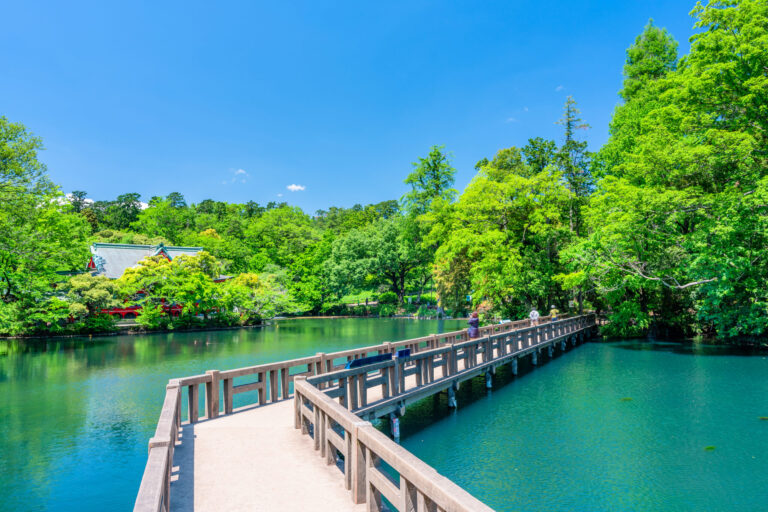
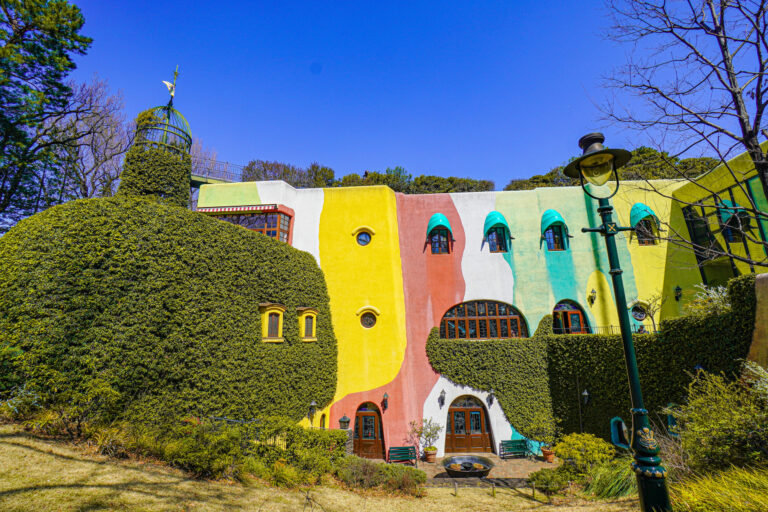
Jindai Botanical Gardens (神代植物公園) are next to the temple, about 10 minutes on foot from the main gate, so you can visit both. On the way back, a bus to Kichijoji Station takes you near Inokashira Park (井の頭恩賜公園), and a bus to Mitaka Station takes you toward the Ghibli Museum, Mitaka (三鷹の森ジブリ美術館).
Summary
Jindaiji is a Tendai temple in spring-fed woods, with a thatched gate and the oldest National Treasure Buddha in eastern Japan. Take the bus from the station, time your visit to Shakado Hall’s opening hours, and leave room for a bowl of soba on the approach.
Basic Information
| Item | Details |
|---|---|
| Name | Jindaiji Temple (深大寺, formally 浮岳山昌楽院深大寺) |
| Address | 5-15-1 Jindaiji Motomachi, Chofu, Tokyo |
| Highlights | Thatched Sanmon gate (the oldest building), National Treasure gilt-bronze Shaka Nyorai (Hakuho Buddha) in Shakado Hall, old bronze bell (Important Cultural Property), Ganzan Daishi Hall, view from Kaisando Hall, Jinja-do Hall, Fudo Falls |
| Things to do | Worship, viewing the National Treasure, goshuin, Jindaiji soba, daruma market (every year on March 3–4) |
| Hours | Grounds about 6:00–17:00 (may vary by season) / Shakado Hall 9:30–16:00 / Amulet and goshuin counter 9:30–16:00 |
| Closed | No regular closing days (Shakado Hall sometimes closes for cleaning or display work) |
| Admission | Free; National Treasure viewing free (donations accepted). Goshuin: 500 yen each |
| Reservations | Not needed |
| Access | Keio Line Chofu Sta., Keio Bus 調34, about 15 min / Tsutsujigaoka Sta., Keio Bus 丘21, about 15 min; last stop “Jindaiji,” 1 min on foot / JR Kichijoji Sta. South Exit, Odakyu Bus 吉04, about 30 min / JR Mitaka Sta., Odakyu Bus 鷹65, about 25 min; “Jindaiji,” 3 min on foot |
| Parking | None for general visitors (use nearby paid lots). Traffic restrictions nearby 10:00–16:00 on weekends and holidays |
| Restrooms | Yes (two wheelchair-accessible restrooms, baby changing tables; no nursing room) |
| Phone | +81-42-486-5511 |
| Official website | https://www.jindaiji.or.jp/ (Japanese) |
Information checked on November 21, 2026 (visiting hours and Shakado Hall opening hours) / Official source checked: Jindaiji Temple official website
Google Map
Nearby sights

Odakyu Bus Jindaiji to Kichijoji Sta., about 30 min + about 5 min on foot
Odakyu Bus Jindaiji to Mitaka Sta., about 25 min + about 15 min on foot

Head on from Tokyo to Kamakura
From Jindaiji, the bus to Chofu Station, the Keio Line and the JR Shonan-Shinjuku Line reach Kamakura in about 1 hour 50 minutes. Change to the Keio Line at Chofu Station and to the Shonan-Shinjuku Line at Shinjuku. Trains bound for Zushi or Yokosuka run straight through; on trains bound for Odawara, change to the Yokosuka Line at Ofuna. Temples, shrines and the sea: discover the old capital in our Kamakura Travel Guide.