
Senso-ji Temple (浅草寺)
Asakusa’s Kannon temple, beyond Kaminarimon and Nakamise
Quick facts
| Hours | Main Hall 6:00–17:00 (6:30–17:00 Oct–Mar). The grounds are always open |
|---|---|
| Last entry | Until the Main Hall closes |
| Fees | Free |
| Closed | None (open every day) |
| Reservations | Not needed |
| Best time to visit | Early morning (before Kaminarimon and Nakamise get crowded), or the evening illumination (sunset to about 23:00) |
| Time needed (approx.) | 1 hour (including Nakamise) |
| Access notes | About 5 min walk from Asakusa Station: Exit 1 on the Ginza Line, Exit A4 on the Toei Asakusa Line. The Tsukuba Express Asakusa Station is a separate station some distance away |
| Checked / official info | Checked on Nov 15, 2026 Official website |
What Is Senso-ji Temple (浅草寺)? | History and Origins
Senso-ji Temple (浅草寺) is the head temple of the Sho-Kannon school (聖観音宗) of Buddhism, a school centered on devotion to Kannon, and is regarded as the oldest temple in Tokyo. According to the temple’s founding legend, in the early 7th century two fishermen, the brothers Hinokuma no Hamanari (檜前浜成) and Takenari (竹成), found a statue of Kannon, the Buddhist figure believed to save people from suffering, in their net in the Miyato River, today’s Sumida River (隅田川). The local chief, Haji no Nakatomo (土師中知), turned his house into a temple to enshrine it. The principal image, Sho Kannon Bosatsu (聖観世音菩薩), is a hidden Buddha (hibutsu), so it is never shown to visitors.
In the 9th century the priest Ennin (円仁), also known as Jikaku Daishi (慈覚大師), a monk who had studied Buddhism in Tang China, visited the temple, and Senso-ji regards him as the founder who revived it. Devotion to Kannon continued into the age of the samurai: according to the temple’s history, Minamoto no Yoritomo (源頼朝), the warrior who set up the Kamakura shogunate, Japan’s first warrior government, prayed here for victory during his campaign against the Taira, the warrior clan then dominating the imperial court, in the late 12th century and later donated rice fields when he set out against the Fujiwara of Oshu, rulers of northeastern Japan. The Azuma Kagami (吾妻鏡), the chronicle of the Kamakura shogunate, records monks of Senso-ji taking part in a memorial service held in Kamakura. The same chronicle also records that, as there were no suitable craftsmen in Kamakura, a master carpenter from Asakusa in Musashi Province (the old province around today’s Tokyo) was summoned to build the Wakamiya shrine at Tsurugaoka Hachimangu Shrine (鶴岡八幡宮), the shrine Yoritomo placed at the center of Kamakura.
The main hall rebuilt in the mid-17th century at the request of Tokugawa Iemitsu (徳川家光), the third shogun of the Tokugawa family that ruled Japan, burned down in the air raids on Tokyo near the end of World War II, and the present main hall was rebuilt in 1958. According to the temple, about 30 million visits are still made here each year.
Highlights
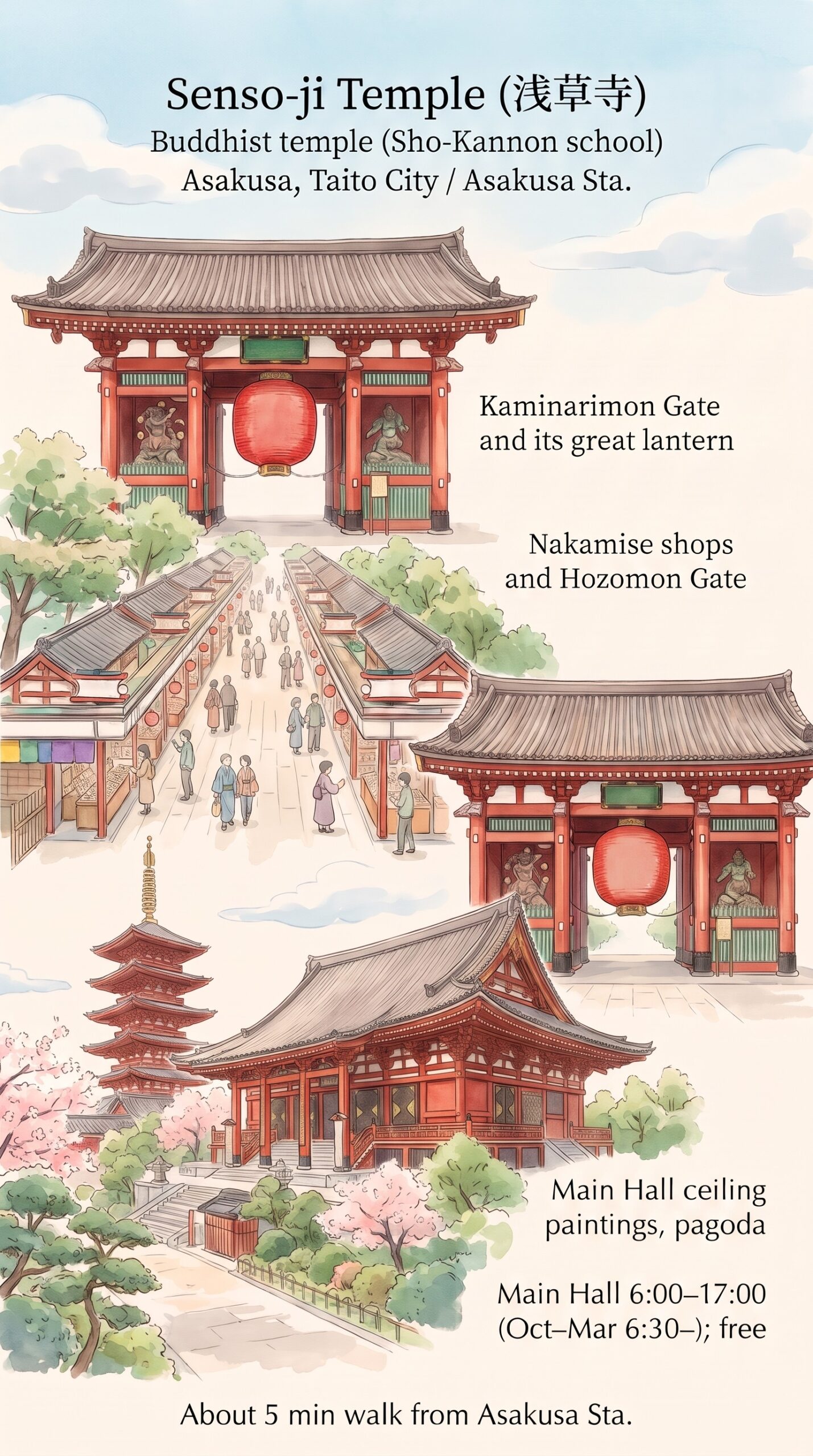
The highlights of Senso-ji Temple (浅草寺) line a single straight approach: Kaminarimon Gate (雷門), the Nakamise (仲見世) shopping street, Hozomon Gate (宝蔵門) and the main hall.
Kaminarimon Gate (雷門)
Kaminarimon Gate (雷門) is the temple’s outer gate, and its formal name is Furaijinmon (風雷神門); statues of Fujin, the wind god, and Raijin, the thunder god, stand on either side. The present gate was rebuilt with a donation from Konosuke Matsushita (松下幸之助), founder of the electronics maker Panasonic. The great red lantern hanging in the middle weighs about 700 kg, and if you look up as you pass beneath it, you can see a carved dragon on its base.
Nakamise (仲見世) and Hozomon Gate (宝蔵門)
Nakamise (仲見世) is the row of shops running about 250 m from Kaminarimon Gate to Hozomon Gate (宝蔵門). Hozomon Gate, once called the Niomon (仁王門), a gate guarded by two Nio guardian statues. Its upper floor is a storehouse for temple treasures, including the Gen-ban Issaikyo (元版一切経), a complete set of Buddhist scriptures printed in China under the Yuan dynasty (13th–14th centuries) and an Important Cultural Property.
Main Hall (本堂, Kannon-do)
The main hall, also called the Kannon-do (観音堂), enshrines the principal image. The ceiling of the outer hall, the part visitors can enter, bears three large paintings: “Dragon” (龍之図) by Kawabata Ryushi (川端龍子), a 20th-century Japanese painter, in the center, and “Heavenly Maidens” (天人之図) and “Scattering Flowers” (散華之図) by Domoto Insho (堂本印象), another 20th-century Japanese painter, on either side. Above the front hangs a plaque reading “Semui” (施無畏, “giving fearlessness”). The “Sensai Icho” (戦災いちょう) ginkgo east of the main hall is said to have sprouted from a branch planted by Minamoto no Yoritomo (源頼朝) when he visited, and it survived the wartime air raids though largely burned.
Five-Story Pagoda (五重塔) and Nitenmon Gate (二天門)
The five-story pagoda southwest of the main hall stands about 53 m high and holds relics of the Buddha from Sri Lanka in its top story. Nitenmon Gate (二天門), elsewhere on the grounds, is a national Important Cultural Property.
Spiritual Significance
Senso-ji Temple (浅草寺) is stop 13 of the Bando 33 Kannon pilgrimage (坂東三十三観音), a circuit of 33 Kannon temples across the Kanto region, and stop 1 of the Edo 33 Kannon pilgrimage, a circuit of 33 temples in Tokyo (formerly called Edo). The 18th of every month is Kannon’s festival day, and three services are held in the main hall every day: in the morning (6:00, or 6:30 from October to March), at 10:00 and at 14:00.
Goshuin (御朱印) Temple Stamps
Goshuin (御朱印) stamps, handwritten ink inscriptions with red seals given as a record of a visit, are issued at Yogodo Hall (影向堂), on the west side of the main hall (to the left as you face it); hours differ at New Year and on special days, so check the Basic Information table. Two stamps are available: one for the principal image, Sho Kannon, and one for Daikokuten, a god of prosperity and one of the Asakusa Seven Lucky Gods, a circuit of temples and shrines around Asakusa that each enshrine one of seven gods of good fortune.
Access and Opening Hours
Senso-ji Temple (浅草寺) is about a 5-minute walk from Asakusa Station on the Tokyo Metro Ginza Line, the Toei Asakusa Line, the Tobu Skytree Line and the Tsukuba Express. On the Ginza Line, use Exit 1, the closest to Kaminarimon Gate; on the Toei Asakusa Line, use Exit A4. The Tsukuba Express Asakusa Station is in a different place from the other Asakusa stations, so allow extra time if you are changing lines. The temple has no parking.
The main hall’s opening hours change with the season, so check the Basic Information table. There is no charge to enter the grounds or the main hall. The main hall is reached by steps at the front, but there is an elevator on its left side as you face it, and accessible toilets are located to the right of Hozomon Gate and at the back of the main hall.
Best Time to Visit
Kaminarimon Gate and Nakamise get crowded during the day, especially on weekends and holidays, while early morning is quiet and easy to walk. Most Nakamise shops are still closed in the early morning, so visiting the temple first and walking Nakamise after the shops open lets you enjoy both.
The main hall, five-story pagoda, Hozomon Gate and Kaminarimon Gate are lit up every day from sunset. After the main hall closes, the grounds take on a different mood and you can look at the buildings at leisure.
Nearby Spots
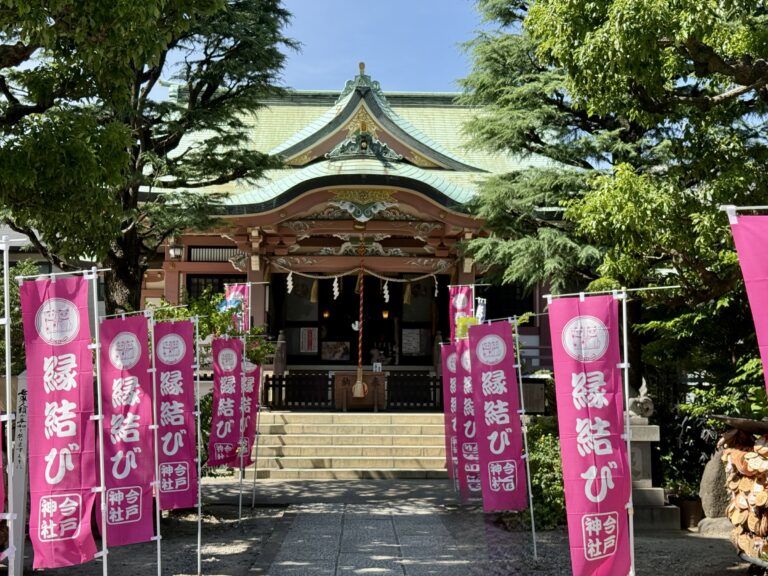
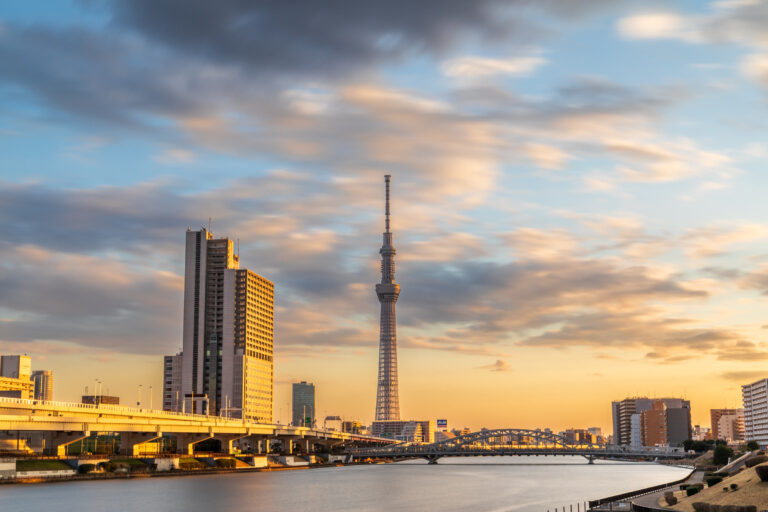
The Asakusa, Oshiage and Shitamachi area around Senso-ji Temple (浅草寺) also includes Tokyo Skytree (東京スカイツリー), a 634 m broadcasting tower, across the Sumida River (隅田川) and Imado Shrine (今戸神社), said to be one of the birthplaces of the beckoning-cat (maneki-neko) figure, to the northeast. When Nakamise is crowded, the streets running alongside it are an easier way to reach the main hall.
Summary
Senso-ji Temple (浅草寺) began with the legend of a Kannon statue found in the 7th century, and today Kaminarimon Gate, Nakamise, Hozomon Gate, the main hall and the five-story pagoda stand along one approach. Come early in the morning to avoid the crowds, or in the evening to see the buildings lit up.
Basic Information
| Item | Details |
|---|---|
| Name | Senso-ji Temple (浅草寺, Kinryu-zan Senso-ji) |
| School | Sho-Kannon school |
| Address | 2-3-1 Asakusa, Taito City, Tokyo |
| Highlights | Kaminarimon Gate, Nakamise, Hozomon Gate, main hall (ceiling paintings), five-story pagoda, Nitenmon Gate |
| Things to do | Worship, goshuin stamps, daily services |
| Hours | Main hall 6:00–17:00 (from 6:30, October–March) / Goshuin 8:00–16:30 (Yogodo Hall) / Illumination sunset–around 23:00 |
| Admission | Free |
| Access | About 5 min walk from Asakusa Station (Tokyo Metro Ginza Line Exit 1, Toei Asakusa Line Exit A4, Tobu Skytree Line, Tsukuba Express) |
| Parking | None |
| Restrooms | Yes (accessible toilets to the right of Hozomon Gate and behind the main hall) |
| Phone | +81-3-3842-0181 |
| Official website | https://www.senso-ji.jp/english/ |
Information checked on November 15, 2026 (goshuin office hours, lighting-up and access) / Official source checked: Senso-ji official website
Google Map
Nearby sights

about 15 min walk

about 25 min walk / 1 stop on the Tobu Line
about 20 min by train and on foot


Head on from Tokyo to Kamakura
From Asakusa, take the Toei Asakusa Line to Shimbashi and change to the JR Yokosuka Line, to reach Kamakura in about 1 hour 15 minutes. Temples, shrines and the sea: discover the old capital in our Kamakura Travel Guide.