
AREA A
Asakusa, Oshiage & Shitamachi Area
From the temple town of Kannon to a 634 m tower.
Edo's old downtown lives on in everyday life.
- Starting station
- Asakusa (Tokyo Metro Ginza Line, Toei Asakusa Line, Tobu Line)
- Time needed (approx.)
- Half a day for Asakusa–Oshiage, a full day including Ryogoku and Kameido. Shibamata takes another half day
- Neighbouring area
- Ueno & Yanesen (3 stops from Asakusa on the Ginza Line)
- Senso-ji Temple
- Imado Shrine
- Tokyo Skytree
- Sumida Edo Kiriko Museum
- Edo-Tokyo Museum
- Ryogoku Kokugikan
- Kameido Katori Shrine
- Shibamata Taishakuten
- Shibamata Taishakuten Sando
- Kameido Tenjin Shrine
See on Toshi's Tokyo Sightseeing Map
Highlights of the area
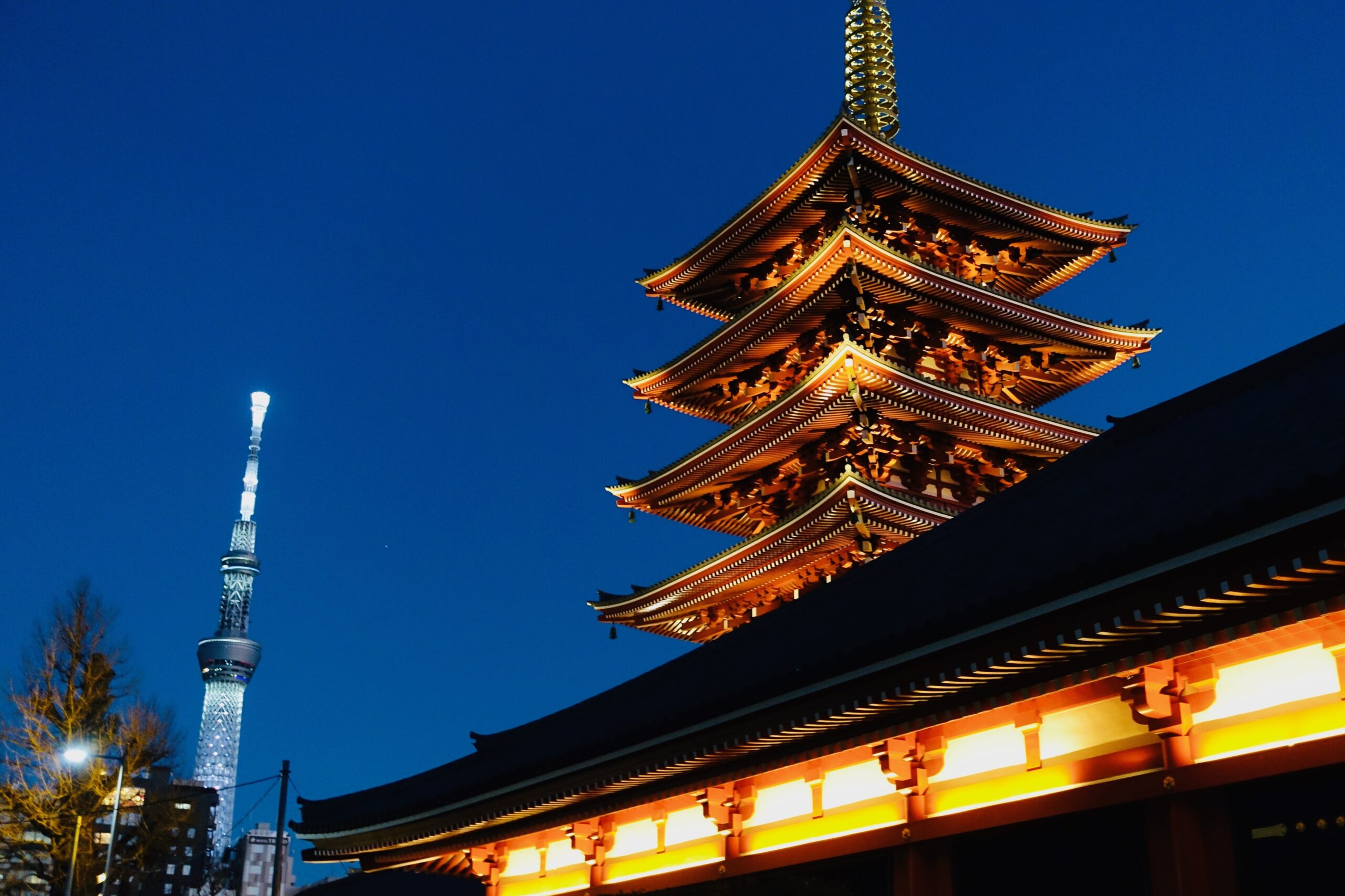
Spread along both banks of the Sumida River, this area still carries strong traces of the life of the townspeople of Edo (Tokyo's name until 1868). At its heart is Asakusa, the temple town of Senso-ji (浅草寺), a Buddhist temple said to date from the 7th century, where people stream along the approach from Kaminarimon (the temple's main gate) through the Nakamise shopping street to the Main Hall from early morning until night. Senso-ji's history also records that Minamoto no Yoritomo (源頼朝), the warrior who set up Japan's first military government in Kamakura in the late 12th century, prayed for victory here. Across the river in Oshiage stands the 634 m Tokyo Skytree, and seeing the old streets and the newest tower in a single view is what makes this area special.
Heading south, Ryogoku, the town of sumo, has the Kokugikan, the arena for grand sumo tournaments, and the Edo-Tokyo Museum side by side, while in Kinshicho and Kameido you can visit a workshop of Edo Kiriko, a cut-glass craft made in Edo since the 19th century, and Kameido Katori Shrine, loved as a god of winning. A little further out, Shibamata has Taishakuten, a Buddhist temple founded in the 17th century, and its approach street of kusa-dango shops, with the old-town feel made famous by the movies. Temples and shrines, craftsmanship, sumo and an observation deck: this is an area where you can see the everyday face of Tokyo, carried on from Edo, in a single day.
Example route (1 day)
- Morning: Senso-ji (before the crowds) → about 15 min walk → Imado Shrine
- From Asakusa Station, 1 stop on the Tobu Line → Oshiage and Tokyo Skytree
- About 15 min walk → Kinshicho: Sumida Edo Kiriko Museum → about 20 min walk → Kameido Katori Shrine
- JR Sobu Line to Ryogoku → Ryogoku Kokugikan and Edo-Tokyo Museum
Shibamata is about 25 min from Oshiage on the Keisei Line. Allow half a day for Taishakuten and the sando.
Sightseeing spots
Senso-ji Temple (浅草寺)
Through Kaminarimon
to Asakusa's Kannon templePass under the great lantern of Kaminarimon, the temple's outer gate, and walk through Nakamise, the shopping street on the approach, to the Main Hall. The temple traces its origins to a 7th-century legend of a statue of Kannon, the Buddhist figure of mercy, said to have been pulled from the river, and Hozomon Gate, the Main Hall and the five-story pagoda line a single approach. Early morning and the evening illumination are less crowded.
About 1 hour / no booking needed
Imado Shrine (今戸神社)
Beckoning cats and matchmaking
a small shrine north of AsakusaAbout a 15-minute walk north of Senso-ji. Known as a shrine for finding a partner, its grounds are lined with maneki-neko, beckoning-cat figures believed to invite good fortune, large and small. Goshuin, the ink-and-seal stamps given as a record of a visit, are available at the shrine office.
About 20–30 min / no booking needed
Tokyo Skytree (東京スカイツリー)
A 634 m broadcasting tower
with views across TokyoA broadcasting tower directly connected to Oshiage Station. From the Tembo Deck and Tembo Galleria you can look out over the whole city. Same-day tickets and date-and-time web tickets are available; late afternoons on clear days get busy.
About 1.5–2 hours / same-day tickets (web tickets too)
Sumida Edo Kiriko Museum (すみだ江戸切子館)
Watch the craftsmen at work
then cut your own Edo KirikoA workshop and shop of Edo Kiriko, a cut-glass craft made in Edo (old Tokyo) since the 19th century, about 6 minutes on foot from Kinshicho Station. You can watch the craftsmen through the glass, and in the bookable workshop you cut a pattern into a glass and take it home.
About 30 min to look (workshop about 90 min) / workshops need booking
Edo-Tokyo Museum (江戸東京博物館)
From Edo to Tokyo
the story of the city and its peopleA museum of the history and culture of Edo and Tokyo, which has reopened after renovation. It stands right by Ryogoku Station, next to the Kokugikan.
About 2–3 hours / no booking needed
Ryogoku Kokugikan (両国国技館)
The home of sumo
tournaments and the Sumo MuseumThe arena that hosts three of the yearly grand tournaments of sumo, Japan's traditional wrestling. Outside tournament periods you can visit the Sumo Museum inside (free; closed weekends and holidays).
About 30 min for the museum / tournaments need a ticket
Kameido Katori Shrine (亀戸香取神社)
A shrine for sporting success
and the legend of the victory arrowThanks to the legend of the “victory arrow”, said to have been offered by a warlord who prayed here for victory and won, this shrine is called a god of sporting success. About 10 minutes on foot from Kameido Station North Exit, it offers victory amulets and a goshuin (visit stamp) for the Kameido Seven Lucky Gods, a local pilgrimage to seven gods of good fortune.
About 20–30 min / no booking needed
Shibamata Taishakuten (柴又帝釈天)
A hall wrapped in carvings
and the Suikeien gardenAbout 3 minutes on foot from Keisei Shibamata Station. The highlights are the gallery of carvings of Lotus Sutra stories around the hall of Taishakuten, a Buddhist guardian deity, and the Suikeien garden viewed from its corridors (adults ¥400).
About 1 hour / no booking needed
Shibamata Taishakuten Sando (柴又帝釈天参道)
Kusa-dango and old shopfronts
from the station to the templeThe approach street from Shibamata Station to Taishakuten, lined with shops of kusa-dango (mugwort rice dumplings) and rice crackers, with a statue outside the station of Tora-san, hero of the long-running film series “Otoko wa Tsurai yo” (from 1969) set in Shibamata. Together with Taishakuten it makes a half-day outing.
About 30 min–1 hour / no booking needed
Kameido Tenjin Shrine (亀戸天神社)
Over the arched bridges
to the Tenjin of plum and wisteriaCross the three bridges over a pond modelled on Dazaifu Tenmangu in Kyushu, the head of Japan's Tenjin shrines, to the Main Hall of Sugawara no Michizane, a 9th-century scholar revered as the god of learning. Known for plum, wisteria and chrysanthemum, with Skytree in view from the arched bridge. About 15 min on foot from Kameido or Kinshicho Station.
About 20 min / no booking needed
Other spots in this area
- Nakamise-dori … A shopping street of about 250 m from Kaminarimon to Hozomon
- Sumida Park … A park along both banks of the Sumida River, with rows of cherry trees in spring
- Kappabashi Kitchen Street … A street of kitchenware and plastic food sample shops
- Asakusa Hanayashiki … An amusement park just west of Senso-ji
- Ushijima Shrine … The guardian shrine of Honjo, the old name of the district east of the Sumida River, inside Sumida Park
- Mukojima-Hyakkaen Garden … A flower garden laid out in the Edo period (early 17th to mid-19th century)
- Eko-in Temple … A temple in Ryogoku that hosted Edo-period fund-raising sumo bouts, with deep ties to the history of sumo
- Former Yasuda Garden … A Japanese garden near Ryogoku Station, viewed by walking around its pond
- Sumida Hokusai Museum … A museum of works and materials on Katsushika Hokusai, the 19th-century ukiyo-e artist known for “The Great Wave off Kanagawa”
- Katsushika Shibamata Tora-san Museum … A museum about the “Otoko wa Tsurai yo” films set in Shibamata

Head on from Tokyo to Kamakura
From Asakusa, take the Toei Asakusa Line to Shimbashi then the JR Yokosuka Line, to reach Kamakura in about 1 hour 15 minutes. Change to the JR Yokosuka Line at Shimbashi. From Kinshicho, JR Sobu Rapid Line trains run through onto the Yokosuka Line. Temples, shrines and the sea: discover the old capital in our Kamakura Travel Guide.