
Nezu Shrine (根津神社)
Tsunayoshi’s shrine buildings, a torii tunnel and azaleas
Check first
| Karamon gate hours | Karamon gate opens 5:00–6:00 and closes 17:00–18:00 depending on the month; amulet office 9:30 to 16:30–17:30 |
|---|---|
| Admission | Free |
| Closed | Open every day |
| Booking | Not needed |
| Best time to visit | Early morning, when it is quiet; azaleas usually in April |
| Time needed (approx.) | 30 min–1 hour |
| Access notes | About 5 min on foot from Nezu (根津駅) or Sendagi (千駄木駅) Stations on the Tokyo Metro Chiyoda Line, or Todaimae Station (東大前駅) on the Namboku Line |
| Checked / official site | Checked on 16 November 2026 Official website |
What is Nezu Shrine (根津神社)? | History
Nezu Shrine (根津神社) is a shrine in Nezu. Its present buildings were erected in the early 18th century by the fifth shogun, Tokugawa Tsunayoshi (徳川綱吉), head of the warrior family that ruled Japan from Edo (江戸, now Tokyo).
According to shrine tradition, the legendary prince Yamato Takeru (日本武尊) first enshrined a deity at Sendagi (千駄木). The current grounds were the estate of Tokugawa Tsunashige (徳川綱重), Tsunayoshi’s elder brother, and the 6th shogun Tokugawa Ienobu (徳川家宣), who succeeded Tsunayoshi, was born here; for this reason Tsunayoshi moved the shrine from Sendagi to this site and built its halls. In the age when Shinto and Buddhism were worshipped together, it was called Nezu Gongen (根津権現), gongen being a title for a kami seen as a form of a Buddha, and it took its present name in the Meiji era (1868–1912). The novelists Natsume Soseki (夏目漱石) and Mori Ogai (森鷗外), writers of the same era who lived nearby (Ogai was also an army doctor), were parishioners, members of the local community the shrine serves, and the grounds have a “Writers’ Stone” (文豪の石) on which they are said to have rested during walks. In 2025 the house where Ogai wrote the novella “Maihime” (舞姫, “The Dancing Girl”) was moved into the grounds; as the “Maihime House” (舞姫の家), it is open for a fee on weekends and national holidays.
Highlights
Shrine buildings and Romon gate
The gongen-zukuri (権現造) shrine building joins the main, offering and worship halls, and the vermilion Romon and Karamon gates still stand. The 18th-century construction was a “tenka-bushin” (天下普請), a great project the shogunate ordered the feudal lords to carry out, and all seven Important Cultural Property buildings survive intact, finished in genuine lacquer. The Romon is the only shrine tower gate left in old Edo, and one of its guardian statues is said to be modeled on Mito Komon (水戸黄門), the popular name of Tokugawa Mitsukuni (徳川光圀), lord of the Mito branch of the Tokugawa family. The swastika-like manji (卍), the shrine crest from the days when Shinto and Buddhism were combined, still appears on the buildings and gates. Photography is not allowed on the stone path in front of the halls, and visitors keep quiet inside the openwork fence.
Tunnel of torii gates
The path to Otome Inari (乙女稲荷), a smaller shrine within the grounds dedicated to Inari, the god of rice and business, runs through a tunnel of vermilion torii, the gateways that mark the way into a shrine. Otome Inari stands on a stage overlooking a pond, its small shrine set inside a hollow; old records call it “Ana Inari” (穴稲荷), the cave Inari. The path under the torii is narrow, and it is hard to pass other people in places.
Azalea garden
The azalea garden holds about 3,000 shrubs and usually comes into bloom from mid-April. It is open during the Bunkyo Azalea Festival (文京つつじまつり), a local event held each year while the azaleas bloom. The garden began when Tsunashige, while this was his estate, brought Kirishima azaleas from Tatebayashi (館林), an azalea spot in Gunma, and the hill became known as Tsutsuji-ga-oka (つつじヶ岡). Today’s azaleas were replanted after the war. Entry requires a donation whose amount changes with how far the flowers are in bloom, and you can also see them from outside the garden.
An azalea temple in Kamakura
Kamakura also has a temple known for its azaleas, Anyo-in Temple (安養院).
Access and opening hours
The shrine is about 5 minutes on foot from Nezu or Sendagi Stations on the Tokyo Metro Chiyoda Line, or Todaimae Station on the Namboku Line.
The Karamon gate opens early in the morning and closes in the late afternoon; its times, like those of the amulet office that handles charms and goshuin (御朱印, handwritten stamps given as a record of a visit), change with the month. See the table above. The grounds have free parking for worshippers, but you cannot park there during the Bunkyo Azalea Festival.
Best time to visit
Early morning is a good time for a quiet visit. The azalea garden is usually at its best in April. From azalea season through the early-May holidays, lines form for prayers at the worship hall and at the azalea garden entrance. In November many families come for Shichi-Go-San (七五三), the celebration of children’s growth.
Nearby spots
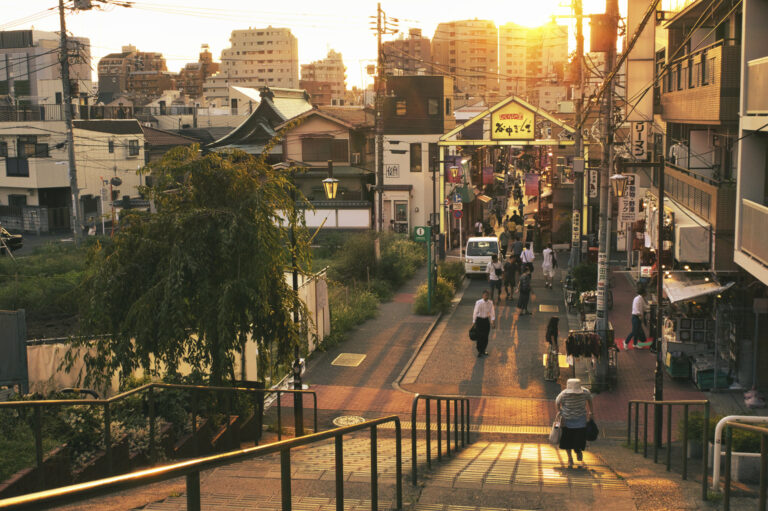
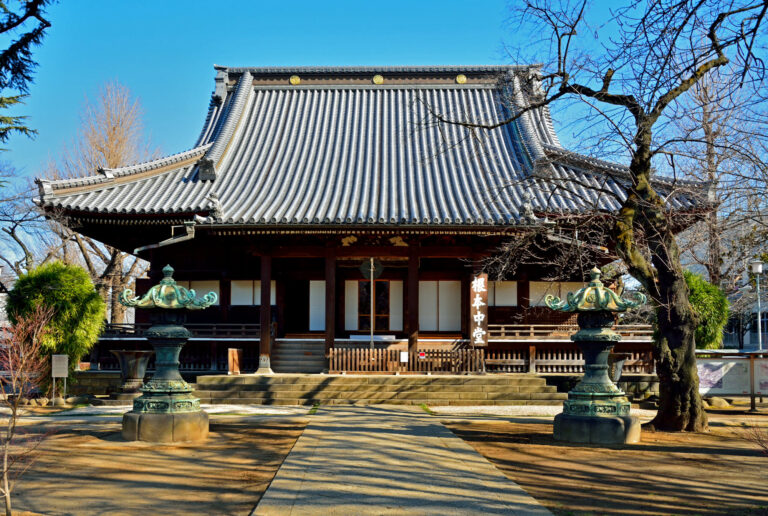
Walking northeast from the shrine brings you to Yanaka Ginza, and east to Kan’ei-ji Temple, linking it to a walk around Yanaka, Nezu and Sendagi.
Summary
Nezu Shrine keeps buildings erected by Tokugawa Tsunayoshi in the early 18th century, now Important Cultural Properties. Known for its torii tunnel and April azaleas, it fits into a walk around Yanaka, Nezu and Sendagi.
Basic information
| Name | Nezu Shrine (根津神社) |
| Address | 1-28-9 Nezu, Bunkyo City, Tokyo |
| Karamon gate hours | Karamon gate opens 5:00–6:00 and closes 17:00–18:00 depending on the month; amulet office 9:30 to 16:30–17:30 |
| Admission | Free |
| Closed | Open every day |
| Access | About 5 min walk from Nezu, Sendagi or Todaimae Stations (Tokyo Metro) |
| Phone | 03-3822-0753 |
| Official website | https://www.nedujinja.or.jp/ |
Information checked on November 26, 2026 (Karamon gate and amulet office hours) / Official source checked: Nezu Shrine official website
Google Map
Nearby sights

About 15 min on foot

About 20 min on foot

Head on from Tokyo to Kamakura
From Ueno, JR reaches Kamakura in about 1 hour 10 minutes. Change to the Yokosuka Line at Tokyo Station. Temples, shrines and the sea: discover the old capital in our Kamakura Travel Guide.