
Nihonbashi Bridge (日本橋)
Kirin- and lion-guarded stone bridge where Edo’s roads began
Quick facts
| Hours | Open at all times (public road bridge) |
|---|---|
| Last entry | None |
| Fees | Free (river cruises charge their own fares) |
| Closed | None |
| Reservations | Not needed. Some river cruises require booking (operators’ official websites) |
| Best time to visit | From early evening (lamp posts and statues lit up) |
| Time needed (approx.) | A short stop for the bridge alone |
| Access notes | 3 min from Exit B6 of Mitsukoshimae Sta. (Tokyo Metro) to the pier (south end), 5 min from Exit B12 of Nihonbashi Sta. (approx.). Walkable from Tokyo Station. The original road origin marker is in the middle of the roadway and cannot be approached |
| Checked / official info | Checked on Nov 19, 2026 Official info (Chuo City, cultural property “Nihonbashi”, in Japanese) |
What Is Nihonbashi Bridge (日本橋)? | History and Origins
Nihonbashi Bridge (日本橋) is a stone bridge over the Nihonbashi River (日本橋川) that still carries cars and pedestrians today. In the Edo period (17th to mid-19th century), when the Tokugawa shoguns, Japan’s military rulers, governed from Edo (present-day Tokyo), it was the starting point of the Gokaido (五街道), the five main highways that ran from Edo to the provinces, including the Tokaido (東海道) linking Edo and Kyoto. The Japan Road Origin Marker (日本国道路元標), which marks the starting point of Japan’s roads, is still set in the center of the bridge. The first bridge here is said to have been built by the early 17th century.
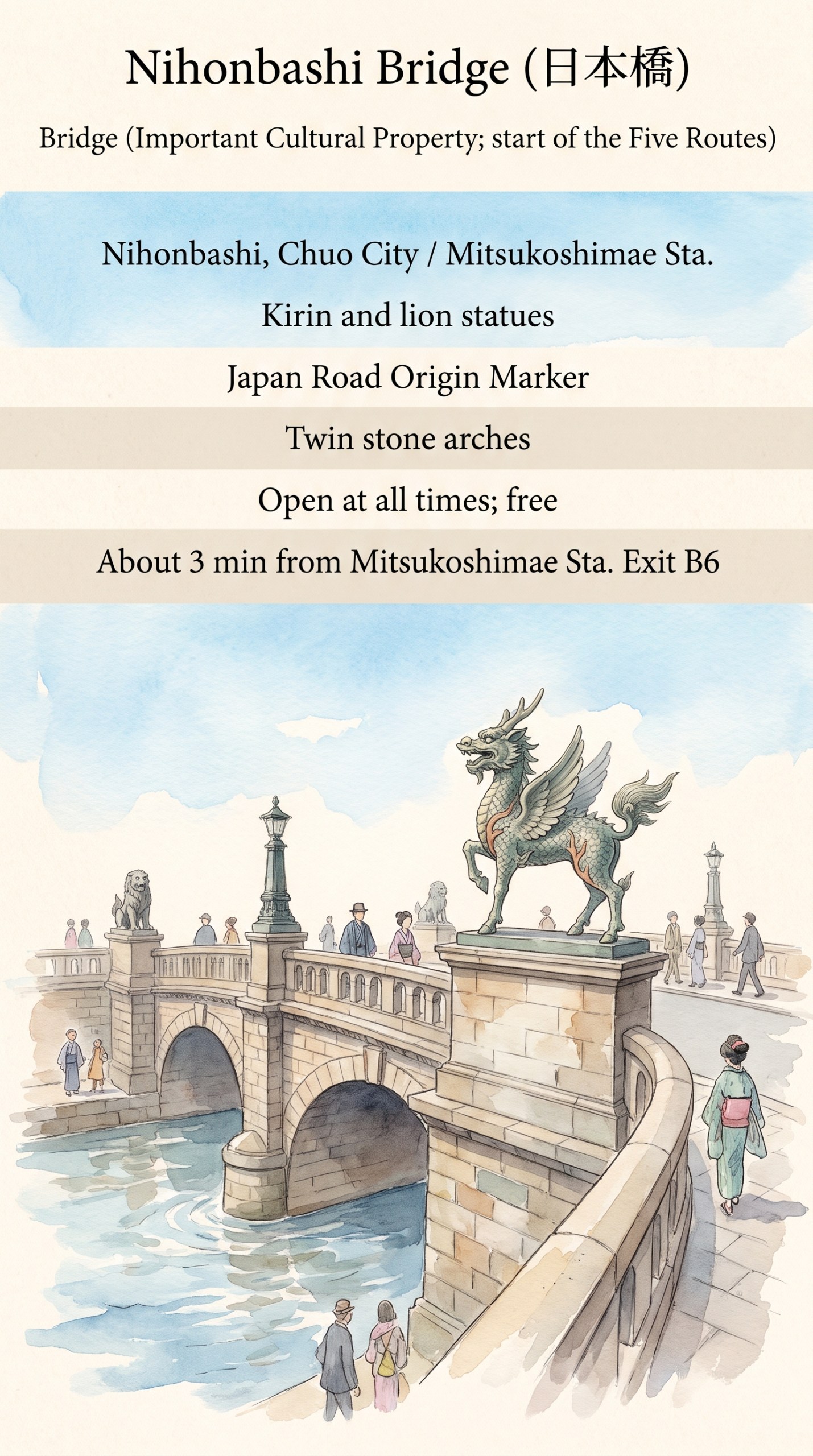
The current bridge, completed in 1911, is a stone bridge with two arches in a row and a national Important Cultural Property. Civil engineers, an architect and sculptors worked together on it, giving it rich decoration including bronze ornaments.
The Uogashi (魚河岸), Edo’s fish market, once stood on the north side of the bridge; after the Great Kanto Earthquake, which struck the Tokyo region in 1923, fish trading moved to Tsukiji (築地), where Tokyo’s main fish market later stood.
Highlights
Kirin and Lion Statues
At the four corners, Chinese-style guardian lions, meant to protect the bridge, hold the crest of the old City of Tokyo, and on the central lamp posts stand two kirin, legendary Chinese beasts, back to back. The kirin were given wings and fins they do not traditionally have, expressing hopes for the growth of the bridge and the district. These kirin, whose dorsal fins look like wings, inspired the novel Kirin no Tsubasa (麒麟の翼, “The Wings of the Kirin”) by Higashino Keigo (東野圭吾), a Japanese mystery writer. The sculptures are by Watanabe Osao (渡辺長男), a sculptor of the Meiji era (1868–1912). The bridge name on the end posts, written as “日本橋” and “にほんはし,” is said to be in the calligraphy of Tokugawa Yoshinobu (徳川慶喜), the last of the Tokugawa shoguns. Besides the end posts and lamp posts, lion faces are also carved on the keystones at the top of the arches on the sides of the bridge, but these faces cannot be seen from the bridge itself, only from boats on the river.
Japan Road Origin Marker and the Former Tokyo City Marker
The original Japan Road Origin Marker is set into the road surface in the middle of the roadway, where heavy traffic keeps you from getting close. A replica stands in the plaza at the northwest end of the bridge, next to the Former Tokyo City Road Origin Marker (旧東京市道路元標). This plaza also has a milepost showing distances to cities across Japan. The Former Tokyo City Road Origin Marker originally stood in the middle of the bridge and doubled as a pole for the overhead wires of the Toden (都電), Tokyo’s streetcars; it was moved to the plaza in 1967 when the streetcar line here was abolished.
Hana no Hiroba and Taki no Hiroba
There are plazas at all four ends of the bridge. Hana no Hiroba (花の広場), the “Flower Plaza” on the west side of the south end, stands where the Edo-period takafuda-ba (高札場), a notice board for the shogunate’s official edicts, once was. Today it holds a monument inscribed with the Nihonbashi Yuraiki (日本橋由来記), an account of the bridge’s origins, and gives a side view of the bridge. Taki no Hiroba (滝の広場), the “Waterfall Plaza” on the east side of the south end, has the entrance to the boat pier.
The Pier and the Bridge Seen from a Boat
Stairs lead down from the bridge to the boat pier. The plaza below sits low, close to the water, so you can look up at the arches of the bridge. From a boat, you see the undersides of the arches and the underside of the Shuto Expressway (首都高速道路) that runs above the bridge. Several companies have counters side by side at the pier, so make sure you go to the right operator for your boat. Some cruises need a reservation; check the official websites of operators such as Nihonbashi Cruise (日本橋クルーズ).
Access and Opening Hours
By subway, the pier at the south end of the bridge is a 3-minute walk from Exit B6 of Mitsukoshimae Station (三越前駅) and 5 minutes from Exit B12 of Nihonbashi Station, both on Tokyo Metro (approx.). You can also walk from Tokyo Station. As a public road bridge, it is free to cross at any time, with no reservation needed. If you only want to see the bridge, a short stop is enough.
The elevated Shuto Expressway runs directly above the bridge, so the deck is shaded even in the daytime, and the traffic and noise never stop. It is hard to take photos without cars or people in them. Work is under way to move the expressway underground, and the elevated section above the bridge is scheduled to be removed. On the north side of the bridge, VISTA, a facility that introduces this project with videos and models, can be visited with advance booking (see Basic Information for the days).
Best Time to Visit
From early evening, the lamp posts and statues are lit up, and the decoration under the elevated expressway also stands out in the light. Usually in summer, traffic is stopped for the Hashi-arai (橋洗い), when large numbers of people wash the bridge with deck brushes and water.
Nearby Spots
Take a river cruise from the pier at the south end and you can see the lion faces and the undersides of the arches that are not visible from the bridge. The bridge is within walking distance of Tokyo Station, so you can combine it with a walk around the station area.
Summary
Nihonbashi Bridge is a stone bridge completed in 1911 at the former starting point of the Gokaido. See the kirin and lion statues and the road markers on the bridge and in the plazas at its ends, then look up at the arches from the low pier or from a boat.
Basic Information
| Item | Details |
|---|---|
| Name | Nihonbashi Bridge (日本橋) |
| Address | Nihonbashi 1-chome to Nihonbashi Muromachi 1-chome, Chuo City, Tokyo |
| Highlights | Back-to-back kirin statues (with wings and fins), guardian lions holding the Tokyo City crest, Japan Road Origin Marker (replica), Former Tokyo City Road Origin Marker and milepost, Nihonbashi Yuraiki monument in Hana no Hiroba (former notice-board site), double stone arches, bridge name said to be in Tokugawa Yoshinobu’s hand |
| Things to do | See the kirin and lion statues up close, view the bridge from the side at Hana no Hiroba, look up at the arches from the low pier plaza, see the keystone lion faces and the bridge’s underside from a boat, evening lighting |
| Hours | Open at all times (public road) |
| Closed | None (closed to cars during the summer Hashi-arai bridge washing) |
| Admission | Free (public road bridge) |
| Access | Tokyo Metro Mitsukoshimae Sta. Exit B6, 3 min walk / Nihonbashi Sta. Exit B12, 5 min walk (both to the pier at the south end, approx.) |
| Notes | The elevated Shuto Expressway covers the bridge and traffic is heavy. The original Japan Road Origin Marker is in the middle of the roadway and cannot be approached; a replica and the Former Tokyo City Road Origin Marker are in the plaza at the northwest end. Expressway undergrounding work is under way. Several operators’ counters at the pier; some cruises require booking. VISTA, the undergrounding project facility (Muromachi NS Building 3F), weekdays by advance booking |
| Official info | Chuo City, cultural property “Nihonbashi” (in Japanese) |
Google Map
Nearby sights

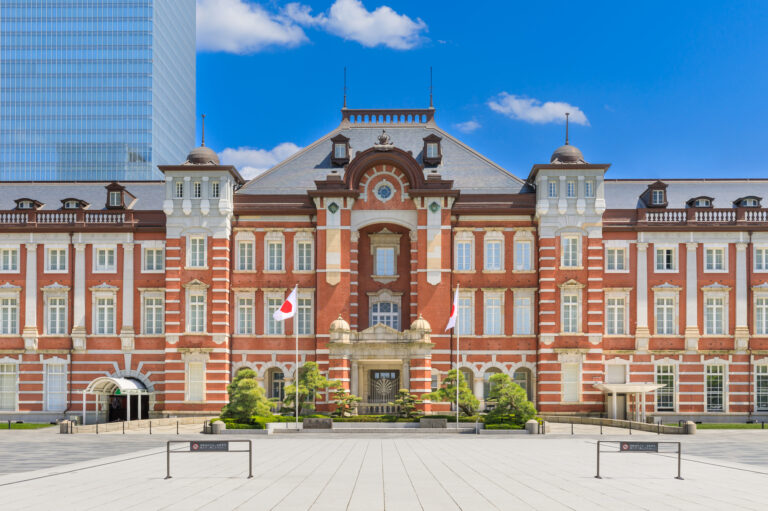
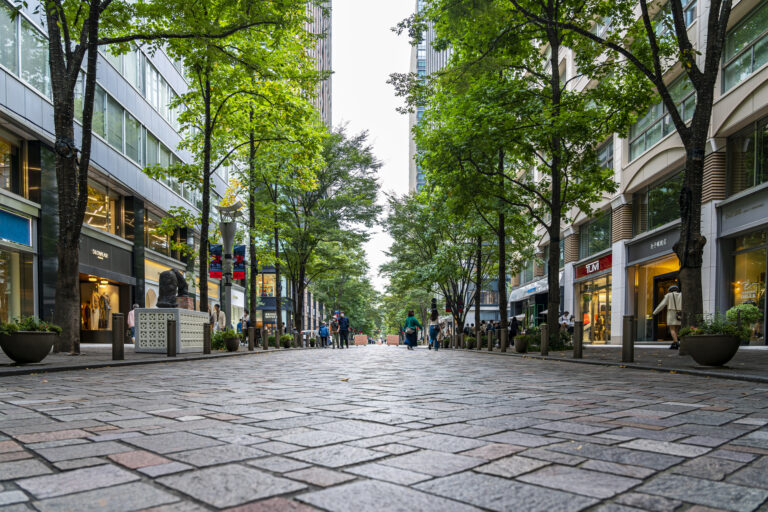
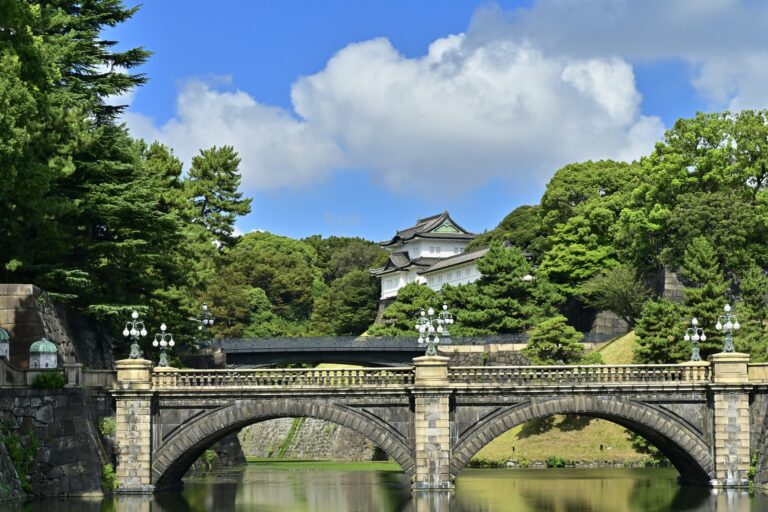
JR Sobu Rapid Line: Shin-Nihombashi to Tokyo, 1 stop

JR Sobu Rapid Line: Shin-Nihombashi to Tokyo, 1 stop, then a short walk from the Marunouchi South Exit
JR Sobu Rapid Line: Shin-Nihombashi to Tokyo, 1 stop, then about 15 min on foot

Head on from Tokyo to Kamakura
From Tokyo Station, the JR Yokosuka Line reaches Kamakura in about 1 hour. Temples, shrines and the sea: discover the old capital in our Kamakura Travel Guide.