
Ueno Toshogu Shrine (上野東照宮)
A shrine to Tokugawa Ieyasu with a gilded main hall
Check first
| Visiting hours | 9:00–17:30 (until 16:30 from October to February) |
|---|---|
| Main hall interior | 9:30–17:00 (until 16:00 from October to February) |
| Admission | Free to visit the grounds; 700 yen for adults (junior high school age and over) and 300 yen for primary school children to view the main hall |
| Closed | Open every day |
| Booking | Not needed |
| Best time to visit | Mornings, when it is quieter |
| Time needed (approx.) | 15–30 min (paid viewing 10–15 min) |
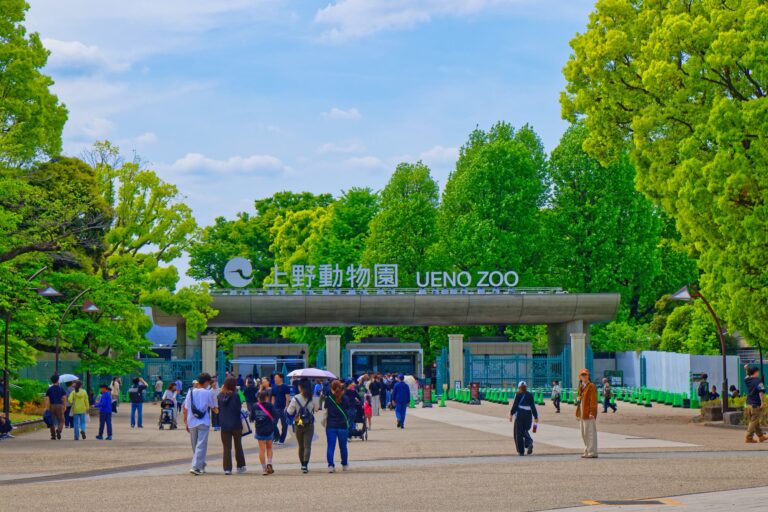
| Access notes | About 10 min on foot from the Park Exit of JR Ueno Station (上野駅), near the Main Gate of Ueno Zoo |
| Checked / official site | Checked on 16 November 2026 Official website |
What is Ueno Toshogu Shrine (上野東照宮)? | History
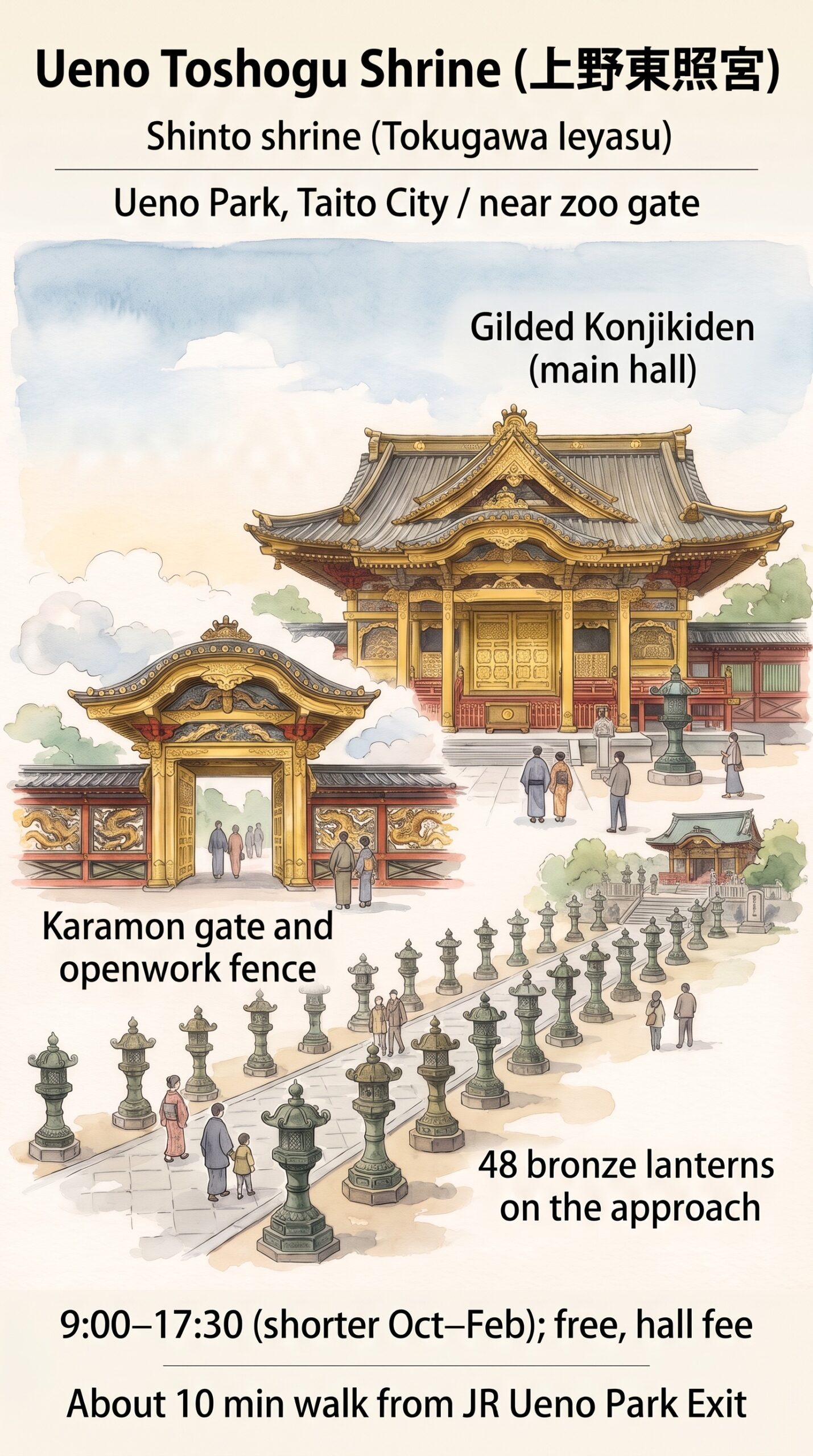
Ueno Toshogu Shrine (上野東照宮) stands inside Ueno Park (上野恩賜公園) and enshrines Tokugawa Ieyasu (徳川家康), the warlord who in the early 17th century founded the shogunate, the military government that ruled Japan until the mid-19th century. It was founded in the early 17th century, and in the mid-17th century the third shogun (the military ruler at the head of that government), Tokugawa Iemitsu (徳川家光), rebuilt it as the present shrine.
The gold-decorated main hall is also called Konjikiden (金色殿), and the main hall, Karamon gate (唐門), openwork fence (透塀) and bronze lanterns are designated Important Cultural Properties, a national heritage designation by the Japanese government. Besides Tokugawa Ieyasu, the shrine also enshrines the 8th shogun Tokugawa Yoshimune (徳川吉宗), who restored the shogunate’s finances in the early 18th century, and the 15th and last shogun Tokugawa Yoshinobu (徳川慶喜), who handed power back to the emperor. Following Ieyasu’s last wishes, Tenkai (天海), a Buddhist monk who served Ieyasu, and Todo Takatora (藤堂高虎), a feudal lord in Ieyasu’s service known for castle building, built it as one of the buildings within Kan’eiji Temple (寛永寺), which Tenkai had opened as the shoguns’ family temple, and in the mid-17th century the imperial court granted it the title “Toshogu,” a rank reserved for shrines of high standing. The buildings survived the Battle of Ueno (上野戦争), fought on Ueno hill between former shogunate troops and the new government’s army at the end of the Edo period (early 17th to mid-19th century, when the Tokugawa shoguns ruled Japan), the Great Kanto Earthquake, which struck the Tokyo region, and the Tokyo air raids at the end of the Second World War; during the air raids an incendiary bomb that fell just behind the Konjikiden is said to have failed to explode. People come here to pray for success in their careers, for victory and for a long, healthy life.
Highlights
Konjikiden (main hall)
The main hall is a gongen-zukuri (権現造) building, a shrine style that links the worship hall and the main sanctuary into one building, decorated with gold leaf; the paid viewing lets you see the decoration up close. The building consists of three rooms, the worship hall, the offering hall (幣殿, heiden) and the main sanctuary, with carvings of hawks on the front, peonies around it and phoenixes on the sides. The carvings are finished in “ikezaishiki” (生彩色), a technique of coloring with mineral pigments over gold leaf. The interior is normally closed, with an opportunity to view it about once a year.
A samurai-era shrine in Kamakura
Where Ueno Toshogu honors Tokugawa Ieyasu, Tsurugaoka Hachimangu Shrine (鶴岡八幡宮) in Kamakura was placed at the heart of the city by Minamoto no Yoritomo (源頼朝), who set up a samurai government in Kamakura in the late 12th century. Both are shrines tied to a samurai government.
Karamon gate and openwork fence
The Karamon gate in front of the main hall carries carvings of an ascending and a descending dragon on either side. The openwork fence around the main hall is also finely carved. The dragon carvings on the Karamon are attributed to Hidari Jingoro (左甚五郎), a carver said to have worked around the 17th century, and legend has it that the dragons go to drink from Shinobazu Pond (不忍池) every night. The openwork fence (Sukibei) takes its name from the diamond lattice you can see through; more than 250 carvings, land animals and plants on the upper tier and sea and river creatures on the lower tier, line both its inner and outer sides.
Bronze lanterns along the approach
Bronze lanterns donated by feudal lords line the approach and are designated Important Cultural Properties. The lanterns on either side of the Karamon were donated by the three senior Tokugawa branch families of Kii, Mito and Owari (徳川御三家), which could supply an heir to the shogun. Beside the great stone torii, the gateway that marks the entrance to the shrine, stands the “Obake Doro” (お化け灯籠, Monster Lantern), about 6.8 m tall and counted among Japan’s three great stone lanterns, and beside the shrine building is the Eiyo Gongen Shrine (栄誉権現社), which honors a tanuki (raccoon dog) deity known as Otanuki-sama (御狸様) and draws worshippers praying for success in exams and contests. The tanuki of the Eiyo Gongen Shrine is said to have brought misfortune to the shogun’s inner palace, the Ooku (大奥), where the shogun’s wives and their women lived, and other places during the Edo period, and was given to the shrine in the early 20th century. The great stone torii at the entrance, also an Important Cultural Property, was donated by Sakai Tadayo (酒井忠世), a senior retainer of the Tokugawa shoguns, in the early 17th century.
Sacred Tree and Seishinjo
On the paid viewing route along the inner approach stands a sacred camphor tree said to be more than 600 years old, and in front of it is the “Seishinjo” (静心所), a seat where you can sit and look at the tree. The former sacred ginkgo had to be cut down after its trunk split, and its wood was used for the Seishinjo roof. On the left of the approach is the peony garden, and on the right you can see the five-story pagoda of the former Kan’eiji Temple. The pagoda now stands on the grounds of Ueno Zoo and is managed by the Tokyo Metropolitan Government, so from the approach you view it over a fence.
Access and opening hours
The shrine is about 10 minutes on foot from the Park Exit of JR Ueno Station, near the Main Gate of Ueno Zoo.
The grounds (outside the openwork fence) are free to visit. Viewing the main hall is paid, and the hours for both change with the season, so check the table above. It is about 12 minutes on foot from Keisei Ueno Station and about 10 minutes from Tokyo Metro Ueno Station. Set deep in the park, it can be hard to find. There is no parking. The viewing fee, amulets and goshuin (handwritten shrine seals) can be paid by credit card or QUICPay, while offerings are cash only. Most visitors finish the paid viewing in 10–15 minutes, and no reservation is needed. Steps and stone paving make the paid viewing difficult with a wheelchair or stroller, but you can still pray at the front.
Best time to visit
To take your time over the bronze lanterns and the Konjikiden, mornings are a good choice, when it is quieter. During cherry blossom season food stalls line the approach and it gets crowded. On days when limited-edition amulets are offered a line can form from the morning.
Nearby spots
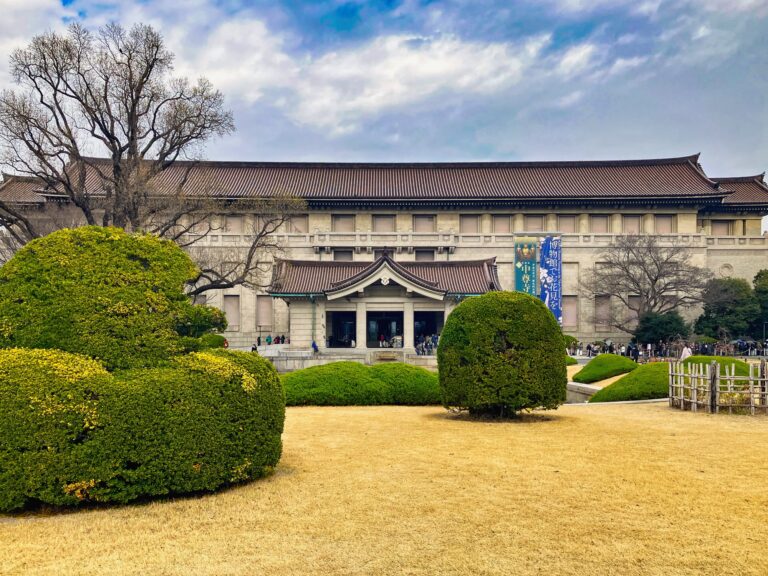
The shrine is in the middle of Ueno Park, right next to Ueno Zoo, and combines easily with the Tokyo National Museum.
Summary
Ueno Toshogu Shrine enshrines Tokugawa Ieyasu, and its Konjikiden, Karamon gate and openwork fence, rebuilt in the mid-17th century, and the bronze lanterns along the approach survive as Important Cultural Properties. It is an easy stop on a walk around Ueno Park.
Basic information
| Name | Ueno Toshogu Shrine (上野東照宮) |
| Address | 9-88 Ueno-koen, Taito City, Tokyo |
| Visiting hours | 9:00–17:30 (until 16:30 Oct–Feb) |
| Main hall viewing | 9:30–17:00 (until 16:00 Oct–Feb), adults 700 yen, primary school children 300 yen |
| Access | About 10 min walk from JR Ueno Station (Park Exit) |
| Closed | Open every day |
| Phone | 03-3822-3455 |
| Official website | https://www.uenotoshogu.com/en/ |
Information checked on November 26, 2026 (visiting hours, closures and admission fees) / Official source checked: Ueno Toshogu Shrine official website
Google Map
Nearby sights

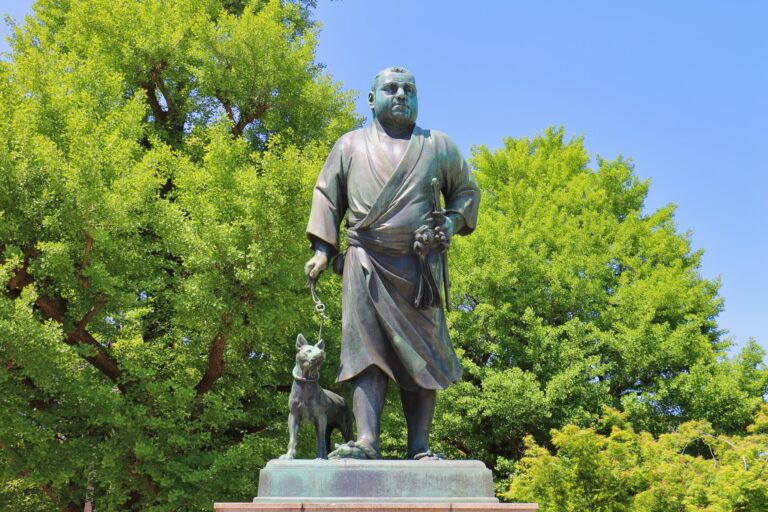
In the same park (a short walk)
About 3 min on foot

About 10 min on foot

Head on from Tokyo to Kamakura
From Ueno, JR reaches Kamakura in about 1 hour 10 minutes. Change to the Yokosuka Line at Tokyo Station. Temples, shrines and the sea: discover the old capital in our Kamakura Travel Guide.