
Imado Shrine (今戸神社)
A matchmaking shrine of beckoning cats and round ema
Quick facts
| Hours | Shrine office 9:00–16:00 (open every day) |
|---|---|
| Last entry | Until the shrine office closes |
| Fees | Free |
| Closed | None (open every day) |
| Reservations | Not needed to visit. Prayer rituals need advance booking (in person or by phone) |
| Best time to visit | 9:00–16:00 while the shrine office is open (for goshuin and amulets) |
| Time needed (approx.) | 20–30 minutes |
| Access notes | About 15 min walk from Asakusa Station. No parking or restrooms |
| Checked / official info | Checked on Nov 15, 2026 Official website |
What Is Imado Shrine (今戸神社)? | History and Origins
Imado Shrine (今戸神社) is a Shinto shrine in the Imado neighborhood of Asakusa, near the Sumida River. According to the shrine, it was founded in the mid-11th century as Imado Hachiman, when Minamoto no Yoriyoshi (源頼義) and his son Yoshiie (義家), warriors who made their name in wars in northeastern Japan and ancestors of Minamoto no Yoritomo, founder of the Kamakura shogunate, invited Hachiman, a guardian god of warriors, from Iwashimizu Hachimangu, a major shrine in Kyoto, to this spot. Around the same time, according to shrine tradition, father and son also enshrined Hachiman at Tsurugaoka in Kamakura (Yui Wakamiya Shrine (由比若宮), the origin of Kamakura’s central shrine, Tsurugaoka Hachimangu Shrine (鶴岡八幡宮)). Tokugawa Iemitsu (徳川家光), the third Tokugawa shogun, had the shrine rebuilt in the early 17th century.
In 1937 it merged with the neighboring Hakusan Shrine (白山神社), dedicated to the gods of the sacred Mount Hakusan, and took its present name. The shrine was damaged in the 1923 Great Kanto Earthquake and the US air raids on Tokyo near the end of World War II, and the current hall was built after the war with donations from local parishioners. Four deities are enshrined: Emperor Ojin (應神天皇), an ancient emperor identified with Hachiman; Izanagi (伊弉諾尊) and Izanami (伊弉冉尊), the gods who created the Japanese islands in myth; and Fukurokuju (福禄寿), a god of long life and happiness.
Highlights
Beckoning Cats (Maneki-neko, 招き猫)
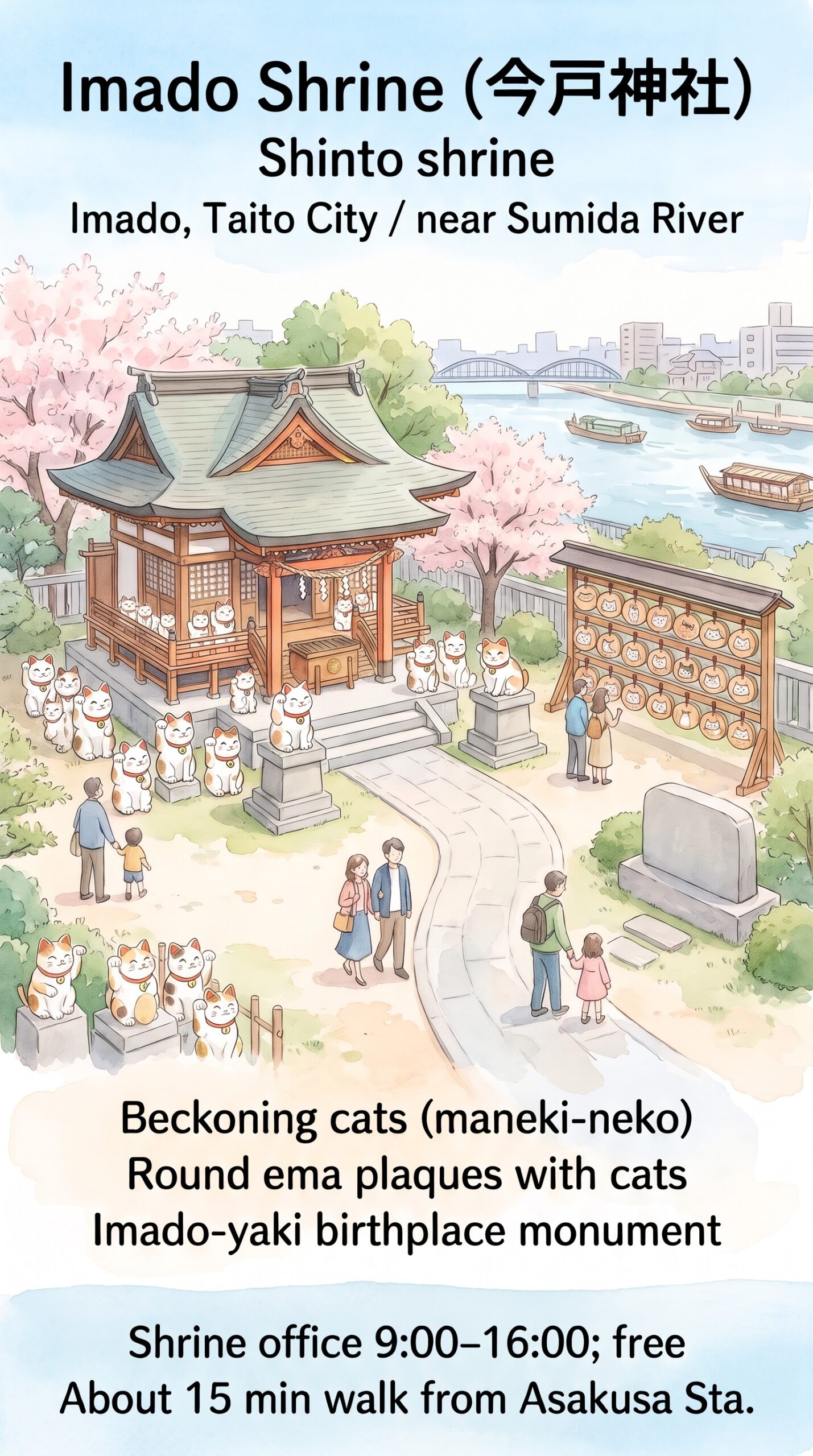
Imado was a center of Imado-yaki (今戸焼) pottery, a simple unglazed local earthenware, from the Edo period (17th–19th centuries) into the Meiji period (1868–1912), and Imado Shrine is said to be one of the birthplaces of the maneki-neko, the beckoning cat. Cat figures large and small stand around the grounds, and a large pair sits in front of the hall. Several places in Japan claim to be the birthplace of the maneki-neko, and Imado is one of them.
Round Ema Plaques and Stone Monuments
The shrine’s ema (絵馬), wooden plaques for writing wishes, are round and decorated with cats, and many hang on the racks in the grounds. You will also find a monument marking the birthplace of Imado-yaki pottery and one stating that Okita Soji (沖田総司) died here. Okita is known as the best swordsman of the Shinsengumi, a band of swordsmen who kept order in Kyoto in the 1860s at the end of the Edo period, and died young of illness; another account places his death in Sendagaya, a district of Tokyo. The stone komainu (狛犬) guardian lions in the grounds were donated in the mid-18th century by Imado-yaki potters and are registered as a Taito City tangible cultural property.
Spiritual Significance
Izanagi and Izanami, the deities of the merged Hakusan Shrine, are a married couple in Japanese mythology, so Imado Shrine is known as a place to pray for love and a good match. The shrine also holds its own matchmaking events (縁結び会); applications are by return postcard and participants are chosen by lottery. The shrine is also one of the Asakusa Seven Lucky Gods stops, for Fukurokuju; this circuit links temples and shrines around Asakusa that each enshrine one of seven gods of good fortune.
Goshuin (御朱印) Shrine Stamps
Goshuin stamps, ink inscriptions with red seals given as a record of a visit, are available at the shrine office as pre-written sheets only (except the Seven Lucky Gods shikishi board and fuku-e print). See the Basic Information table for office hours.
Access and Opening Hours
The shrine is about a 15-minute walk from Asakusa Station on any line, past the busy center of Asakusa into a quiet residential area near the Sumida River. By Toei Bus, get off at Asakusa 7-chome (浅草七丁目, about 5 minutes on foot) or Riverside Sports Center-mae (リバーサイドスポーツセンター前, about 1 minute); the Taito City Kita-Megurin community bus also stops at Riverside Sports Center-mae.
There is no charge to visit. The shrine has no parking and no restrooms, so use the facilities in Asakusa before you come. Prayer rituals (gokito) require a reservation in person or by phone. The grounds are compact, so a visit to the hall and the cat figures does not take long.
Best Time to Visit
Come during office hours if you want a goshuin or an amulet. Weekends and holidays get busier during the day, so weekdays and mornings are calmer. Visitors often mention meeting a white cat in the grounds.
Nearby Spots
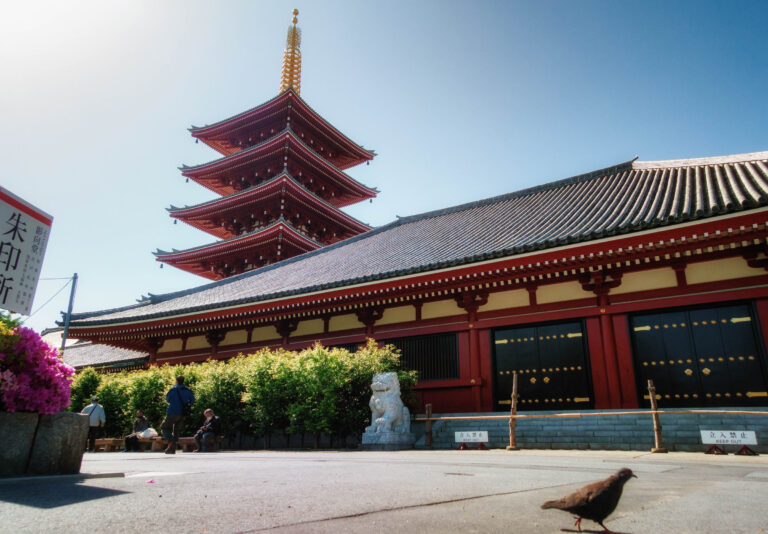
Imado Shrine lies a walk northeast of Senso-ji Temple (浅草寺), so the two are easy to combine, and you can also walk there along the Sumida River.
Summary
Imado Shrine began as Imado Hachiman in the 11th century and became a shrine for matchmaking after it merged with Hakusan Shrine and its married couple of deities. Its small grounds full of cats and round ema make an easy stop on a visit to Senso-ji.
Basic Information
| Item | Details |
|---|---|
| Name | Imado Shrine (今戸神社) |
| Deities | Emperor Ojin, Izanagi, Izanami, Fukurokuju |
| Address | 1-5-22 Imado, Taito City, Tokyo |
| Highlights | Beckoning cats, round ema, Imado-yaki monument, Okita Soji monument |
| Things to do | Worship, goshuin (pre-written), matchmaking events |
| Office hours | 9:00–16:00 (open every day) |
| Admission | Free |
| Access | About 15 min walk from Asakusa Station / Toei Bus: Asakusa 7-chome (5 min), Riverside Sports Center-mae (1 min) |
| Parking | None |
| Restrooms | None |
| Phone | +81-3-3872-2703 |
| Official website | https://imadojinja1063.crayonsite.net/ |
Information checked on November 15, 2026 (shrine office hours, closures and parking) / Official source checked: Imado Shrine official website
Google Map
Nearby sights

about 15 min walk

about 20 min walk

about 35 min walk


Head on from Tokyo to Kamakura
From Asakusa, take the Toei Asakusa Line to Shimbashi and change to the JR Yokosuka Line, to reach Kamakura in about 1 hour 15 minutes. Temples, shrines and the sea: discover the old capital in our Kamakura Travel Guide.