
Hama-rikyu Gardens (浜離宮恩賜庭園)
A daimyo garden with a seawater pond beside Shiodome’s towers
Quick facts
| Hours | 9:00–17:00 |
|---|---|
| Last entry | 16:30 |
| Fees | General 300 yen, 65+ 150 yen (free for elementary school age and under, and for junior high students living or studying in Tokyo; children of elementary school age and under must be accompanied by a guardian) |
| Closed | Dec 29–Jan 1 |
| Reservations | Not needed (no booking system) |
| Best time to visit | Weekdays (weekends in flower seasons are crowded). The Nakajima teahouse can be full |
| Time needed (approx.) | 1–1.5 hours for a full loop |
| Access notes | Nakanogomon Gate entrance: about 5 min walk from Shiodome Sta. Exit 10 (Toei Oedo Line) / Otemon Gate entrance: about 7 min from Tsukijishijo or Shiodome Sta., about 12 min from Shimbashi Sta. |
| Checked / official info | Checked on Nov 19, 2026 Official website |
What Are Hama-rikyu Gardens (浜離宮恩賜庭園)? | History and Origins
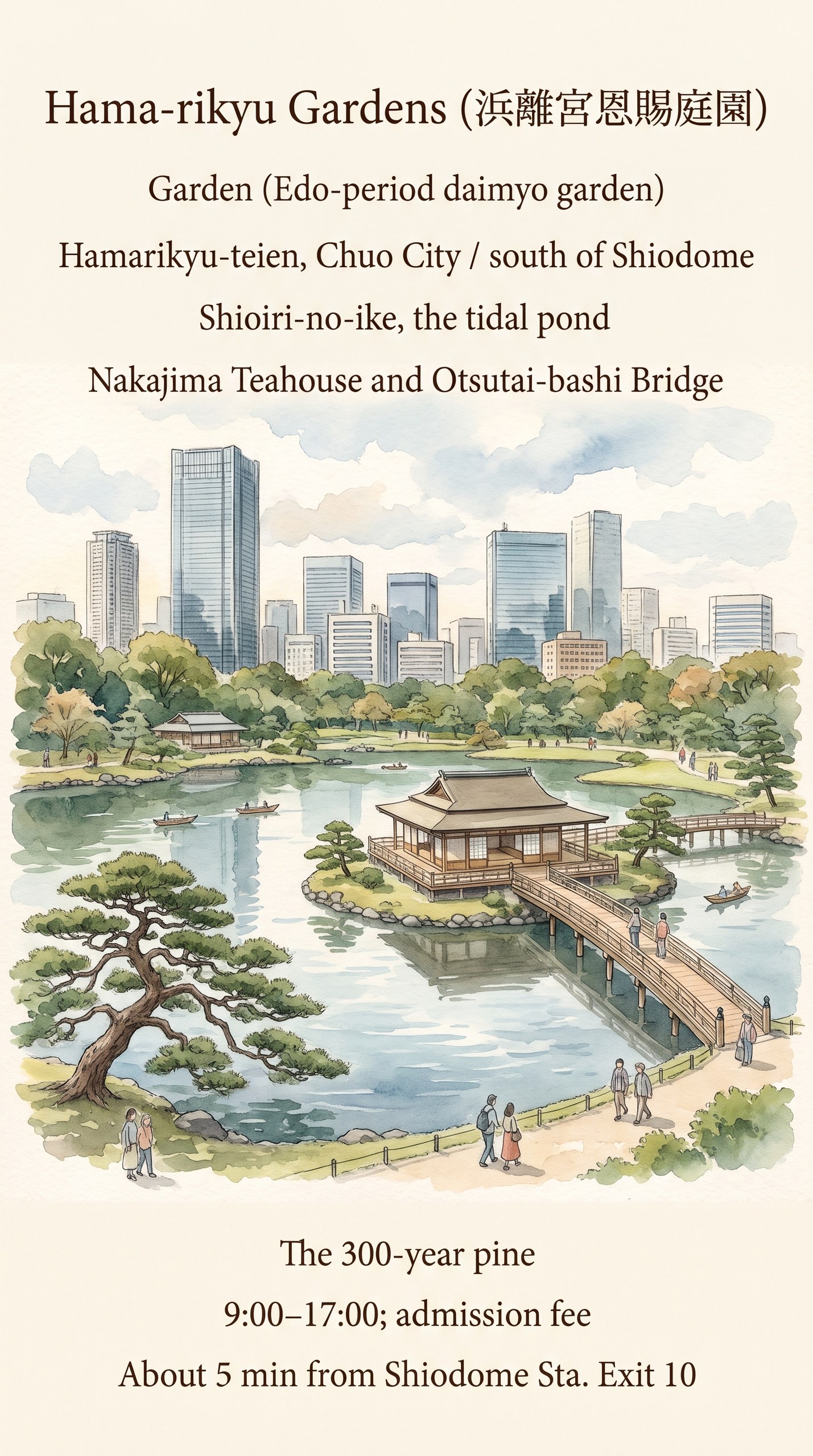
Hama-rikyu Gardens (浜離宮恩賜庭園) are Tokyo Metropolitan gardens beside the office towers of Shiodome (汐留), Tokyo. They keep a tidal pond fed by seawater, the Shioiri-no-ike (潮入の池), and two kamoba (鴨場), ponds and channels built to lure wild ducks and catch them. They are a daimyo garden of the Edo period (17th to mid-19th century), when the shogun, the military ruler of Japan, governed from Edo, present-day Tokyo; such gardens were laid out at the residences of daimyo, the lords who ruled Japan’s provinces.
Until the first half of the 17th century, this site was a field of reeds used by the shogun’s family for falconry, the samurai sport of hunting birds with trained hawks. In the mid-17th century, the lord of the Kofu domain, a member of the shogun’s family, reclaimed land from the sea and built a villa here; when his son became the sixth shogun, Tokugawa Ienobu (徳川家宣), it became the shogun family’s villa, the Hama Goten (浜御殿). It took roughly its present form under the 11th shogun, Tokugawa Ienari (徳川家斉), who visited the garden 248 times, mainly for falconry, more than any other shogun. At the end of the Edo period it served as a landing place for the shogunate’s warships, and in the Meiji era (1868–1912) it became a detached palace of the Imperial Family and came to be called Hama Rikyu, the “Beach Detached Palace.”
It opened to the public as a Tokyo Metropolitan garden in 1946. The garden and the surrounding water are designated both a Special Place of Scenic Beauty, for scenery of especially high value, and a Special Historic Site, for places of especially high historical importance; in Tokyo, only this garden and Koishikawa Korakuen (小石川後楽園) hold this double designation.
Highlights
Shioiri-no-ike, the Tidal Pond
Seawater from Tokyo Bay flows in and out of the Shioiri-no-ike through a sluice gate, so the water level of the pond rises and falls with the tide. It is the only seawater pond still surviving in a Tokyo garden handed down from the Edo period, and sea fish such as mullet and goby swim in it; you may even spot jellyfish.
Nakajima Teahouse and Otsutai-bashi Bridge
On the island in the pond, at the end of the long Otsutai-bashi Bridge (お伝い橋), stands the Nakajima Teahouse (中島の御茶屋), where you take off your shoes and enjoy matcha and Japanese sweets while looking out over the pond. Even when the garden is quiet, the teahouse can be full and you may have to wait. There are also the Taka no Ochaya (鷹の御茶屋), Matsu no Ochaya (松の御茶屋) and Tsubame no Ochaya (燕の御茶屋) teahouses, all restored to their Edo-period appearance; sit inside and you see the garden from an angle different from the one you get while walking.
The Two Duck Ponds and the Otemon Stone Walls
At the two kamoba, you can still see how hunters watched the narrow channels (引堀) used to lure the ducks in through small peepholes (小覗), and there is also a mound where the ducks caught in the hunts are memorialized. Around the Otemon Gate (大手門), the stone walls of the masugata (枡形), a square enclosure guarding the entrance, and of a watchtower base remain as they were in the Edo period.
The 300-Year Pine and Hills Overlooking the Garden
The “300-Year Pine” (三百年の松) is a black pine said to have been planted to honor the achievement of Ienobu when he greatly remodeled the garden. Climb small hills such as Fujimi-yama (富士見山) and Ochin-yama (御亭山) for views over the pond and garden. Beyond the Japanese garden rise the towers of Shiodome, and you can hear traffic on the Shuto Expressway (首都高速道路). Go out to the seaside on the east and you smell the sea, with Tokyo Bay opening out beyond the sluice gate.
Access and Opening Hours
There are two entrances: the Otemon Gate entrance and the Nakanogomon Gate (中の御門) entrance. The Nakanogomon Gate entrance is about a 5-minute walk from Exit 10 of Shiodome Station on the Toei Oedo Line, and the Otemon Gate entrance about 7 minutes from Tsukijishijo and Shiodome stations on the Oedo Line or Shiodome Station on the Yurikamome. From JR Shimbashi Station it is about 12 minutes on foot to the Otemon Gate entrance, and from JR Hamamatsucho Station about 15 minutes to the Nakanogomon Gate entrance. There is no parking for general visitors.
Opening hours and admission are in the table above; entry is free for children of elementary school age and under, and for junior high students living or studying in Tokyo. There is no booking system; just enter at the gate. Allow about 1 to 1.5 hours for a full loop of the gardens, or about 2 hours if you walk with children and take breaks. The gardens have a water-bus pier, and you can arrive by boat from Asakusa, but no services depart from Hama-rikyu; the pier is for getting off only. Check the operator’s information for service status.
Most paths are fine gravel that crunches underfoot. You can push a stroller, but in some places you have to lift it over steps or bridges. Otsutai-bashi Bridge has steps and Fujimi-yama has stairs, so both are difficult in a wheelchair; wheelchair users take the barrier-free route on the Nakanogomon Gate side. Nakanogomon Gate has lockers, and wheelchairs can be borrowed at the service centers at Otemon Gate and Nakanogomon Gate.
There is no restaurant in the gardens, but the shop sells dango and daifuku, two kinds of Japanese rice-cake sweets. You can bring a bento and eat it on a bench, but alcohol, fire and drones are not allowed. Picnic mats can be spread only at the Uchibori Plaza (内堀広場) and the Outdoor Table Plaza (野外卓広場). Smoking and pets are not allowed, and photo shoots centered on people require an application. Free garden guides, including in English, are also offered. Children of elementary school age and under must be accompanied by a guardian.
Best Time to Visit
Plum blossoms and the rapeseed flowers in the flower field usually bloom from February to around March; cherry blossoms, wisteria and Japanese kerria in spring; Japanese irises and hydrangeas in June; and yellow cosmos from late September to October. Autumn leaves usually peak from late November to early December. Weekends in the flower seasons, such as cherry blossom time, are crowded, while weekdays are relatively quiet. There is little shade in summer, and puddles form on the paths after rain.
Nearby Spots
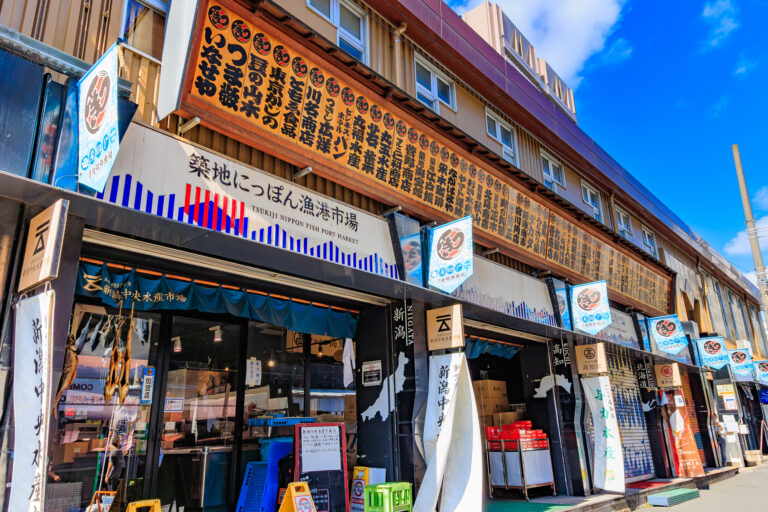
Tsukijishijo Station on the Toei Oedo Line is also the nearest station to Tsukiji Outer Market (築地場外市場), so you can walk the market in the morning and then head to the Otemon Gate entrance.
Summary
Hama-rikyu Gardens are an Edo-period daimyo garden that keeps a tidal pond fed by Tokyo Bay and two duck ponds, and at the Nakajima Teahouse you can enjoy matcha and Japanese sweets while looking out over the pond. Allow at least an hour for a loop of the gravel paths.
Basic Information
| Item | Details |
|---|---|
| Name | Hama-rikyu Gardens (浜離宮恩賜庭園) |
| Address | 1-1 Hamarikyuteien, Chuo City, Tokyo |
| Highlights | Shioiri-no-ike tidal pond fed by Tokyo Bay / Nakajima Teahouse and Otsutai-bashi Bridge / two duck ponds and peepholes / 300-Year Pine / daimyo garden backed by office towers |
| Things to do | Matcha and Japanese sweets at the Nakajima Teahouse / sit in the restored teahouses and look at the garden / free garden guides (weekends and holidays), teahouse guides (Thursdays) and English guides / seasonal flowers (rapeseed, cherry, iris, yellow cosmos, autumn leaves) |
| Hours | 9:00–17:00 (last entry 16:30). Hours may be extended during events |
| Closed | New Year holidays (Dec 29–Jan 1) |
| Admission | General: 300 yen / 65+: 150 yen. Free for elementary school age and under and for junior high students living or studying in Tokyo. Groups of 20 or more: General 240 yen / 65+ 120 yen. Free for holders of a disability certificate and one companion (in principle). Free entry on Greenery Day (May 4) and Tokyo Citizens’ Day (October 1). “Enmusubi Ticket” combined ticket with Kyu-Shiba-rikyu Gardens (旧芝離宮恩賜庭園): General 400 yen / 65+ 200 yen (no expiry) |
| Access | Nakanogomon Gate entrance: Toei Oedo Line Shiodome Sta. Exit 10, about 5 min walk; JR Hamamatsucho Sta., about 15 min / Otemon Gate entrance: Toei Oedo Line Tsukijishijo or Shiodome Sta., or Yurikamome Shiodome Sta., about 7 min walk; JR Shimbashi Sta., about 12 min |
| Parking | None for general visitors (spaces only for wheelchair users’ and disabled visitors’ cars and tour buses) |
| Official website | https://www.tokyo-park.or.jp/park/hama-rikyu/index.html |
Information checked on November 26, 2026 (opening hours, closing days and admission fees) / Official source checked: Tokyo Metropolitan Park Association, Hamarikyu Gardens
Google Map
Nearby sights

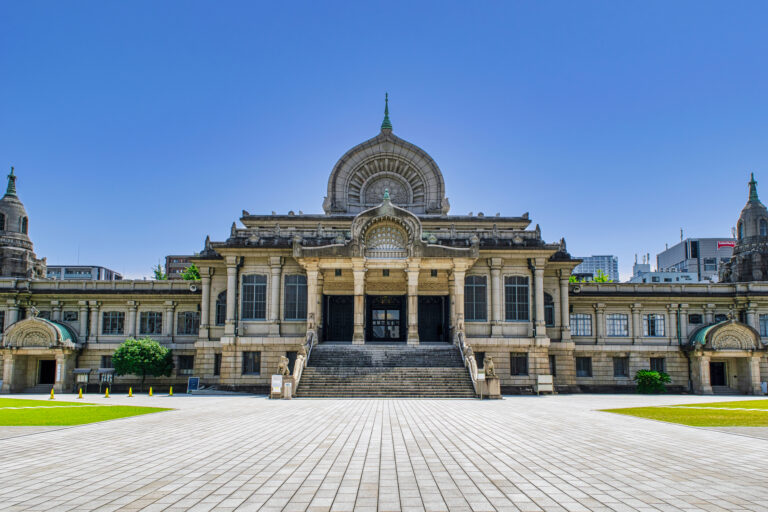
about 1 min walk from Tsukijishijo Station
about 5 min walk from Tsukijishijo Station

Head on from Tokyo to Kamakura
From Shimbashi, the JR Yokosuka Line reaches Kamakura in about 1 hour. Temples, shrines and the sea: discover the old capital in our Kamakura Travel Guide.