
Sengakuji Temple (泉岳寺)
Offer incense at the graves of the 47 Ronin and their lord
Quick facts
| Hours | Gates open 7:00–16:00. Ako Gishi Memorial Hall 9:00–15:30 (may close for about 45 minutes around midday) |
|---|---|
| Last entry | Not stated |
| Fees | Grounds free. Combined ticket for the Memorial Hall and Wooden Statue Hall: adults 500 yen, junior high and high school students 400 yen, ages 10 and over 250 yen. Incense at the graves 500 yen |
| Closed | None (grounds open every day) |
| Reservations | Not needed |
| Best time to visit | Weekday mornings (quiet). Crowded during the Gishi-sai festival around December 14 |
| Time needed (approx.) | 30 min–1 hour |
| Access notes | About 3 min on foot from Sengakuji Station (Toei Asakusa Line / Keikyu Line). About 5 min from the North Gate of JR Takanawa Gateway Station |
| Checked / official info | Checked on Nov 19, 2026 Official website |
What Is Sengakuji Temple (泉岳寺)? | History and Origins
Sengakuji Temple (泉岳寺) in Takanawa, Tokyo, is where the Ako Roshi (赤穂浪士), the masterless samurai known in English as the 47 Ronin, are buried with their lord, and where visitors offer incense at each gravestone in turn. It belongs to the Soto school (曹洞宗), one of the branches of Zen Buddhism. Anyone can enter the grounds free of charge, and the graveyard is designated a national Historic Site.
The story of the Ako Roshi goes back to the Ako Incident of the early 18th century. Asano Takumi-no-Kami Naganori (浅野内匠頭長矩), lord of the Ako domain (赤穂藩) in what is now southwestern Hyogo Prefecture, drew his sword on Kira Kozuke-no-Suke (吉良上野介), an official serving the shogunate, inside Edo Castle, the seat of the Tokugawa shoguns, Japan’s military rulers, in what is now Tokyo, and was ordered to commit seppuku, ritual suicide. His retainers became ronin, samurai who had lost the lord they served. Later, 47 of them, led by the domain’s chief retainer Oishi Kuranosuke (大石内蔵助), raided Kira’s mansion to avenge their lord and offered Kira’s head at their lord’s grave in this temple. On the shogunate’s orders the ronin then committed seppuku and were buried near their lord’s grave. Sengakuji was the Asano family temple, entrusted with the family’s graves and memorial rites.
The incident later became widely known through Kanadehon Chushingura (仮名手本忠臣蔵), a play for bunraku puppet theatre and kabuki, Japan’s traditional stage drama. In the Edo period (17th to mid-19th century) it was forbidden to stage real recent events as they happened, so the story was moved to the 14th century, the era of the Northern and Southern Courts, when two rival imperial courts divided Japan, and the characters were renamed. The opening scene of the play is set in front of Tsurugaoka Hachimangu Shrine (鶴岡八幡宮) in Kamakura.
Highlights
The Dragon of the Sanmon Gate and the Main Hall
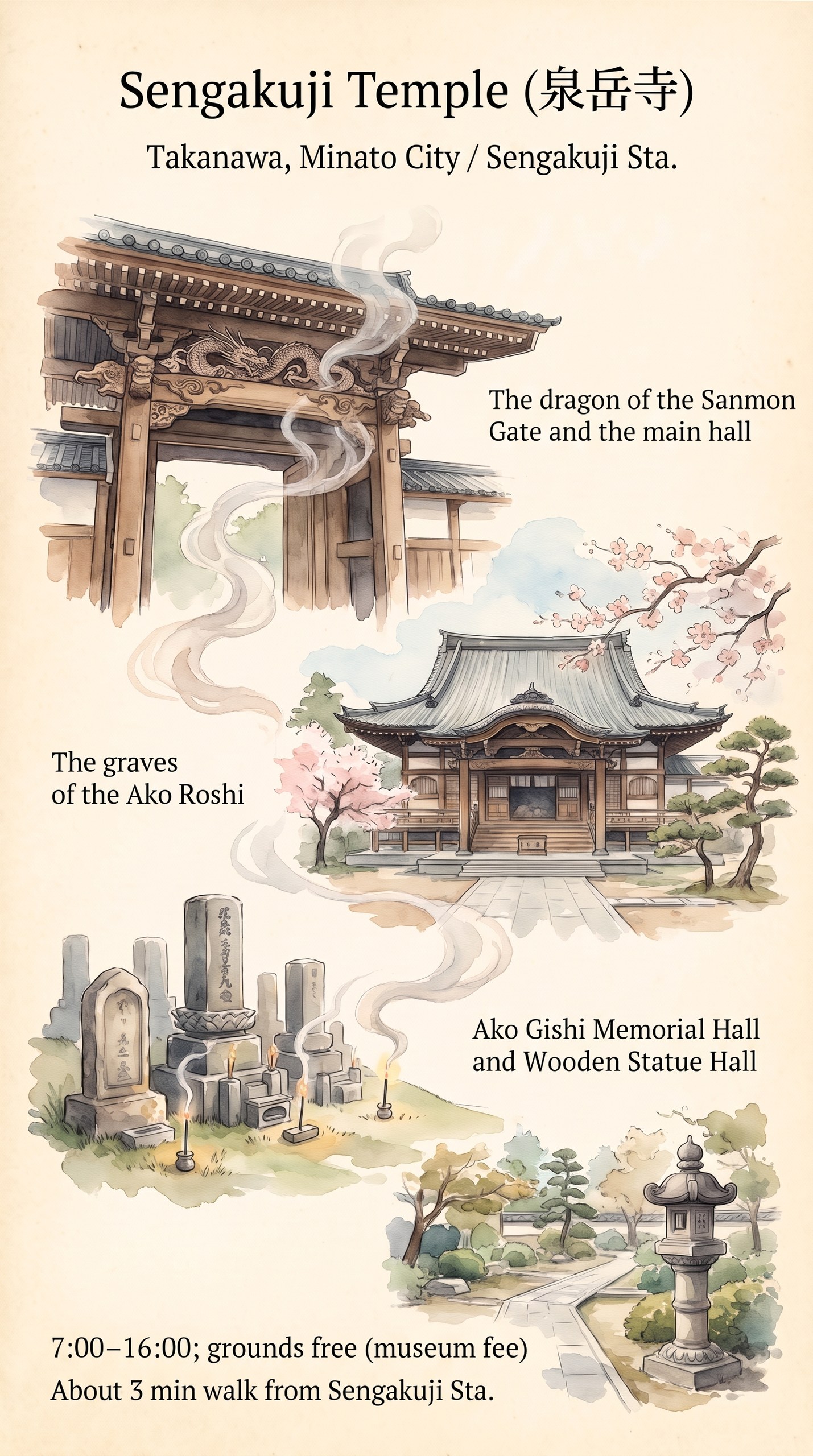
Pass through the Chumon, the middle gate facing the street, and the Sanmon, the main gate, stands at the end of the approach. A large bronze dragon is carved on the ceiling of the gate’s ground floor, and statues of the Sixteen Arhats, sixteen disciples who guard the Buddha’s teachings, are enshrined upstairs. You normally cannot walk under the Sanmon; enter the grounds through the entrance to its right. The main hall burned in an air raid during the war and was rebuilt in 1953. You normally cannot go inside the hall to pray. In the grounds stand a statue of Oishi Kuranosuke holding the renpanjo, the pledge to carry out the raid, and a plum tree and a stone said to have been splashed with blood when Asano Takumi-no-Kami committed seppuku.
The Graves of the Ako Roshi
The graveyard lies at the back of the grounds, at the top of a flight of stone steps. Its entrance gate is the former back gate of the Asano family’s Edo mansion, moved here in the Meiji era (1868–1912). To the right of the steps is the Kubiarai-ido, the well where Kira’s head is said to have been washed. The steps have a handrail, and there is a gentle slope to the left. At the graveyard entrance you pay for incense, receive a lit bundle and offer some at each gravestone in turn. The ronin’s graves stand close together in a small plot, 48 gravestones in all, including a memorial grave for Kayano Sanpei (萱野三平), a ronin who died before the raid. Oishi Kuranosuke’s grave is roofed, and Asano Takumi-no-Kami’s grave lies beyond it. The incense smoke is thick and clings to your clothes. Visitors are asked not to take photos in the graveyard.
The Ako Gishi Memorial Hall and the Gishi Wooden Statue Hall
One combined ticket covers the Ako Gishi Memorial Hall (赤穂義士記念館) and the Gishi Wooden Statue Hall (義士木像館) on the 2nd floor of the lecture hall. Gishi (義士), meaning loyal retainers, is an honorific name for the Ako Roshi. The Memorial Hall displays letters and belongings of the ronin and gear used in the raid, and shows a film about the incident. The Wooden Statue Hall holds wooden statues of the 47 ronin made between the end of the Edo period and the early Meiji era. Photography is not allowed inside.
Goshuin and Sutra Copying
Goshuin are seals and calligraphy that temples write as a record of your visit. At Sengakuji, goshuin are written by hand into your own goshuin book on the spot; there are no pre-written sheets. While the temple has your book, visitors copy a sutra by tracing it at the sutra-copying area next to the reception and leave it as an offering.
Access and Opening Hours
The nearest station is Sengakuji (泉岳寺) on the Toei Asakusa Line and Keikyu Line, about a 3-minute walk away. From the North Gate of JR Takanawa Gateway Station (高輪ゲートウェイ駅) it is about 5 minutes on foot.
The gates open at the same hours all year and close before evening. The grounds are free and no reservation is needed. The Ako Gishi Memorial Hall opens later and closes earlier than the gates and may close for a short break around midday, so arrive early if you also want to see it (hours and fees are in the Quick facts table). Allow about 30 minutes to 1 hour for the graveyard and the Memorial Hall together.
Best Time to Visit
On ordinary weekdays few people visit and the temple is quiet. In the grounds, cherry trees bloom in front of the Sanmon in spring, hydrangeas in early summer, and the maples turn red in early winter. During Gishi-sai (義士祭), held around December 14, the anniversary of the raid, food stalls line the grounds, visiting hours run into the evening and the Sanmon is opened. The line in front of the graves can take over an hour, and on the 14th a procession in the ronin’s costume arrives at the temple.
Nearby Spots
Souvenir shops connected with the Chushingura story line the approach outside the gate, handy before or after your visit.
Summary
Sengakuji is a Soto Zen temple in Takanawa where you can offer incense at the graves of the Ako Roshi and their lord. The gates close before evening, so plan to arrive early.
Basic Information
| Item | Details |
|---|---|
| Name | Sengakuji Temple (泉岳寺; Banshozan Sengakuji, 萬松山 泉岳寺) |
| Address | 2-11-1 Takanawa, Minato City, Tokyo |
| Highlights | Graves of the Ako Roshi and Asano Takumi-no-Kami, Kubiarai-ido well, bronze dragon on the Sanmon ceiling, statue of Oishi Kuranosuke, belongings in the Memorial Hall and the wooden statues of the ronin |
| Things to do | Offering incense at each grave, sutra copying while waiting for your goshuin, the Gishi-sai festival in December |
| Hours | Gates open 7:00–16:00 (all year). Ako Gishi Memorial Hall 9:00–15:30 (may close for about 45 minutes around midday). Visiting and Memorial Hall hours are extended during Gishi-sai in December |
| Closed | None (grounds open every day) |
| Admission | Grounds: Free. Combined ticket for the Ako Gishi Memorial Hall and Gishi Wooden Statue Hall: Adults: 500 yen / junior high and high school students: 400 yen / children (10 and over): 250 yen (discount for people with disabilities). Incense at the graves: 500 yen |
| Access | Toei Asakusa Line / Keikyu Sengakuji Sta., about 3 min walk / JR Takanawa Gateway Sta. North Gate, about 5 min walk |
| Official website | https://sengakuji.or.jp/ |
Information checked on November 26, 2026 (opening hours and admission fees of the Ako Gishi Memorial Hall and Gishi Wooden Statue Hall, and the incense fee at the graveyard) / Official source checked: Sengakuji Temple official website
Google Map
Nearby sights

2 stops on the Keikyu Main Line (Sengakuji to Kita-Shinagawa)

2 stops on the Toei Asakusa Line (Sengakuji to Daimon)

Head on from Tokyo to Kamakura
From Sengakuji Station, the Keikyu Main Line and the JR Yokosuka Line reach Kamakura in about 1 hour. Change from the Keikyu Main Line to the JR Yokosuka Line at Shinagawa. Temples, shrines and the sea: discover the old capital in our Kamakura Travel Guide.