
Tokyo Tower (東京タワー)
A broadcasting tower with outdoor stairs to climb on weekends
Quick facts
| Hours | Main Deck 9:00–23:00; Top Deck Tour 9:00–22:45; open-air stairs: up 9:00–16:00 on weekends and holidays, down 9:00–20:00 daily |
|---|---|
| Last entry | Main Deck 22:30 (may be earlier when crowded). The last Top Deck Tour slot is 22:00–22:15 |
| Fees | Main Deck: adults 1,500 yen / high school students 1,200 yen / elementary and junior high students 900 yen / children 4+ 600 yen. Top Deck Tour (includes the Main Deck): adults 3,300 yen online, 3,500 yen at the counter |
| Closed | Open every day (the outdoor stairs close in rain, storms or heatstroke alerts) |
| Reservations | Not needed for the Main Deck. The Top Deck Tour uses timed slots: book on the official booking page, or take an open slot at the ticket counter on 1F of FOOT TOWN on the day |
| Best time to visit | Right after opening, when it is usually quieter. Late afternoon for sunset followed by the night view |
| Time needed (approx.) | 1–2 hours |
| Access notes | About 5 min on foot from the Akabanebashi Exit of Akabanebashi Station (Toei Oedo Line); about 7 min from Exit 1 of Kamiyacho Station (Tokyo Metro Hibiya Line) |
| Checked / official info | Checked on November 17, 2026 Official website |
What Is Tokyo Tower (東京タワー)? | History and Origins
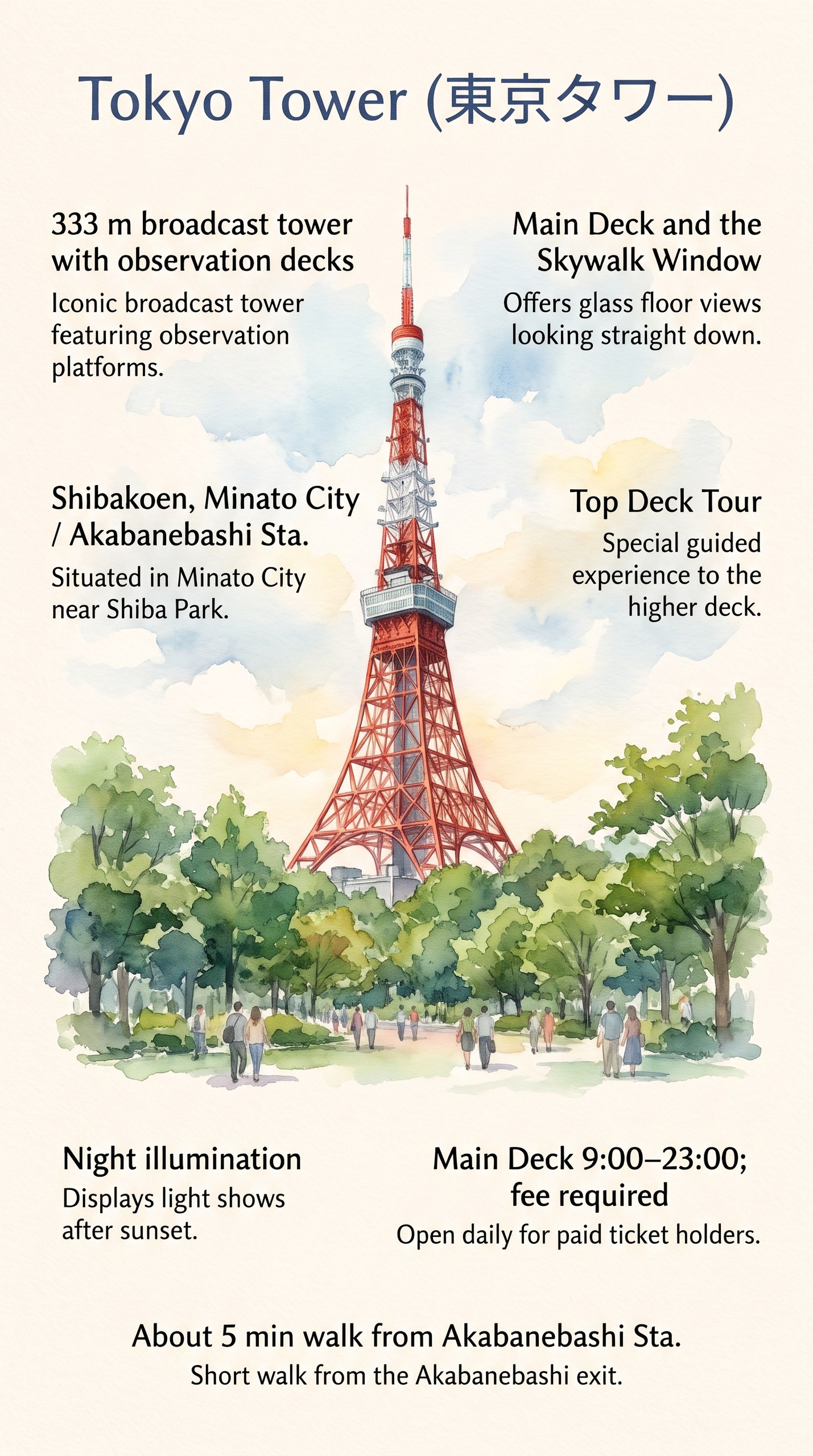
Tokyo Tower (東京タワー) is the red-and-white broadcasting tower on the hill of Shiba Park (芝公園), and its two observation decks, the Main Deck at 150 m and the Top Deck at 250 m, look out over the city. It was completed in 1958 and stands 333 m tall. The hill was once called Kannon-yama (観音山). According to nearby Zojoji Temple (増上寺), in the mid-13th century, when Japan’s samurai government was based in Kamakura, the old samurai capital of the late 12th to early 14th centuries, the regent Hojo Tokiyori (北条時頼), who held real power in that government, built a small hall here and set up a stone statue of Kannon, the Buddhist figure believed to save people from suffering, facing the road to Kamakura. The statue is still enshrined in the temple grounds as the West-Facing Kannon (西向観音).
Its design was supervised by the structural engineer Tachu Naito (内藤多仲), who is said to have worked out the calculations by hand in an age before computers; construction took about a year and a half. The name came from a public contest. The entry with the most votes was “Showa Tower,” after Showa, the name of the era that began in 1926, and “Tokyo Tower” placed only 13th, but one of the judges, Musei Tokugawa (徳川夢声), a former silent-film narrator who became a well-known radio entertainer, is said to have argued that no other name fit the tower so well, and it was chosen.
The tower looks red, but its color is “International Orange.” The alternating orange and white bands follow aviation rules that make tall structures easy to see from aircraft, and the tower is repainted about every seven years. It is also a Registered Tangible Cultural Property, a national listing for modern structures worth preserving.
Highlights
Main Deck and the Skywalk Window
The Main Deck (150 m) has two floors. On the lower floor, the Skywalk Window is a glass panel set into the floor that lets you look straight down; some visitors freeze on it, and some children refuse to step on at all. Compared with the decks of the taller Tokyo Skytree (東京スカイツリー) in Sumida, you are close enough to the city to see cars and people moving. The upper floor holds Tower Daijingu (タワー大神宮), a small Shinto shrine that enshrines Amaterasu Omikami (天照大御神), the sun goddess of Japanese mythology, brought from Ise Jingu (伊勢神宮), regarded as the most important shrine in Japan. It is said to be the highest shrine in Tokyo’s 23 wards.
Top Deck Tour
The Top Deck (250 m), renovated in 2024, has mirrored walls and ceilings that reflect the view outside, and at night the floor lights bounce off the mirrors. You reach it on a timed Top Deck Tour. On clear days with crisp air, Mt. Fuji (富士山) can sometimes be seen to the southwest. The tour includes a drink and a souvenir photo. There is no shop and no seating on the Top Deck.
Open-Air Stairs
The Open-Air Stairs are about 600 outdoor steps that climb from the roof of FOOT TOWN, the building at the tower’s base, to the Main Deck, with the city showing through the gaps in the steel frame. The upward stairs open only during the day on weekends and public holidays, and the official guide time for the climb is 12–13 minutes. At the top you receive a stair-climbing certificate on the Main Deck. A separate staircase for going down is open every day. Both require an observation deck ticket and close in rain, storms or when a heatstroke alert is issued. Expect to work up a sweat, and if heights bother you, the climb can feel unnerving.
Night Illumination
At night the tower is lit in two ways: the Landmark Light, which bathes it in orange (a silver tone in summer), and the Infinity Diamond Veil, a design of colored LEDs. The Diamond Veil normally runs on Mondays and Thursdays from 20:00 to 22:00, and from sunset until midnight the parts just above the Top Deck and the Main Deck glow pure white for two minutes at the top of every hour. Special illuminations can change this schedule.
Access and Opening Hours
The closest station is Akabanebashi Station (赤羽橋駅) on the Toei Oedo Line, about 5 minutes on foot from the Akabanebashi Exit. It is also about 6 minutes from Exit A1 of Onarimon Station (御成門駅) on the Toei Mita Line, 7 minutes from Exit 1 of Kamiyacho Station (神谷町駅) on the Tokyo Metro Hibiya Line, and 15 minutes from the North Exit of JR Hamamatsucho Station (浜松町駅).
The Main Deck stays open late and is open every day of the year. You need no booking for the Main Deck; the Top Deck Tour price includes the Main Deck, and booking online is cheaper than buying at the counter. Tickets allow one entry only, though a 1DAY Pass lets you go up to the Main Deck as many times as you like that day. Strollers can be used up to the Main Deck, but because there are stairs along the way, the tower recommends leaving them at the 1F operation center of FOOT TOWN. Allow about 1–2 hours.
Best Time to Visit
Weekends, holidays and long weekends are busy from midday to early evening, and you may wait for the elevators both up and down. Mornings right after opening are usually quieter. Go up in the late afternoon to watch the city shift from daylight through sunset to the night view. Top Deck Tour slots have a set capacity and can sell out, so booking ahead is the safe choice if you have a fixed time.
Nearby Spots
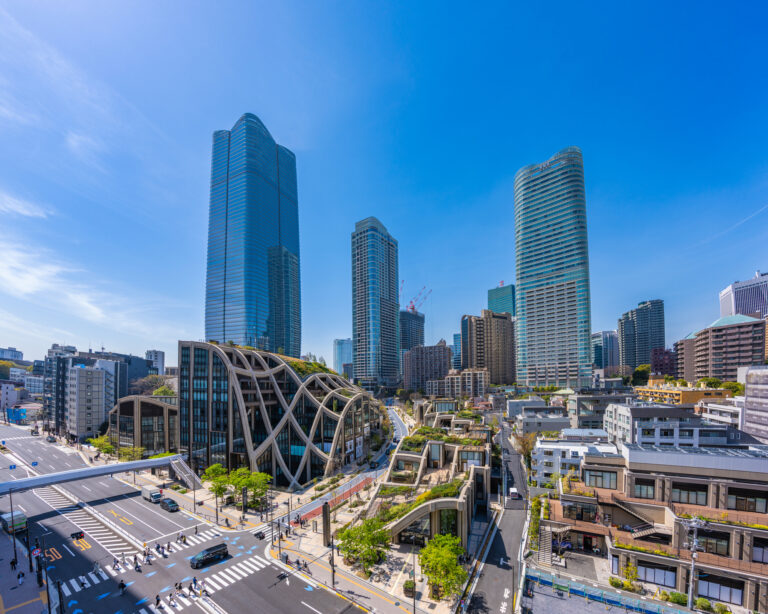
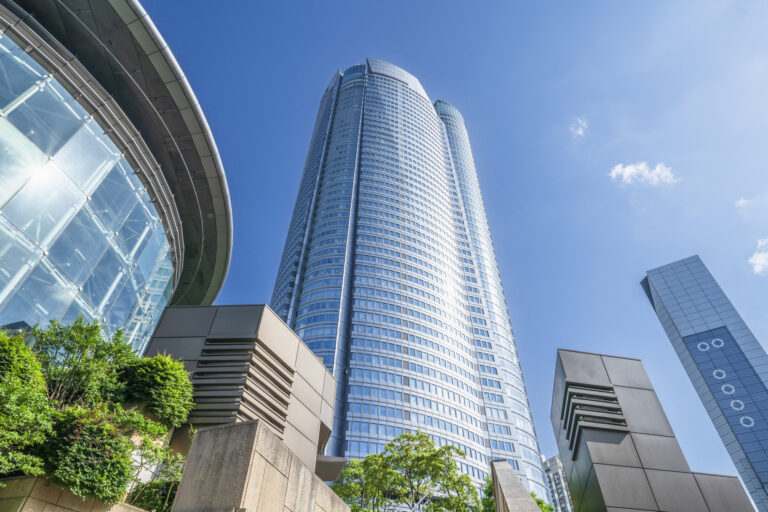
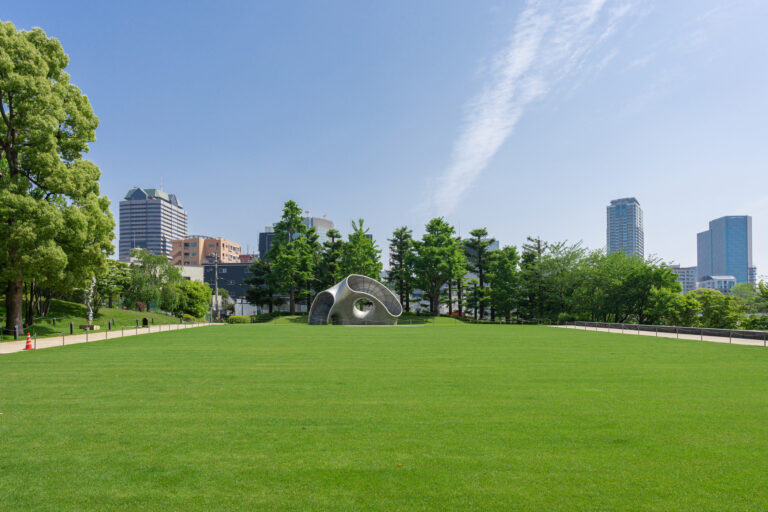
Zojoji Temple (増上寺), the family temple of the Tokugawa shoguns who ruled Japan from the 17th to the 19th century and the burial place of six of them, is about 6 minutes away on foot. About 11 minutes away, Azabudai Hills (麻布台ヒルズ) is home to teamLab Borderless, a digital art museum, and you can carry on to Roppongi Hills (六本木ヒルズ) to make a route toward Roppongi.
Summary
Tokyo Tower is a 333 m broadcasting tower whose decks at 150 m and 250 m put you close above the city. With the Main Deck open late into the night, it also works well for a late-afternoon or evening visit.
Basic Information
| Item | Details |
|---|---|
| Name | Tokyo Tower (東京タワー) |
| Address | 4-2-8 Shibakoen, Minato City, Tokyo |
| Highlights | Main Deck (150 m), Skywalk Window, Tower Daijingu, Top Deck (250 m), open-air stairs (about 600 steps), illumination |
| Things to do | Views from the decks, Top Deck Tour, walking the outdoor stairs (up on weekends and holidays only) |
| Hours | Main Deck 9:00–23:00 (last entry 22:30); Top Deck Tour 9:00–22:45 (last slot 22:00–22:15); open-air stairs: up 9:00–16:00 on weekends and holidays, down 9:00–20:00 daily |
| Closed | Open every day |
| Admission | Main Deck: Adults: 1,500 yen / high school students: 1,200 yen / elementary and junior high students: 900 yen / children 4+: 600 yen. Top Deck Tour (online / counter): Adults: 3,300 / 3,500 yen / high school students: 3,100 / 3,300 yen / elementary and junior high students: 2,100 / 2,300 yen / children 4+: 1,500 / 1,700 yen |
| Access | Toei Oedo Line Akabanebashi Sta., Akabanebashi Exit, 5 min / Toei Mita Line Onarimon Sta. Exit A1, 6 min / Tokyo Metro Hibiya Line Kamiyacho Sta. Exit 1, 7 min / Toei Mita Line Shibakoen Sta. Exit A4, 10 min / Daimon Sta. Exit A6, 10 min / JR Hamamatsucho Sta. North Exit, 15 min |
| Notes | No re-entry. The outdoor stairs close in rain, storms or heatstroke alerts. Leaving strollers at FOOT TOWN 1F is recommended |
| Official website | https://www.tokyotower.co.jp/ |
Information checked on November 26, 2026 (business hours and fees) / Official source checked: Tokyo Tower official website
Google Map
Nearby sights

about 11 min walk

2 stops on the Toei Oedo Line (Akabanebashi to Roppongi)
2 stops on the Toei Oedo Line (Akabanebashi to Roppongi)

Head on from Tokyo to Kamakura
From Hamamatsucho, the JR Yamanote or Keihin-Tohoku Line and the Yokosuka Line reach Kamakura in about 1 hour. Change to the Yokosuka Line at Shinagawa. Temples, shrines and the sea: discover the old capital in our Kamakura Travel Guide.