
AREA E
Roppongi & Akasaka Area
From the walkable museums of Roppongi
to Tokyo Tower by night and the Diet in Nagatacho.
- Starting station
- Roppongi (Tokyo Metro Hibiya Line, Toei Oedo Line), Nogizaka (乃木坂) (Tokyo Metro Chiyoda Line), Kamiyacho (神谷町) (Tokyo Metro Hibiya Line)
- Time needed (approx.)
- A full day for the museums and observatory in Roppongi; half a day for Tokyo Tower and Azabudai Hills; 1 hour for a tour of the National Diet Building
- Neighbouring area
- Shibuya (渋谷), Harajuku (原宿) & Ebisu (恵比寿) (2 stops from Roppongi to Ebisu on the Hibiya Line); Tokyo Station, Marunouchi (丸の内) & Ginza (銀座) (5 stops to Ginza on the Hibiya Line)
- Tokyo Tower
- The National Art Center, Tokyo
- Roppongi Hills
- Tokyo Midtown
- teamLab Borderless
- National Diet Building
See on Toshi's Tokyo Sightseeing Map
Highlights of the area
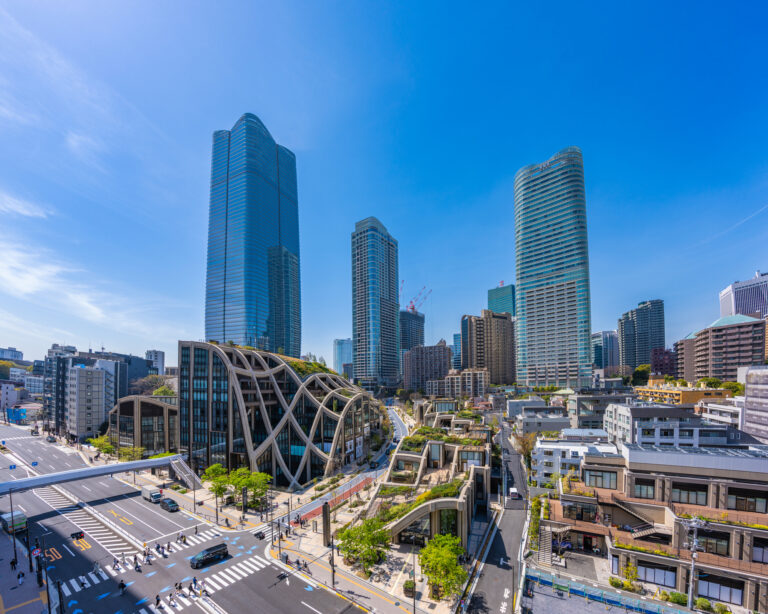
The Roppongi and Akasaka area centres on Roppongi (六本木) in Minato City and reaches east to Azabudai (麻布台) and Shiba Park (芝公園) and northeast to Nagatacho (永田町). In Roppongi, The National Art Center, Tokyo (国立新美術館), a national museum with no collection of its own where exhibitions change through the year, the Mori Art Museum (森美術館) and the Tokyo City View (東京シティビュー) observatory at Roppongi Hills (六本木ヒルズ), and the Suntory Museum of Art (サントリー美術館) at Tokyo Midtown (東京ミッドタウン) are all within walking distance of one another. Both Roppongi Hills and Tokyo Midtown stand on land where the Mori family (毛利家), feudal lords of what is now Yamaguchi Prefecture, had residences in the Edo period (early 17th to mid-19th century, when the Tokugawa shoguns governed Japan); the Mohri Garden (毛利庭園) at Roppongi Hills takes its name from them. How the Mori family links to Kamakura is told on the Tokyo Midtown page.
East of Roppongi, Tokyo Tower (東京タワー), a 333 m broadcasting tower completed in 1958, and teamLab Borderless (チームラボボーダレス), a digital art museum beneath Azabudai Hills (麻布台ヒルズ), are within walking distance of each other. In Nagatacho to the northeast stands the National Diet Building (国会議事堂), home of the Diet, Japan's parliament, where free tours by the House of Representatives and the Senate take you through the plenary chamber and the Central Hall. Tokyo Tower's Main Deck stays open until 23:00 and the Tokyo City View until 22:00, so you can spend the day at museums or on a Diet tour and the evening looking out over the city lights.
Example route (1 day)
- Morning: Exit 5 of Kamiyacho Station, through the underground passage → teamLab Borderless (the first entry slot of the morning is usually quieter)
- Walk about 11 min → Tokyo Tower (Main Deck)
- 2 stops on the Toei Oedo Line from Akabanebashi Station (赤羽橋駅) to Roppongi → Tokyo Midtown → walk about 5 min → The National Art Center, Tokyo
- Late afternoon: walk about 10 min → Roppongi Hills (go up to the Tokyo City View shortly before sunset to stay for the night view)
For a tour of the National Diet Building (about 1 hour), afternoon tours are recommended; Kokkai-gijidomae Station (国会議事堂前駅) is 2 stops from Nogizaka on the Chiyoda Line. The National Art Center, Tokyo and the Suntory Museum of Art close on Tuesdays. Distances and times depend on how often you stop.
Sightseeing spots
Tokyo Tower (東京タワー)
A 333 m broadcasting tower
with decks at 150 m and 250 mA broadcasting tower completed in 1958. From the Main Deck at 150 m and the Top Deck at 250 m you look down on the city close up, and on weekends and holidays you can also climb some 600 outdoor steps. About 5 min on foot from the Akabanebashi Exit of Akabanebashi Station (Toei Oedo Line).
Approx. 1–2 hours / no booking for the Main Deck (Top Deck Tour uses timed slots)
The National Art Center, Tokyo (国立新美術館)
Waves of glass
and ever-changing exhibitionsA national art museum opened in 2007 with no collection of its own, designed by the architect Kurokawa Kisho (黒川紀章). Special and open-call exhibitions take turns, and entry to the building is free (each exhibition sets its own fee). Directly connected to Exit 6 of Nogizaka Station (Tokyo Metro Chiyoda Line).
Approx. 1–1.5 hours per exhibition / closed Tuesdays, no booking to enter
Roppongi Hills (六本木ヒルズ)
A 52nd-floor observatory
and the Mori Art Museum above itA complex opened in 2003. From the Tokyo City View, the indoor observatory on the 52nd floor of Mori Tower (森タワー), Tokyo Tower faces you head-on, and the Mori Art Museum on the 53rd floor shows contemporary art. Directly connected by concourse to Exit 1C of Roppongi Station (Tokyo Metro Hibiya Line).
Approx. 1–2 hours for the observatory / Tokyo City View: timed tickets booked in advance (walk-ins if slots remain)
Tokyo Midtown (東京ミッドタウン)
A lawn garden and about 100 cherry trees,
with the Suntory Museum of ArtA complex opened in 2007 that brings together shops, museums and green space, with free entry. It has the lawn and cherry trees of Midtown Garden, the Suntory Museum of Art and the design gallery 21_21 DESIGN SIGHT. Directly connected to Exit 8 of Roppongi Station (Toei Oedo Line).
Approx. 1–3 hours / no booking needed (closed January 1)

teamLab Borderless (チームラボボーダレス)
No map, no route:
a museum of digital artA museum on the first basement floor of Azabudai Hills by teamLab, an art collective that makes artworks with digital technology. About 70 artworks move from room to room with no map or set route, and you find them by wandering. 2 min through an underground passage from Exit 5 of Kamiyacho Station (Tokyo Metro Hibiya Line).
Approx. 1.5–2 hours / buy a timed-entry ticket in advance
National Diet Building (国会議事堂)
From the plenary chamber to the Central Hall
on a free tourThe home of the Diet, Japan's parliament, completed in 1936. The House of Representatives and the Senate each run free tours, led by eishi (衛視), the Diet's security and guide staff, through the plenary chamber and the Central Hall in about an hour. The House of Representatives entrance is 3 min on foot from Exit 1 of Kokkai-gijidomae or Nagatacho Station.
Approx. 60 min / no booking for up to 9 people (Senate tours on weekdays only)
Other spots in this area
- Zojoji Temple (増上寺) … The family temple of the Tokugawa shoguns, who ruled Japan from the 17th to the 19th century, with the graves of six shoguns. About 6 min on foot from Tokyo Tower
- Hie Shrine (日枝神社) … An Akasaka shrine once regarded as the guardian of Edo Castle (江戸城), the shoguns' seat. Known for its Sanno Matsuri (山王祭) festival in June; there is an escalator beside the stone steps
- Akasaka Hikawa Shrine (赤坂氷川神社) … A shrine whose main hall, built in the early 18th century on the order of the eighth shogun Tokugawa Yoshimune (徳川吉宗), has survived earthquakes and air raids

Head on from Tokyo to Kamakura
From Roppongi, the Tokyo Metro Hibiya Line and the JR Shonan-Shinjuku Line reach Kamakura in about 1 hour 10 minutes. Change to the Shonan-Shinjuku Line at Ebisu (恵比寿). Trains bound for Zushi or Yokosuka run straight through; on trains bound for Odawara, change to the Yokosuka Line at Ofuna. Temples, shrines and the sea: discover the old capital in our Kamakura Travel Guide.