
Tsukiji Hongwanji Temple (築地本願寺)
A Tsukiji temple whose main hall echoes ancient India
Quick facts
| Hours | Grounds 6:00–21:00 / main hall 6:00–16:00 |
|---|---|
| Last entry | Main hall until 16:00 (doors close after the evening service) |
| Fees | Free |
| Closed | Open all year (on days with memorial services or events you may not be able to enter the inner part of the main hall, and some worship and counters may be suspended) |
| Reservations | Not needed (Cafe Tsumugi’s breakfast can be booked online from 30 days ahead; no same-day booking) |
| Best time to visit | Morning (fewer people, quiet). The main hall is lit up from sunset to around 21:00 |
| Time needed (approx.) | 30 min–1 hour |
| Access notes | Exit 1 of Tsukiji Sta. (Tokyo Metro Hibiya Line) connects directly. About 5 min walk from Shintomicho Sta. Exit 4, Higashi-Ginza Sta. Exit 5 and Tsukijishijo Sta. Exit A1 |
| Checked / official info | Checked on Nov 19, 2026 Official website |
What Is Tsukiji Hongwanji Temple (築地本願寺)? | History and Origins
Tsukiji Hongwanji Temple (築地本願寺) in Tsukiji, Tokyo, is a temple of the Jodo Shinshu Hongwanji-ha (浄土真宗本願寺派), a branch of Jodo Shinshu, the Buddhist school founded by the monk Shinran (親鸞) in the Kamakura period (late 12th to early 14th century). It is the branch’s base in the Kanto region, under its head temple, Nishi Hongwanji (西本願寺) in Kyoto. Its principal image is Amida Nyorai (阿弥陀如来), the Buddha at the center of Jodo Shinshu faith, and the temple explains that the standing statue shows him “coming right now to save each and every person.”
The temple was first built near Asakusa (浅草) in the early 17th century and, after burning in a great fire in the mid-17th century, moved to land reclaimed from the sea. Followers of Jodo Shinshu from Tsukudajima (佃島), a fishing island at the mouth of the Sumida River (隅田川), are said to have filled in the sea and built up the land, and this is said to be the origin of the place name Tsukiji, meaning “built land.” Fires after the Great Kanto Earthquake, which struck the Tokyo region in 1923, destroyed most of the buildings.
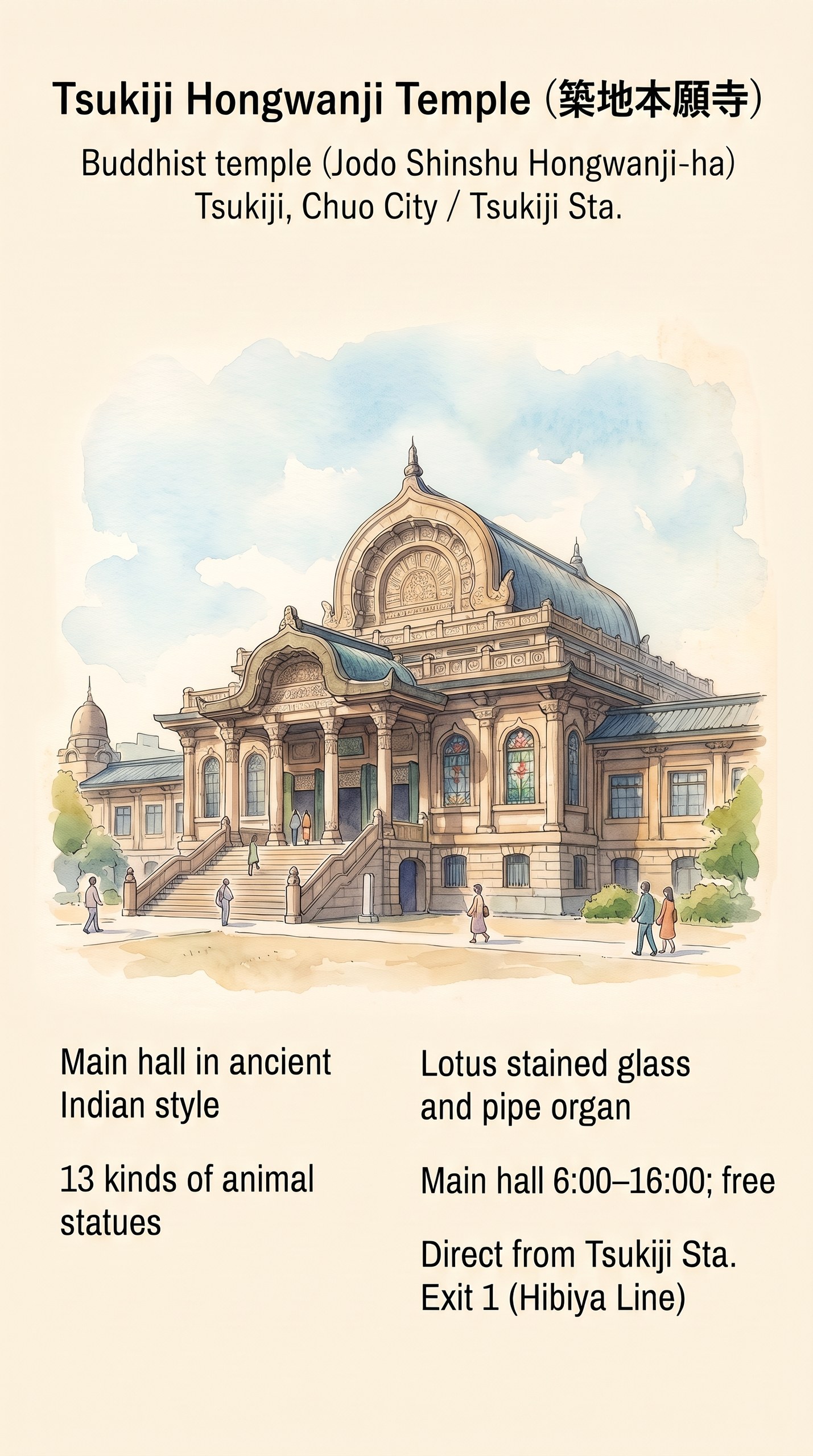
The current main hall was rebuilt in 1934 to a design by the architect Ito Chuta (伊東忠太), with an exterior modeled on the Buddhist architecture of ancient India and Asia. Many visitors are surprised that it looks so unlike a Japanese temple, and the design is said to have been possible because Otani Kozui (大谷光瑞), then the monshu (the head priest who leads the Hongwanji-ha), had a deep understanding of overseas cultures. The main hall, together with its gates and stone wall, is designated a national Important Cultural Property.
Highlights
The Main Hall Exterior and Its 13 Kinds of Animal Statues
The rounded roof takes the shape of a leaf of the bodhi tree (the tree under which the Buddha attained enlightenment), and the decoration on the front takes the shape of a lotus flower. Winged lions sit on both sides at the foot of the grand staircase in front of the main hall, and statues of cows, horses, birds, monkeys, elephants and other animals are placed on the stair railings, the roof and elsewhere. There are 13 kinds of animals in all, and why they were arranged this way is still said to be a mystery, so hunting for them as you walk around is part of the fun.
A Main Hall Where You Pray Sitting on Chairs
You enter the main hall with your shoes on and pray sitting on chairs, an arrangement that dates back to when the hall was built. The entrance has stained glass of lotus flowers, the ceiling inside is high, and a pipe organ is right above you as you step in. Many people feel that the hall, with its stained glass and organ, is like a church. When no events are on, the hall is nearly silent and smells of incense, and you can sit quietly on a chair.
Lunchtime Concerts and Dharma Talks in English
In principle, a free lunchtime concert on the pipe organ is held around midday on the last Friday of every month, and the main hall fills with people that day (check the temple’s official information for dates). On the evening of the last Saturday of every month, there is also a dharma talk on Buddhism in English (see the table for times).
Visit Commemoration Cards and Stamps
In keeping with Jodo Shinshu teachings, the temple does not offer goshuin (handwritten temple seals collected in a special book), omikuji fortunes or omamori amulets. Instead, you can receive a visit commemoration card and a commemorative stamp on the left side as you enter the main hall.
Night Illumination and Breakfast at the Cafe
The grounds are a wide, car-free stone-paved area, and the main hall is lit up every day after sunset (see the table for times). Cafe Tsumugi on the grounds serves the “18-item breakfast,” with small dishes, rice porridge and miso soup, in the morning, and window seats look out on the main hall. The breakfast is limited in number, a line often forms before opening, and it can sell out if you do not book.
Access and Opening Hours
Exit 1 of Tsukiji Station on the Tokyo Metro Hibiya Line connects directly to the grounds; take the station elevator up and the temple is right in front of you. It is also about a 5-minute walk from Exit 4 of Shintomicho Station on the Tokyo Metro Yurakucho Line, Exit 5 of Higashi-Ginza Station on the Toei Asakusa Line and Exit A1 of Tsukijishijo Station on the Toei Oedo Line. There is no parking for sightseeing; parking is only for people with business at the temple.
Opening hours for the grounds and main hall are in the table above; visiting is free with no reservation needed. Allow about 30 minutes to 1 hour to see the grounds and main hall. Wheelchair users enter not by the grand staircase at the front but through the entrance and elevator on the left side of the main hall.
When taking photos in the main hall, refrain from photographing during services or from directly in front of the principal image, and follow the guidance on site. On days with services or events you may not be able to enter the inner part of the main hall, and on some days worship and counters are partly suspended for temple events, so check the temple’s official notices. Preservation and repair work on the buildings is currently under way, and depending on the period, parts of the exterior may be covered or walkways and counters may be moved.
Best Time to Visit
Mornings are quiet with few people, and it gets busier from around noon. Many international visitors come too. After sunset you can see the main hall lit up.
Nearby Spots
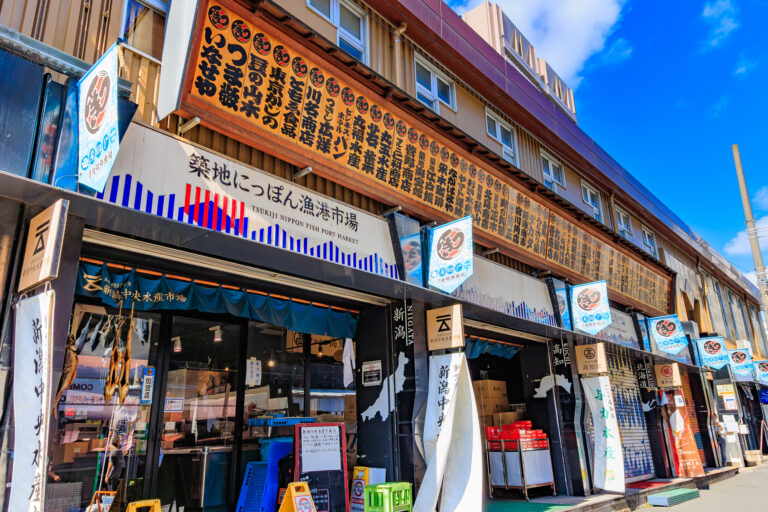
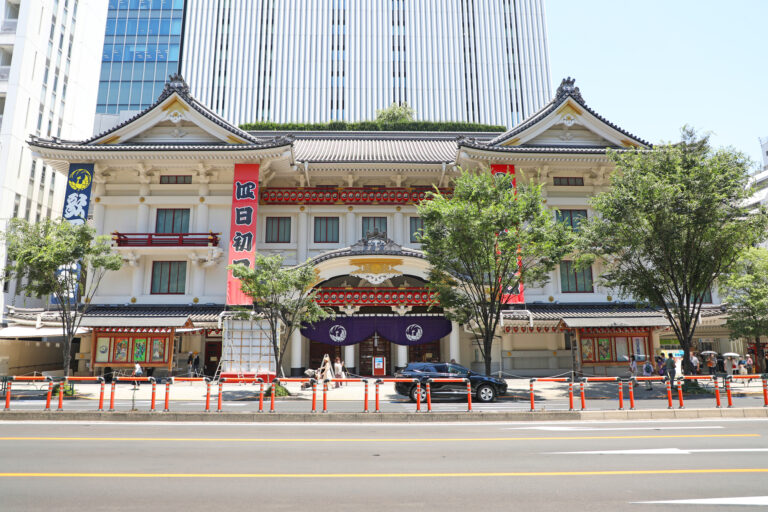
Tsukiji Outer Market (築地場外市場) is right next door, so you can walk around the market after breakfast or your visit. Higashi-Ginza Station is also the nearest station to the Kabukiza Theatre (歌舞伎座), so the temple combines well with a kabuki show.
Summary
Tsukiji Hongwanji Temple is a Jodo Shinshu temple known for its main hall, rebuilt in 1934 and modeled on the Buddhist architecture of ancient India and Asia. You pray sitting on chairs, and with a direct connection from Tsukiji Station you can visit in the morning together with Tsukiji Outer Market.
Basic Information
| Item | Details |
|---|---|
| Name | Tsukiji Hongwanji Temple (築地本願寺) |
| Address | 3-15-1 Tsukiji, Chuo City, Tokyo |
| Highlights | Main hall modeled on the Buddhist architecture of ancient India and Asia (Important Cultural Property) / 13 kinds of animal statues / lotus stained glass and pipe organ / night illumination |
| Things to do | Pray in the main hall sitting on chairs / lunchtime concert (in principle the last Friday of each month from 12:10, free) / dharma talk in English (last Saturday of each month from 17:30) / Cafe Tsumugi’s “18-item breakfast” |
| Hours | Grounds (gate) 6:00–21:00 / main hall 6:00–16:00 (main hall doors close after the evening service) |
| Closed | Open all year |
| Admission | Free (grounds and main hall) |
| Access | Tokyo Metro Hibiya Line Tsukiji Sta. Exit 1, direct connection / about 5 min walk from Tokyo Metro Yurakucho Line Shintomicho Sta. Exit 4, Toei Asakusa Line Higashi-Ginza Sta. Exit 5 or Toei Oedo Line Tsukijishijo Sta. Exit A1 |
| Parking | Only for people with business at the temple (no parking for sightseeing) |
| Phone | 0120-792-048 (contact center 9:00–17:00; toll-free number within Japan) |
| Official website | https://tsukijihongwanji.jp/ |
Information checked on November 26, 2026 (visiting hours of the Main Hall) / Official source checked: Tsukiji Hongwanji Temple official website
Google Map
Nearby sights

Right next door
About 5 min walk
About 12 min walk to Otemon Gate

Head on from Tokyo to Kamakura
From Tokyo Station, the JR Yokosuka Line reaches Kamakura in about 1 hour. Temples, shrines and the sea: discover the old capital in our Kamakura Travel Guide.