
AREA H
Kagurazaka, Korakuen & Kudan Area
From the stone-paved alleys of Kagurazaka and the shrines of Kudan
to Korakuen's amusement park, Yushima's Tenjin shrine and Akihabara.
- Starting station
- Iidabashi (飯田橋) (JR Chuo-Sobu Line local trains, Tokyo Metro Tozai, Yurakucho and Namboku lines, Toei Oedo Line), Kudanshita (九段下) (Tokyo Metro Tozai and Hanzomon lines, Toei Shinjuku Line), Suidobashi (水道橋) (JR Chuo-Sobu Line local trains, Toei Mita Line) and Korakuen (後楽園) (Tokyo Metro Marunouchi and Namboku lines), Yushima (湯島) (Tokyo Metro Chiyoda Line), Akihabara (秋葉原) (JR Yamanote, Keihin-Tohoku and Chuo-Sobu lines)
- Time needed (approx.)
- Half a day for Kagurazaka, Tokyo Daijingu and Yasukuni Shrine (add 1–1.5 hours for the Yushukan museum); 2–3 hours for Tokyo Dome City; half a day for Yushima Tenmangu and Akihabara Electric Town
- Neighboring area
- Ueno (上野) & Yanesen (谷根千) (about 10 min on foot from Yushima Tenmangu to Shinobazu Pond); Shinjuku (新宿) & Ikebukuro (池袋) (6 stops from Iidabashi to Shinjuku on JR Chuo-Sobu Line local trains); Tokyo Station, Marunouchi (丸の内) & Ginza (銀座) (2 stops from Kudanshita to Otemachi on the Tokyo Metro Tozai Line)
- Akihabara Electric Town
- Kagurazaka
- Tokyo Dome City
- Yushima Tenmangu Shrine
- Yasukuni Shrine
- Tokyo Daijingu Shrine
See on Toshi's Tokyo Sightseeing Map
Highlights of the area
The Kagurazaka, Korakuen and Kudan area centers on Iidabashi Station (飯田橋駅) beside the Sotobori (外堀), the old outer moat, and takes in Kagurazaka (神楽坂), climbing to the northwest, and Kudan (九段) to the south, as well as Korakuen (後楽園), Yushima (湯島) and Akihabara (秋葉原) to the east. Climbing northwest from the station, Kagurazaka is a hillside street that flourished from the early 20th century as a hanamachi (花街), a district where geisha entertained guests at ryotei, traditional restaurants with private rooms; one block off the main street, stone-paved alleys lined with black wooden fences hold ryotei and small shops. Halfway up the slope, Zenkokuji Temple (善國寺), known as "the Bishamon of Kagurazaka" after Bishamonten (毘沙門天), a Buddhist guardian figure believed to bring good fortune, is the landmark of the street. It belongs to the Nichiren school of Buddhism, which began with Nichiren (日蓮), a 13th-century monk who preached in Kamakura, the seat of Japan's first samurai government. Across the moat, Tokyo Daijingu Shrine (東京大神宮) enshrines the gods of Ise Jingu (伊勢神宮), the shrine regarded as the most sacred in Japan, and is where modern Shinto weddings began; at the top of the Kudan slope, Yasukuni Shrine (靖国神社) has a straight approach about 400 m long from a torii gate about 25 m tall to its worship hall.
One stop from Iidabashi on JR Chuo-Sobu Line local trains, Suidobashi is home to Tokyo Dome City (東京ドームシティ), built around the Tokyo Dome stadium, where an amusement park with free entry has a roller coaster that threads through the hollow center of a Ferris wheel. Next door to the west are Koishikawa Korakuen Gardens (小石川後楽園), begun in the early 17th century as the estate garden of the Mito Tokugawa family, a branch of the family of shoguns who ruled Japan from Edo. On a hilltop in Yushima to the east, Yushima Tenmangu Shrine (湯島天満宮) enshrines Sugawara no Michizane (菅原道真), a 9th-century scholar worshipped as the god of learning, and is known for its white plum blossoms; walk south from there and you reach Akihabara Electric Town (秋葉原電気街), which grew from radio-parts stalls after World War II into a district of electronics, anime and game shops. Quiet shrine grounds in the morning, Kagurazaka's alleys and Akihabara's specialty stores by day, and the lights of Tokyo Dome City after dark: you can choose where to walk by the time of day.
Example route (1 day)
- Morning: from Exit 1 of Kudanshita Station, walk uphill about 5 min → Yasukuni Shrine (fewer visitors early in the morning and before noon)
- Walk about 10 min from the North Gate → Tokyo Daijingu Shrine (weekday mornings are usually quieter)
- Cross the moat and walk about 6 min → Kagurazaka (walk the main street and the alleys, and have lunch)
- 1 stop on JR Chuo-Sobu Line local trains from Iidabashi to Suidobashi → Tokyo Dome City (rides are lit up from early evening, with night views from the Big-O Ferris wheel)
Yushima Tenmangu Shrine and Akihabara Electric Town make a separate half day: from Korakuen Station it is 1 stop on the Tokyo Metro Marunouchi Line to Hongo-sanchome Station (本郷三丁目駅), then about 10 min on foot to the shrine, and from the shrine about 15 min on foot to Akihabara. Many of Akihabara's parts shops close in the early evening, and on Sunday afternoons Chuo-dori Avenue becomes a pedestrian zone. Distances and times depend on how often you stop.
Sightseeing spots
Akihabara Electric Town (秋葉原電気街)
A town of electronics and anime
that began with radio-parts stallsAn electronics district that began after World War II, when stalls selling radio parts gathered here and moved under the railway tracks by the station. Buildings along Chuo-dori Avenue are filled with shops for home electronics, anime, games and figures, while tiny electronic-parts shops crowd together under the tracks. On Sunday afternoons Chuo-dori becomes a pedestrian zone. Right outside the Electric Town Gate of JR Akihabara Station.
Approx. 2–3 hours / no booking needed (many parts shops close in the early evening)
Kagurazaka (神楽坂)
A former geisha district
of stone-paved, black-fenced alleysA slope climbing northwest from near Iidabashi Station, and the streets around it. From the early 20th century it flourished as a hanamachi (花街), a geisha district of traditional restaurants, and one block off the main street you find stone-paved alleys with black wooden fences, such as Hyogo Yokocho (兵庫横丁) and Kakurenbo Yokocho (かくれんぼ横丁). Halfway up the slope stands Zenkokuji Temple (善國寺), known as "the Bishamon of Kagurazaka." The foot of the slope is a short walk from the West Exit of JR Iidabashi Station, and Kagurazaka Station on the Tokyo Metro Tozai Line is near the top.
Approx. 1–2 hours / no booking needed (the main street is car-free at set times around midday)
Tokyo Dome City (東京ドームシティ)
A roller coaster that threads
through a hollow Ferris wheelAn entertainment district around Tokyo Dome with an amusement park, a spa and a hotel, once known as Korakuen Amusement Park (後楽園ゆうえんち). Entry to the park, Tokyo Dome City Attractions, is free, and you pay only for the rides you choose. The Thunder Dolphin roller coaster runs through the ring of Big-O, a Ferris wheel with a hollow center. Right by JR Suidobashi Station and Tokyo Metro Korakuen Station.
Approx. 2–3 hours / no booking needed (opening hours and pass prices vary by day)

Yushima Tenmangu Shrine (湯島天満宮)
A hilltop shrine to the god of learning,
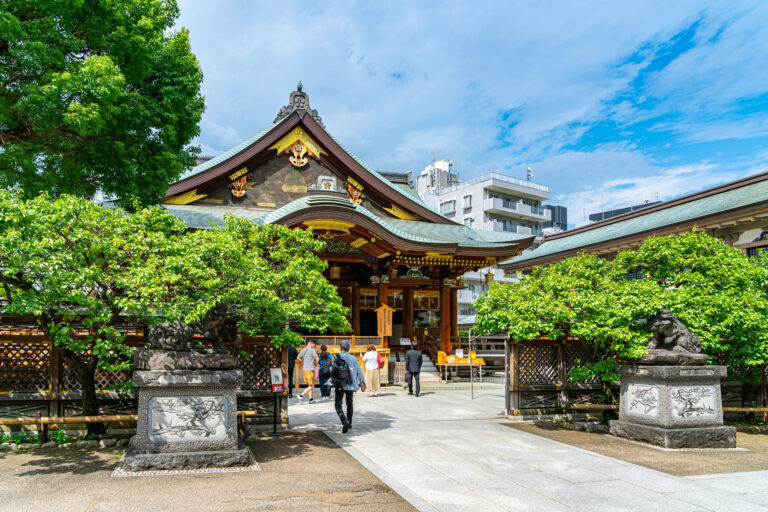
ringed by white plumA hilltop shrine in Yushima, also called Yushima Tenjin, that enshrines Sugawara no Michizane (菅原道真), a 9th-century scholar and statesman worshipped as the god of learning. Ema (絵馬), wooden prayer plaques wishing for exam success, hang in thick layers, and the plum garden of about 300 trees, mostly white, usually blooms from mid-February to early March. You climb to the grounds by the steep Otokozaka (男坂) or the gentler Onnazaka (女坂) steps. About 2 min on foot from Exit 3 of Yushima Station (Tokyo Metro Chiyoda Line).
Approx. 30 min–1 hour / no booking needed (crowded on plum-festival holidays and in exam season)
Yasukuni Shrine (靖国神社)
From a giant torii on the Kudan hilltop,
a straight approach to the worship hallA Shinto shrine founded in 1869 that honors people who died in Japan's wars and conflicts from the 1860s to World War II. A straight approach about 400 m long runs from the First Torii, a gate about 25 m tall, to the worship hall, and behind the hall to the right stands the Yushukan (遊就館), the shrine's museum, which displays personal belongings, a Zero fighter plane and more. In autumn the ginkgo trees along the approach and the maples of the Shinchi Garden (神池庭園) change color. About 5 min on foot from Exit 1 of Kudanshita Station to the First Torii.
Approx. 30 min–1 hour (2–2.5 hours with the Yushukan) / no booking needed to worship (closing time varies by season)
Tokyo Daijingu Shrine (東京大神宮)
The Iidabashi shrine to Ise's gods
where Shinto weddings beganA shrine built in Hibiya in 1880 so that people in Tokyo could worship the gods of Ise Jingu (伊勢神宮), the shrine regarded as the most sacred in Japan; it is known as "the Ise of Tokyo." Modern Shinto weddings, now common across Japan, began here, and many visitors come to pray for a good match. Some come for the love fortunes and the suzuran mamori (鈴蘭守), a lily-of-the-valley charm, others to look for the heart-shaped inome (猪目) motifs on the shrine gate. About 5 min on foot from Iidabashi Station.
Approx. 30 min (1 hour if you also get a fortune or a goshuin seal) / no booking needed to worship
Other spots in this area
- Koishikawa Korakuen Gardens (小石川後楽園) … A daimyo (feudal lord) garden begun in the early 17th century as the estate garden of the Mito Tokugawa family and continued by the second lord, Tokugawa Mitsukuni (徳川光圀), with paths that circle a pond. It is a nationally designated Special Historic Site and Special Place of Scenic Beauty. Next to Tokyo Dome City; about 2 min on foot from Iidabashi Station (Toei Oedo Line)
- Kanda Myojin Shrine (神田明神) … A shrine once regarded as the guardian of all of Edo, old Tokyo. Its Kanda Matsuri (神田祭) festival in May is one of the three great festivals of Edo, and the Akihabara electronics district is among the neighborhoods it protects. About 7 min on foot from the Electric Town exit of JR Akihabara Station
- Chidorigafuchi (千鳥ヶ淵) … One of the inner moats of the Imperial Palace, lined by the Chidorigafuchi Greenway, about 700 m long, where cherry trees blossom in spring. From spring to autumn you can also rent rowing boats on the moat (closed Mondays). About 5–10 min on foot from Exit 2 of Kudanshita Station

Head on from Tokyo to Kamakura
From Iidabashi, the JR Chuo-Sobu Line, Chuo Line Rapid and Yokosuka Line reach Kamakura in about 1 hour 20 minutes. Change to the Chuo Line Rapid at Ochanomizu and to the Yokosuka Line at Tokyo Station. Temples, shrines and the sea: discover the old capital in our Kamakura Travel Guide.