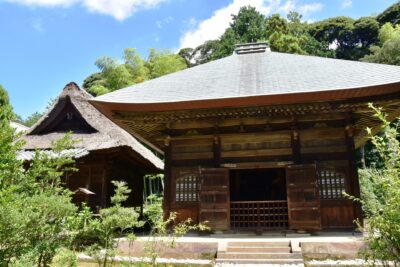
Jorakuji Temple (常楽寺)
What Is Jorakuji Temple? | History and Origins
Jorakuji Temple (常楽寺) is a Zen temple of the Rinzai school, Kenchoji branch, set in a residential neighborhood of Ofuna (大船) in Kamakura. It began in the first half of the 13th century as Awafune Mido (粟船御堂), a hall that Hojo Yasutoki (北条泰時), the third regent of the Kamakura shogunate, built to honor the memory of his wife’s mother. After Yasutoki died, the temple took its name from his posthumous Buddhist name, Jorakuji-dono. The hill behind the temple is called Awafune-yama (粟船山). Tradition says the name comes from boats loaded with millet (awa) that once came this far inland, and “awafune” is also said to be the origin of the place name Ofuna.
In the mid-13th century, the Chinese Zen master Rankei Doryu (蘭渓道隆), who came to Japan from Song China, lived at Jorakuji until Kenchoji Temple (建長寺) was built. A temple record, the Awafunezan Jorakuji Ryakki (粟船山常楽寺略記), states that Hojo Masako (北条政子) founded the temple to pray for her daughter Ohime (大姫) and Ohime’s betrothed, Minamoto no Yoshitaka (源義高), also known as Kiso Yoshitaka.
Highlights | Thatched Gate, Buddha Hall and Monjudo Hall
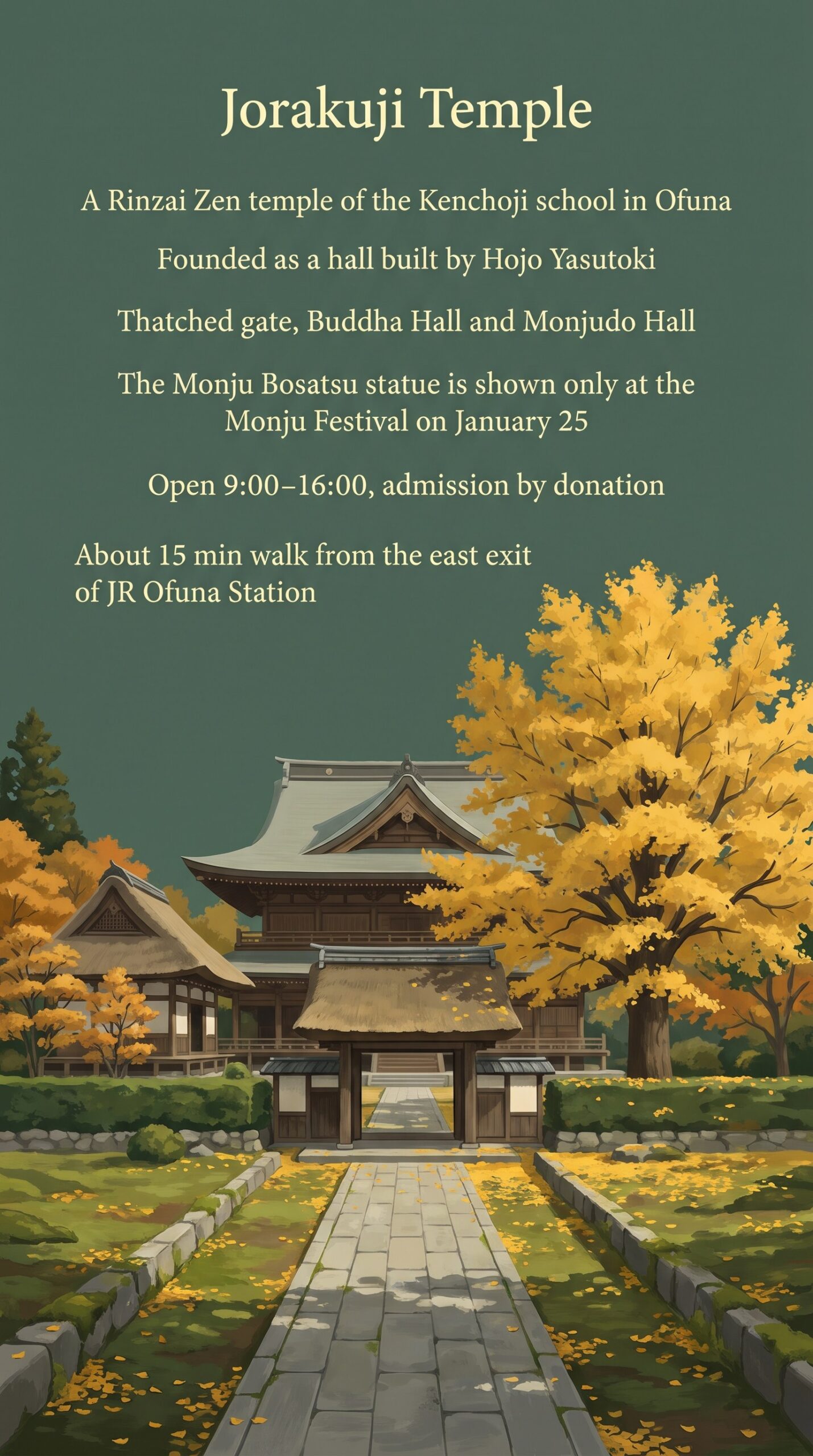
The highlights of Jorakuji are the straight approach running from the thatched-roof Sanmon gate (山門) to the Buddha Hall, and the two halls at its end: the Butsuden (仏殿, Buddha Hall) and the Monjudo Hall (文殊堂). The gate is a Kamakura City designated cultural property, and visitors normally enter through a side gate.
The Butsuden, a Kanagawa Prefecture Important Cultural Property, enshrines the principal image, Amida Nyorai (阿弥陀如来), flanked by Kannon and Seishi (勢至) bodhisattvas. Visitors cannot go inside but can view the triad through the front doors. The ceiling bears a dragon painting said to be by Kano Yukinobu (狩野雪信).
The thatched Monjudo Hall to the left of the Butsuden was moved here in the early Meiji period from Eishoji Temple (英勝寺) in Ogigayatsu (扇ガ谷), and in front of it stands a large ginkgo said to have been planted by the founding priest. Behind the Butsuden is a stone monument said to be the grave of Hojo Yasutoki. To reach the Kiso-zuka (木曽塚), said to be Yoshitaka’s grave on the hill behind the temple, you leave the grounds and climb a slope.
Cultural Significance
Because Rankei Doryu lived here before Kenchoji was founded, Jorakuji has long been regarded as “the root of Kenchoji.” The wooden seated statue of Monju Bosatsu (文殊菩薩, Manjusri) in the Monjudo is a hidden Buddha and a Kanagawa Prefecture Important Cultural Property, unveiled only on January 25 at the Monju Festival at Jorakuji Temple. The temple bell, a National Important Cultural Property, is on deposit at the Kamakura Museum of National Treasures (鎌倉国宝館).
Access and Opening Hours
Jorakuji is about a 15-minute walk from the east exit of JR Ofuna Station (大船駅), and you can also take a bus from the station to the “Jorakuji” stop. From Toshi’s Place, take the Enoden from Hase Station (長谷駅) or Wadazuka Station (和田塚駅) to Kamakura Station (鎌倉駅), then the JR Yokosuka Line to Ofuna. The temple is open from 9:00 to 16:00, and admission is by donation.
Goshuin (御朱印), the temple’s handwritten seal, can be received at the temple office on the right side of the approach.
Best Time to Visit
Jorakuji can be visited all year round; ginkgo leaves color the grounds in autumn and plum trees bloom in winter. The Monju statue is unveiled only on January 25, the day of the Monju Festival. The grounds are not large, and despite being in a residential area they are quiet, with few visitors.
Staying at Toshi’s Place, you can spend a relaxed morning at your lodging before heading to Ofuna and walk the quiet approach soon after the 9:00 opening. As the inn offers room only, you are free to fit in a meal in Ofuna after your visit.
Nearby Attractions | Exploring from Ofuna Station
Jorakuji lies between JR Ofuna Station and Kita-Kamakura Station (北鎌倉駅). On the west side of Ofuna Station is Ofuna Kannonji Temple (大船観音寺). With Ofuna Station as your base, you can combine Jorakuji with other temples and sights in the Ofuna area.
Recommended For | Those Tracing the History of the Hojo Clan
Jorakuji suits travelers who want to visit a temple linked to Hojo Yasutoki and Rankei Doryu, walk quietly through grounds with thatched gates and halls, or learn about the story of Ohime and Yoshitaka.
Summary
Jorakuji began as a hall built by Hojo Yasutoki and later became home to Rankei Doryu before Kenchoji was founded. The approach from the thatched gate to the Buddha Hall, the Amida triad seen through the doors, the Monjudo Hall and Yasutoki’s grave are all gathered within a quiet corner of residential Ofuna. With Toshi’s Place as your base, you can travel out to Ofuna with time to spare and visit at a relaxed pace.
Basic Information
| Item | Details |
|---|---|
| Name | Jorakuji Temple (常楽寺) |
| Address | 5-8-29 Ofuna, Kamakura, Kanagawa |
| Highlights | Thatched Sanmon gate, Butsuden (Amida triad, dragon ceiling painting), Monjudo Hall, large ginkgo tree, grave of Hojo Yasutoki, Kiso-zuka |
| Things to do | Worship, goshuin |
| Opening hours | 9:00–16:00 |
| Suggested time | About 30 minutes (quick 20 min / thorough 45 min) |
| Admission | By donation |
| Notes | You cannot enter the Butsuden (view through the doors). The Monju statue is unveiled only on January 25 (Monju Festival). The bronze bell is kept at the Kamakura Museum of National Treasures. |
| Phone | 0467-46-5735 |
| Official site | https://www.trip-kamakura.com/facility/detail.php?id=43 (Kamakura City Tourism Association) |
Google Map
Nearby Attractions


Upcoming Events at Jorakuji Temple
Upcoming events at Jorakuji Temple, listed by date.
- Monju Festival (文殊祭) Festivals & Rites Mon, Jan 25, 2027, 2:00 PM
A Buddhist service at Jorakuji Temple in Ofuna where the hidden wooden seated statue of Monju Bosatsu (Manjusri) is unveiled once a year and honored.