Kato Kiyomasa Grand Festival at Myohoji Temple (妙法寺 加藤清正公大祭)
- Next
- Wed, May 5, 2027, 9:30 AM – 4:30 PM
- Usually
- May 5, sutra reading in the Daikakuden from 9:30. Victory charm on this day only, limited number
- Venue
- Myohoji Temple
What Is the Kato Kiyomasa Grand Festival at Myohoji Temple?
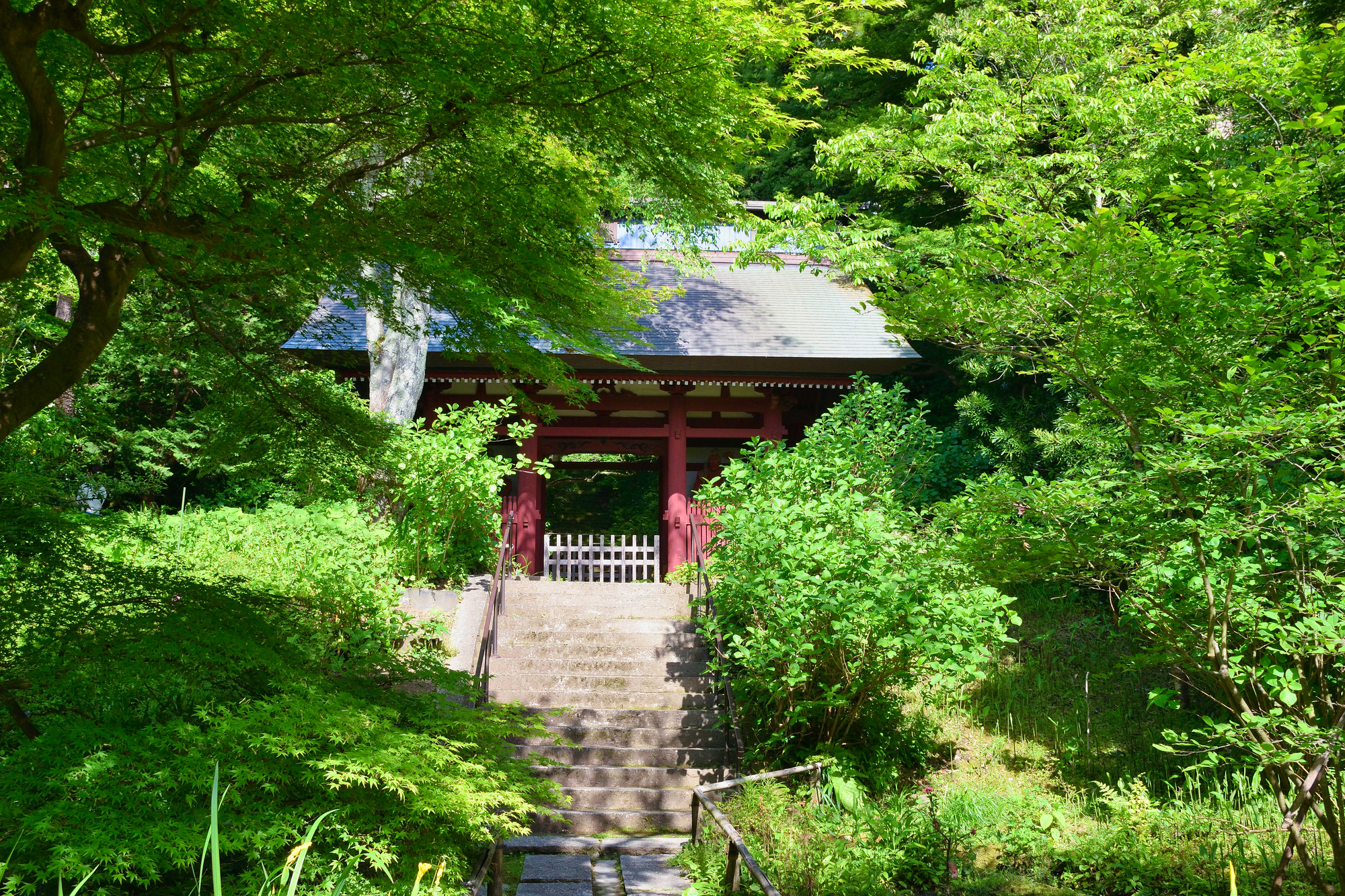
The Kato Kiyomasa Grand Festival (加藤清正公大祭) is a Buddhist memorial service held every year on May 5 at Myohoji Temple (妙法寺) in the Omachi (大町) district of Kamakura. Myohoji is a temple of the Nichiren (日蓮) school of Buddhism, also called Kokedera (苔寺), the “Moss Temple,” for its moss-covered stone steps. The service honors Kato Kiyomasa (加藤清正), a samurai general of the late 16th and early 17th centuries who became the first lord of the Kumamoto (熊本) domain in Higo (肥後), today’s Kumamoto Prefecture in Kyushu, and built Kumamoto Castle (熊本城). He was a devout follower of Nichiren Buddhism and has long been affectionately called Seishoko (清正公). The service takes place in the Daikakuden (大覚殿), a small hall on the temple grounds, and on this day only, the temple gives out the Seishoko Kachimamori (清正公勝守), a “victory charm” wrapped together with leaves of shobu (菖蒲), Japanese iris. May 5 is Tango no Sekku (端午の節句), the traditional Boys’ Day festival now celebrated as Children’s Day. The Kamakura City Tourist Association lists it as the Seishoko-sai (清正公祭).
Date and Time
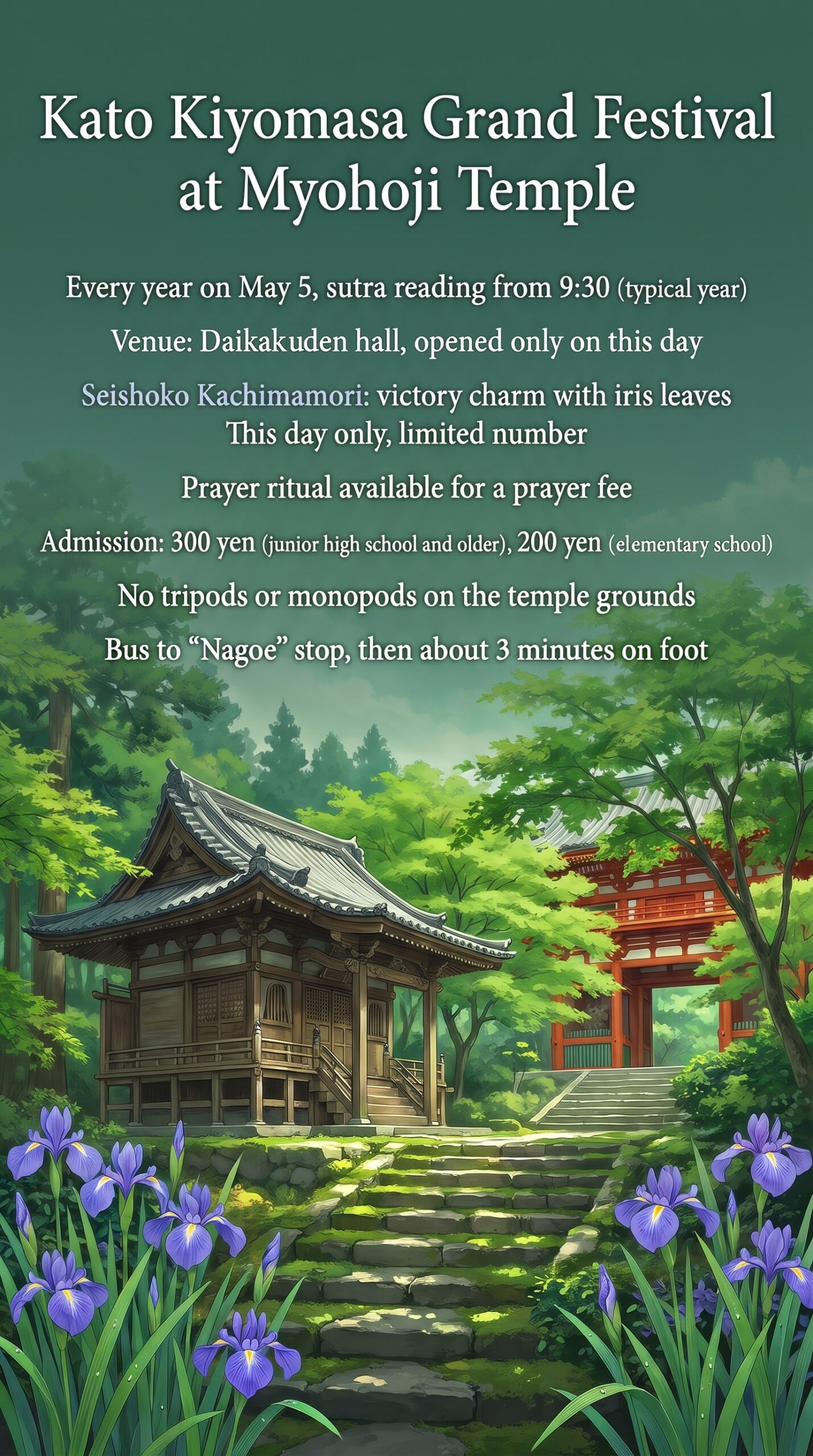
The festival is held every year on May 5, Children’s Day, whatever the day of the week. In a typical year, the sutra reading in the Daikakuden starts in the morning, and the victory charm is given out at the reception desk from around the same time. The start time is listed in the Basic Information table below. On the same day, May 5, the Shobu Festival at Tsurugaoka Hachimangu Shrine (鶴岡八幡宮 菖蒲祭) and the Kusajishi Archery Ritual at Kamakura-gu Shrine (鎌倉宮 草鹿神事) are also held.
Highlights: The Hall Opened Only on This Day and the Iris Victory Charm
The doors of the Daikakuden, usually kept closed, are opened on this day. Inside, a statue of Shaka Nyorai (釈迦如来), the historical Buddha, stands in the center, Myoho Inari Daimyojin (妙法稲荷大明神), a deity of the Inari faith, associated with good harvests and prosperity, worshipped at the temple, is enshrined on the left as you face the altar, and a seated statue of Kato Kiyomasa is on the right. The sutra reading is held quietly, mainly for the temple’s parishioners and followers; this is not a festival with food stalls.
Visitors can receive the Seishoko Kachimamori at the reception desk, and those who pay a prayer fee can also receive a gokito (御祈祷), a prayer ritual performed by the priests, inside the Daikakuden. The charm is wrapped long and slim in white paper, with green iris leaves sticking out of the top, and only a limited number are prepared. A special goshuin (御朱印), the temple’s handwritten seal stamp, is sometimes offered on this day only.
About Myohoji Temple and the Daikakuden
The Daikakuden is a small tile-roofed hall on the right side of the path that leads from the Hondo (本堂), the main hall, toward the Niomon (仁王門), the temple gate guarded by two Nio guardian statues. Kiyomasa and Myohoji are linked by their shared Nichiren faith and through the Hosokawa (細川) family, the lords who ruled Kumamoto after the Kato family. According to temple tradition, the statue of Kiyomasa inside was once enshrined in the main keep of Kumamoto Castle and was donated by the Hosokawa family. Myohoji was supported by the Hosokawa family during the Edo period, when the Tokugawa shoguns ruled Japan, and the present main hall was also built by them in the late Edo period. Every September 12, the same temple holds the Ginger Offering to Ward Off Misfortune at Myohoji Temple (妙法寺 厄除け生姜供養).
Visiting Tips
The usual admission fee is required to enter the temple grounds, and tripods and monopods may not be used on the grounds. In early May, Myohoji is in its season of fresh green leaves. The mossy stone steps beyond the Niomon gate are closed to walkers to protect the moss, but you can climb the stone stairs beside them to the Hokkedo (法華堂) hall and the hilltop.
Access: Visiting During Your Stay at Toshi’s Place
From the bus terminal at the East Exit of Kamakura Station (鎌倉駅) on the JR and Enoden (江ノ電) lines, take a bus bound for the Nagoe (名越) area and get off at the Nagoe stop; the temple is about a 3-minute walk from there. It is about a 15-minute walk from the East Exit of Kamakura Station.
If you stay near Hase Station (長谷駅) or Wadazuka Station (和田塚駅) on the Enoden line, you can ride the Enoden to Kamakura Station and arrive in time for the morning sutra reading. At Toshi’s Place, fully unstaffed smart hotels with full kitchens and no meals provided, you can explore Kamakura’s events at your own pace.
Summary
The Kato Kiyomasa Grand Festival at Myohoji Temple is a memorial service for Kato Kiyomasa held every year on May 5 in the Daikakuden, and on this day only, the temple gives out the victory charm wrapped with iris leaves. For the usual highlights of the temple known for its mossy stone steps, see Myohoji Temple (妙法寺).
Basic Information
| Item | Details |
|---|---|
| Name | Kato Kiyomasa Grand Festival at Myohoji Temple (Seishoko-sai) |
| Date | May 5 every year |
| Hours | Sutra reading from 9:30 (typical year) |
| Venue | Daikakuden hall, Myohoji Temple |
| Address | 4-7-4 Omachi, Kamakura, Kanagawa 248-0007 |
| What happens | Memorial service for Kato Kiyomasa, victory charm given out (this day only, limited number), prayer ritual (prayer fee required) |
| Admission | 300 yen for junior high school students and older, 200 yen for elementary school students (usual admission fee) |
| Temple hours | 9:30–16:30 |
| Notes | No tripods or monopods on the grounds. The mossy stone steps are closed to walkers |
| Access | From the East Exit of JR and Enoden Kamakura Station, bus to Nagoe (名越), then about 3 minutes on foot. About 15 minutes on foot from the East Exit of Kamakura Station |
| Contact | Myohoji Temple +81-467-22-5813 |
| Reference | Myohoji Temple, Kamakura City Tourist Association (Japanese) |