
Special Opening of the Former Watsuji Residence
- Dates
- Sat, Oct 31, 2026 – Tue, Nov 3, 2026
- Usually
- Held separately from the free spring and autumn openings, alongside an exhibition.
- Venue
- Kamakura City Kawakita Film Museum
What Is the Special Opening of the Former Watsuji Residence?
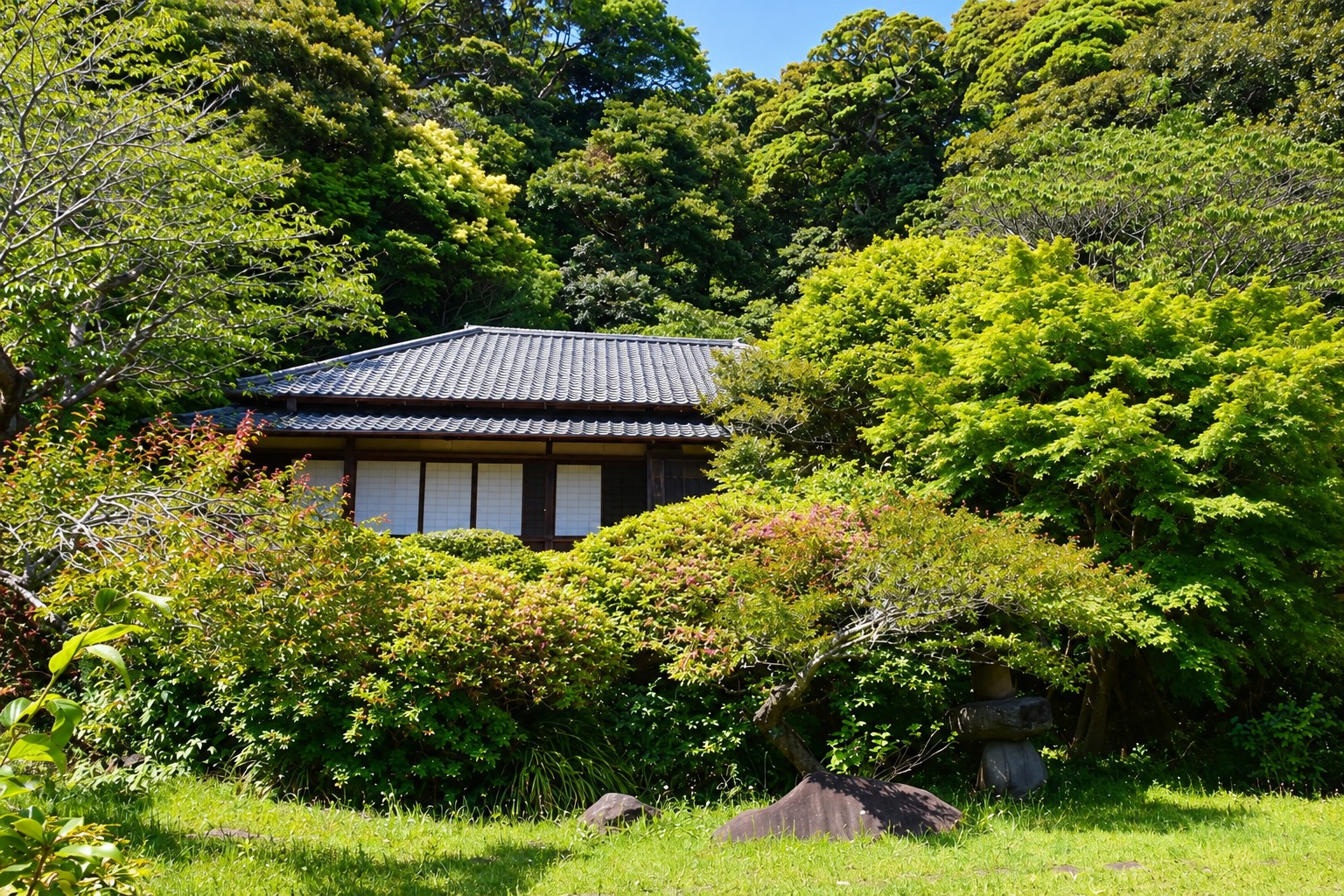
The Former Kawakita Residence Annex (旧川喜多邸別邸) is an old farmhouse standing at the back of the grounds of the Kamakura City Kawakita Film Museum (鎌倉市川喜多映画記念館). Because the philosopher Tetsuro Watsuji (和辻哲郎) once lived in it, it is also called the Former Watsuji Residence (旧和辻邸). It is normally closed to the public. Besides the free openings in spring and autumn, it holds paid special openings combined with an exhibition. During a special opening, you can take off your shoes, step inside the house and walk through it as far as Watsuji’s study.
Dates and Admission
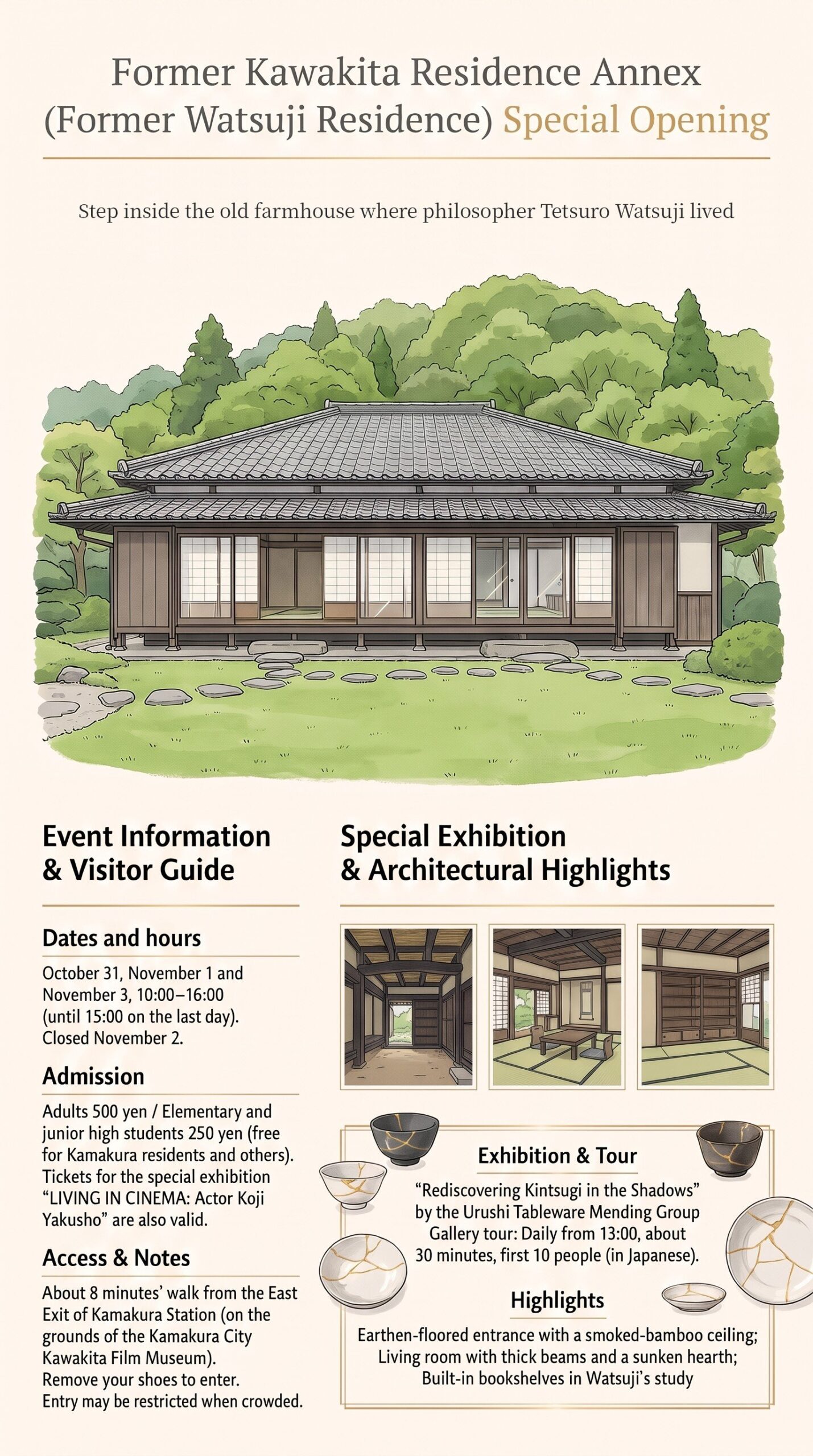
In 2026, the special opening is held on three days: October 31 (Sat), November 1 (Sun) and November 3 (Tue, national holiday). The museum is closed on November 2 (Mon). Hours are 10:00 a.m. to 4:00 p.m., and until 3:00 p.m. on November 3 only.
Admission is 500 yen for adults and 250 yen for elementary and junior high school students. Tickets for the museum’s special exhibition “LIVING IN CINEMA: Actor Koji Yakusho” are also valid. Admission is free for Kamakura residents, holders of a disability certificate and one caregiver, elementary and junior high school students attending school in Kamakura, and members of the museum’s Friends association. According to visitors, you pay at the museum’s reception and then walk on to the annex behind it.
Highlights: Kintsugi Tableware Inside an Old Farmhouse
Alongside the opening, the exhibition “Rediscovering Kintsugi in the Shadows” (陰翳の中で金繕いを再発見する。) is held by the Urushi Tableware Mending Group (漆で器を繕う会). Kintsukuroi (金繕い), also known as kintsugi, is the technique of mending broken or chipped tableware with urushi lacquer and finishing the seams with gold. The exhibition is co-organized by the Kawakita-KBS Group (川喜多・KBSグループ). A gallery tour of about 30 minutes, in Japanese, starts at 1:00 p.m. every day and is open to the first 10 people. The exhibited pieces are not for sale.
The entrance is built like an old farmhouse, and right inside is the doma (土間), an earthen-floored entrance area. Its ceiling uses susudake (煤竹), bamboo darkened by smoke from the days when the house had a thatched roof. Thick beams and pillars support the doma and the living room, and a ro (炉), a sunken hearth, is cut into the corner of the living room, with a table and chairs set on the tatami. A kitchen lies at the back of the doma. The tatami room Watsuji used as his study still has its built-in bookshelves.
About the Former Watsuji Residence
The house is a farmhouse from the Edo period. It originally stood elsewhere in Kanagawa Prefecture and was moved to Nerima (練馬) in Tokyo in 1938, where it became Watsuji’s home. In 1961, after Watsuji’s death, Nagamasa and Kashiko Kawakita (川喜多長政・かしこ), who devoted themselves to importing and introducing films, moved it to Kamakura and used it to welcome film directors and actors visiting from abroad.
The roof, once thatched, is now a hipped roof covered with sangawara (桟瓦) tiles, on a single-storey wooden house. It stands on raised ground reached by a garden path from the front of the museum, and its tiled roof forms a single view with the hills of the yato (谷戸), a narrow valley, behind it. In 2010 it became the first building in Kamakura to be designated a Landscape Important Building (景観重要建造物).
Visiting Notes
You take off your shoes to go inside the house. Entry may be restricted when it is crowded, and the opening may be cancelled in bad weather.
Access: Visiting During Your Stay at Toshi’s Place
From the East Exit of JR and Enoden Kamakura Station (鎌倉駅), walk about 8 minutes along Komachi Street (小町通り) toward Tsurugaoka Hachimangu Shrine (鶴岡八幡宮) to the Kawakita Film Museum, then go on to the back of the grounds. There is no parking, so please come by train or bus.
The museum sits on a quiet street just off Komachi Street, so you can drop by on your way to Tsurugaoka Hachimangu or while strolling along Komachi Street. If you stay in Kamakura, you can visit in the morning and take your time inside the old house. At Toshi’s Place, fully unmanned smart hotels with full kitchens and no meals, you can explore Kamakura at your own pace.
Summary
The special opening of the Former Watsuji Residence is a chance to step inside the old farmhouse where Tetsuro Watsuji lived and where the Kawakitas hosted filmmakers from abroad, and to see its doma, the living room with its hearth, and the study. For the museum’s year-round highlights, see Kamakura City Kawakita Film Museum.
Basic Information
| Item | Details |
|---|---|
| Name | Former Kawakita Residence Annex (Former Watsuji Residence) Special Opening |
| Dates | Held on days separate from the spring and autumn free openings (October 31, November 1 and November 3 in 2026; closed November 2) |
| Hours | 10:00 a.m. – 4:00 p.m. (until 3:00 p.m. on the last day) |
| Admission | Adults 500 yen, elementary and junior high students 250 yen (free for Kamakura residents and others) |
| Venue | Former Kawakita Residence Annex (on the grounds of the Kamakura City Kawakita Film Museum) |
| Address | 2-2-12 Yukinoshita, Kamakura, Kanagawa |
| Access | About 8 minutes’ walk from the East Exit of Kamakura Station (JR and Enoden) |
| Contact | Kamakura City Kawakita Film Museum +81-467-23-2500 |
| Official website | Kawakita Film Museum special opening notice (Japanese) |