Goryo Shrine Annual Festival and Menkake Gyoretsu (御霊神社例祭と面掛行列)
- Next
- Sat, Sep 18, 2027, 12:00 PM – 3:30 PM
- Usually
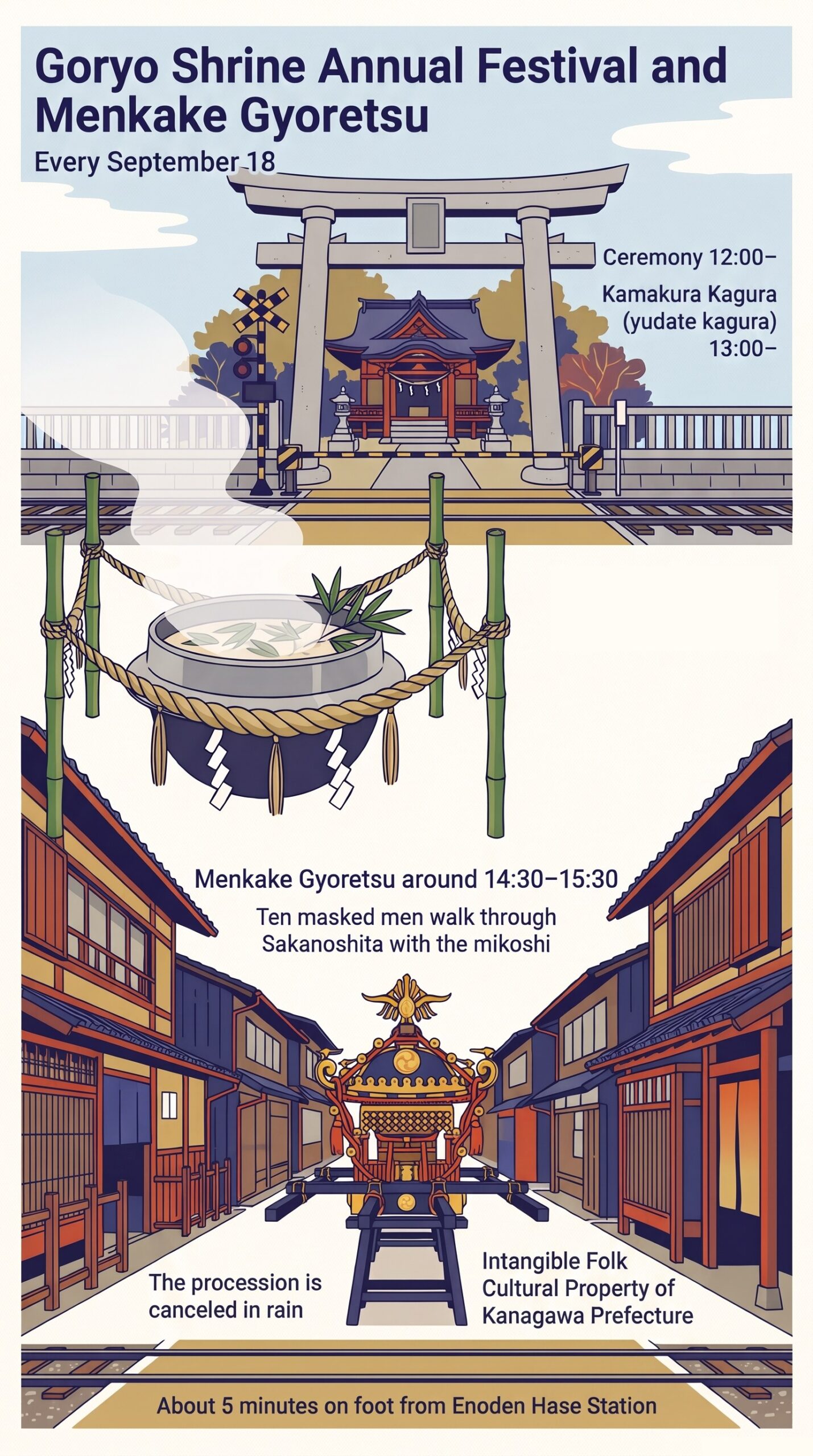
- September 18. Ceremony from 12:00, Kamakura Kagura from 13:00, Menkake Gyoretsu around 14:30–15:30 (procession canceled in rain)
- Venue
- Goryo Shrine
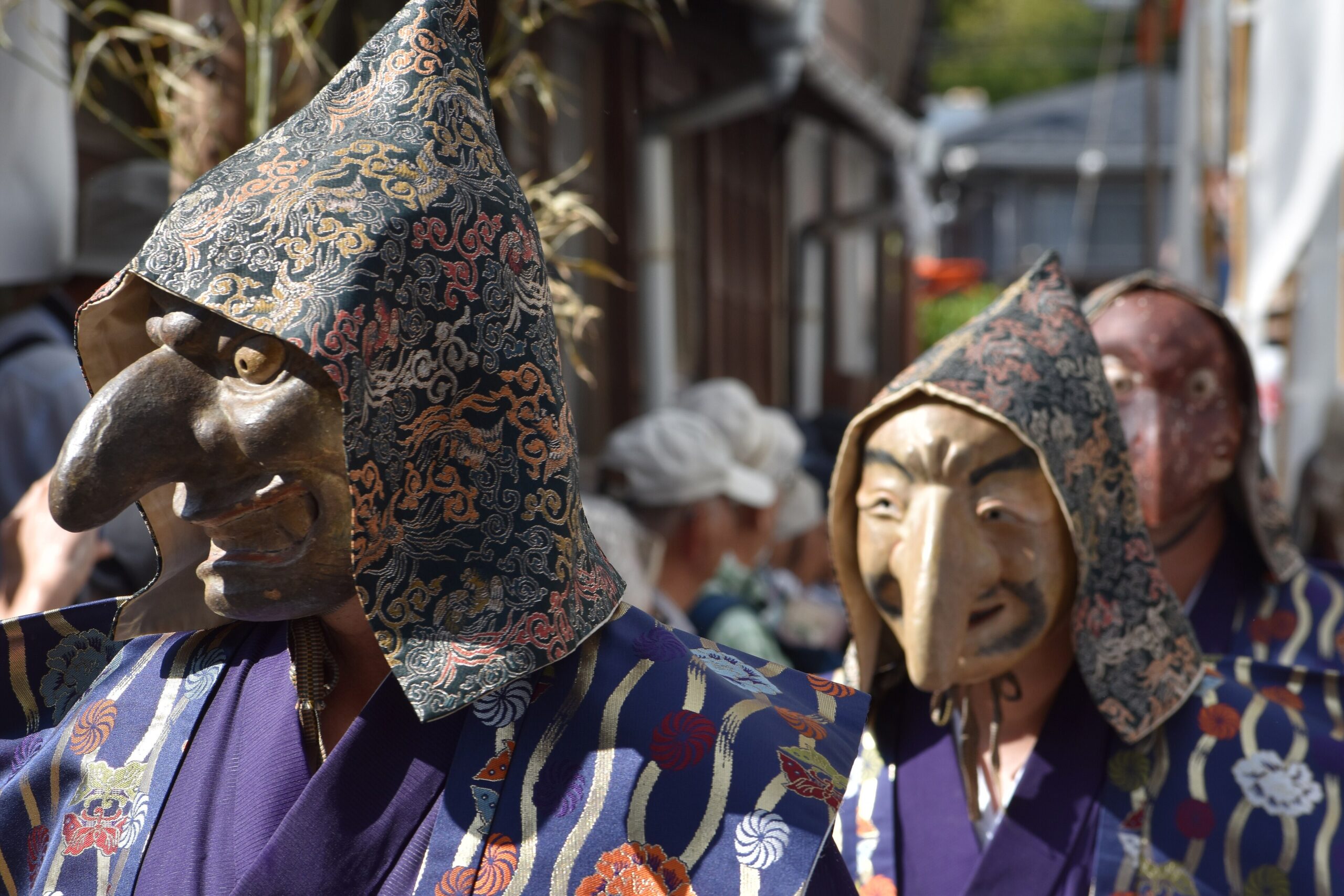
Photo: Fred Cherrygarden / CC BY-SA 4.0
What Is the Goryo Shrine Annual Festival and Menkake Gyoretsu?
The annual festival of Goryo Shrine (御霊神社) is held every year on September 18, the date traditionally given as the death anniversary of the shrine’s deity, Kamakura Gongoro Kagemasa (鎌倉権五郎景政). The shrine stands in the Sakanoshita (坂ノ下) neighborhood. On festival day, Kamakura Kagura (鎌倉神楽), a form of sacred dance and music, is offered in the shrine grounds, and then a mikoshi (portable shrine) is carried through the neighborhood. Walking with the mikoshi is the Menkake Gyoretsu (面掛行列), a procession of ten men wearing masks. It is designated an Intangible Folk Cultural Property of Kanagawa Prefecture.
The Menkake Gyoretsu is said to have originally taken part in the festival procession of Tsurugaoka Hachimangu Shrine (鶴岡八幡宮) before moving to Goryo Shrine. It has not been held at Tsurugaoka Hachimangu since the Meiji era. The masks follow the tradition of gigaku (伎楽), a masked drama of the Nara period, and bear an inscription from the late 18th century. They are designated Tangible Folk Cultural Properties of Kamakura City and are usually kept in the shrine’s storehouse. The procession is handed down by the local Kamakura Sakanoshita Goryokai (鎌倉市坂ノ下御霊会).
Date and Time
The festival is held every year on September 18. In a typical year, the ceremony begins at 12:00 and Kamakura Kagura is performed from 13:00. The Menkake Gyoretsu sets out around 14:30 and walks through the neighborhood until around 15:30. The Menkake Gyoretsu is canceled in case of rain. The shrine does not take inquiries on festival day.
Highlights
Kamakura Kagura is also called yudate kagura (湯立神楽), a kagura performed around a cauldron of boiling water. Twelve pieces are performed in a space on the east side of the shrine buildings, marked off by green bamboo poles at the four corners and a sacred rope. Bamboo leaves are dipped into the boiling water and the drops are scattered to pray for a good harvest. The kagura lasts a little over an hour, and the area around it fills with spectators.
The procession is led by the doshin (同心) and kanabo (金棒) roles, followed by musicians playing flutes and drums, banners, Sarutahiko (猿田彦) in a tengu mask, and a lion head, then the ten masked men and the mikoshi. The ten masks begin with Jii (爺, old man), Oni (鬼, demon), Igyo (異形, strange face) and Hananaga (鼻長, long nose), and end with Okame (阿亀) and Onna (女). In between come Okina (翁, elder), Karasu-tengu (烏天狗, crow tengu), Fukurokuju (福禄寿) and Hyottoko (火吹男); sources differ on the order of these four. These are popular names. The first eight wear matching hoods, red hakama (袴) trousers and sleeveless coats with red and gold patterns.
Okame walks as a pregnant woman, holding a large belly with both hands; the belly is a symbol of good harvests and good catches. Onna, behind her, plays the midwife, fanning her and stroking her belly to make the crowd laugh. All ten, including Okame and Onna, are played by men. Shinto priests and officials in kamishimo (裃, formal samurai-style dress) accompany them, and the procession stretches to about 160 m as it moves slowly along.
The procession leaves the shrine, crosses the Enoden (江ノ電) railway crossing in front of the torii gate, turns at the corner of Chikaramochiya (力餅家) onto Hoshinoi Street (星の井通り), and heads west. It turns back near Kokuzodo Hall (虚空蔵堂) and returns to the shrine along the same road.
Viewing Tips
Hoshinoi Street is narrow, so you can watch the procession up close from the roadside. As departure time approaches, the narrow lane in front of the shrine fills with spectators. Photography is normally prohibited in the shrine grounds. On festival day, follow the shrine’s instructions on photography.
Access | Visiting During Your Stay at Toshi’s Place
Goryo Shrine is about a 5-minute walk from Hase Station (長谷駅) on the Enoden line, and it is within walking distance of every Toshi’s Place property.
At Toshi’s Place, a fully unstaffed smart hotel with a full kitchen and no meals included, you can head out at your own pace, from the afternoon kagura to the procession later in the day.
Summary
On September 18 every year, Goryo Shrine offers Kamakura Kagura, and ten masked men walk through Sakanoshita with the mikoshi. Learn about the shrine itself at Goryo Shrine, and about its autumn colors at Autumn Leaves at Goryo Shrine. Sakanoshita also holds two New Year events on the beach: Funaoroshi at Sakanoshita Beach and Shio Matsuri at Sakanoshita Beach.
Basic Information
| Item | Details |
|---|---|
| Name | Goryo Shrine Annual Festival and Menkake Gyoretsu (御霊神社例祭と面掛行列) |
| Date and time | September 18 every year. Ceremony from 12:00, Kamakura Kagura from 13:00, Menkake Gyoretsu around 14:30–15:30 |
| Venue | Goryo Shrine and the Sakanoshita neighborhood (Hoshinoi Street) |
| Address | 4-9 Sakanoshita, Kamakura, Kanagawa |
| Program | Annual ceremony, Kamakura Kagura (yudate kagura), mikoshi and Menkake Gyoretsu |
| Cultural property | Intangible Folk Cultural Property of Kanagawa Prefecture |
| Notes | Menkake Gyoretsu canceled in rain; photography normally prohibited in the shrine grounds (on festival day, follow the shrine’s instructions); no inquiries on festival day |
| Access | About a 5-minute walk from Enoden Hase Station |
| Contact | Goryo Shrine +81-467-22-3251 |
| Official site | Goryo Shrine Festival and Menkake Gyoretsu (Kamakura City Tourist Association, Japanese) |