
Museum of Modern Art, Kamakura Annex (神奈川県立近代美術館 鎌倉別館)
What Is the Museum of Modern Art, Kamakura Annex? | A Prefectural Museum Behind Tsurugaoka Hachimangu Shrine
The Museum of Modern Art, Kamakura Annex (神奈川県立近代美術館 鎌倉別館) opened in July 1984 as the second building of the Museum of Modern Art, Kamakura & Hayama (神奈川県立近代美術館), run by Kanagawa Prefecture. It stands between the grounds of Tsurugaoka Hachimangu Shrine (鶴岡八幡宮) and the Kobukurozaka (巨福呂坂) slope, on the Kamakura Kaido (鎌倉街道) road that leads to Kita-Kamakura (北鎌倉), in a residential area tucked between hills. The museum itself opened in 1951 inside the shrine grounds as Japan’s first public museum of modern art. Since its original building, the Kamakura building (鎌倉館), closed in 2016, it has operated from two sites: the Hayama building (葉山館) and this Kamakura Annex.
The galleries are on the second floor, and there is no permanent display. Collection exhibitions built around themes from the museum’s holdings, and special exhibitions that pair contemporary artists with collection works, change several times a year. Depending on when you visit, you may see Western-style painting, Japanese-style painting, sculpture, photography, prints or crafts.
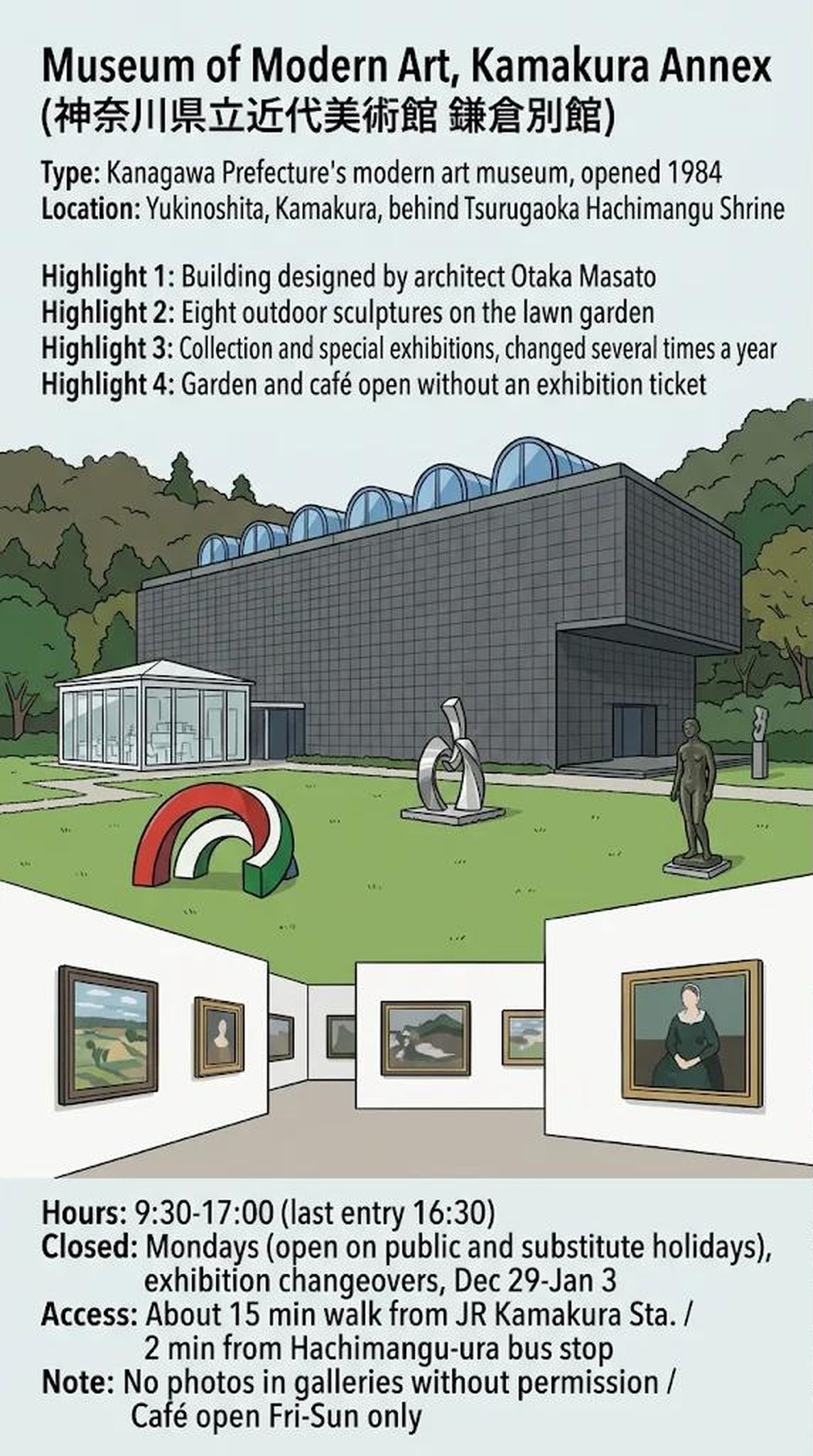
Highlights | Otaka Masato’s Architecture and the Sculpture Garden
The building was designed by the architect Otaka Masato (大髙正人). It has a steel-reinforced concrete structure with two floors above ground and one below, clad in stoneware tiles made from Sanshu (三州) roof-tile clay and Inada (稲田) granite. A row of arched skylights runs along the top of the dark grey tiled walls, and part of the second floor projects outward as a cantilever. The building won the top prize at the Kanagawa Architecture Competition in its opening year and the BCS Prize (建築業協会賞) the following year, 1985.
The lawn in front of the building is a sculpture garden with eight outdoor works: Yanagihara Yoshitatsu’s (柳原義達) “Inu no Uta” (犬の唄), Tada Minami’s (多田美波) “Jiku” (時空), Inoue Reiko’s (井上玲子) “Kageboshi” (カゲボウシ), Watanabe Toyoshige’s (渡辺豊重) “SWING 86-01”, Uematsu Keiji’s (植松奎二) “Uku Katachi – Jiku” (浮くかたち―軸), Yuhara Kazuo’s (湯原和夫) “Untitled” (無題), Hongo Shin’s (本郷新) “Wadatsumi no Koe” (わだつみのこえ) and Maita Masafumi’s (眞板雅文) “Seishi Kukan” (静思空間). The site lies in a yato (谷戸), a narrow valley typical of Kamakura, and wooded hills rise behind the sculptures.
Experiences | Exhibitions, and a Garden and Café Open Without a Ticket
The galleries are compact, and for some exhibitions even a careful look does not take long. Talks, gallery talks and workshops are sometimes held to accompany exhibitions. Photography without permission is not allowed in the galleries, and umbrellas and large bags cannot be taken in. Notes must be written in pencil, which you can borrow at reception.
The garden and the café can be used without an exhibition ticket, so you can stop by just to see the sculptures while walking between Kita-Kamakura and Tsurugaoka Hachimangu Shrine. Compared with the busy area around the shrine, both the building and the garden are calm. Sketching is allowed in the garden as long as it does not disturb other visitors, and photography for personal use is allowed in the garden and the café.
The café, Pinacoteca (ピナコテカ), is in a glass-walled extension at the end of the corridor from the entrance, with a view over the sculpture garden. It opens on Fridays, Saturdays and Sundays only and does not take reservations. There are no vending machines in the building, and the shop and café accept cash only.
History | An Annex Built Around Ancient Remains, Renovated in 2019
The annex was built to provide space for permanent displays and more storage, on the site of a former prefectural car park about 350 m north of the original building. Excavations before construction found remains thought to belong to the Nijugobo (二十五坊), the twenty-five monks’ lodgings of Tsurugaoka Hachimangu Shrine in the Muromachi period. To preserve them, the whole building was shifted toward the hill and made smaller than first planned.
The annex closed in September 2017 for renovation and reopened on October 12, 2019. The exterior was kept, the bush-hammered concrete columns and ceilings were left as they were, and features such as the bronze-coloured handrails were repainted in their original colours. The gallery walls changed from wood-grain panelling to white, the lighting was switched to LED, and a glass automatic door was added between the galleries and the exhibition lobby. The café was added at this time, and some of the outdoor sculptures were moved to the Hayama building.
The original building, the Kamakura building, is a modernist work by the architect Sakakura Junzo (坂倉準三). After it closed it was handed over to Tsurugaoka Hachimangu Shrine, designated an Important Cultural Property of Japan in December 2020, and now operates as the Kamakura Bunkakan Tsurugaoka Museum (鎌倉文華館 鶴岡ミュージアム). In the café and shop next to it, part of the trunk of the shrine’s great ginkgo tree, which fell in 2010, is on display.
Access and Opening Hours
The museum is about 15 minutes on foot from JR Kamakura Station (鎌倉駅), heading toward Tsurugaoka Hachimangu Shrine and Kita-Kamakura. From bus stop 2 at the East Exit of Kamakura Station, an Enoden Bus (江ノ電バス) bound for Ofuna Station (大船駅) or Kami-Ooka Station (上大岡駅) takes about 5 minutes to the Hachimangu-ura (八幡宮裏) stop, from where it is a 2-minute walk. The only parking is one space for disabled visitors (contact the museum in advance). Bicycles and motorcycles can be left beside the slope inside the main gate, but the area has no roof and cannot be used after closing.
The museum is open from 9:30 to 17:00 (last entry 16:30). It is closed on Mondays (open if Monday is a public holiday or substitute holiday), during exhibition changeovers, and over the New Year period (usually December 29 to January 3; December 28, 2026 to January 4, 2027 this season). Admission differs between special exhibitions and collection exhibitions. Junior high school students and younger enter free. Tickets can be paid for by credit card or major QR code payment services.
Best Time to Visit
The museum closes between exhibitions, so check the official website for the current exhibition before you go. If you want to use the café, plan your visit for a Friday, Saturday or Sunday. The garden can be seen without a ticket, so it fits easily into a walk to the temples of Kita-Kamakura or a visit to Tsurugaoka Hachimangu Shrine.
Nearby Spots | Tsurugaoka Hachimangu Shrine and the Temples of Kita-Kamakura
Tsurugaoka Hachimangu Shrine lies just south of the museum, and the Kamakura Bunkakan Tsurugaoka Museum, the former Kamakura building, is inside the shrine grounds. Heading north along the Kamakura Kaido over Kobukurozaka takes you toward the temples of Kita-Kamakura. Every year the annex joins the Kaburaki Kiyokata Memorial Art Museum (鏑木清方記念美術館), the Kamakura City Kawakita Film Museum (鎌倉市川喜多映画記念館), the Kamakura Museum of National Treasures (鎌倉国宝館) and the Kamakura Museum of History and Culture (鎌倉歴史文化交流館) in a stamp rally covering all five museums.
Recommended For
The annex suits visitors who want to see works from the collection along with Otaka Masato’s architecture, the outdoor sculptures and the story of the museum that began in the old Kamakura building. The building has a lift, wheelchair-accessible toilets and a first-aid and baby-care room, and wheelchairs and pushchairs can be borrowed free of charge.
Summary | Exhibitions, Architecture and a Sculpture Garden in One Visit
The Museum of Modern Art, Kamakura Annex lets you see changing displays from the collection, Otaka Masato’s building and a garden of eight outdoor sculptures in a single visit. Staying at Toshi’s Place, a self-catering, fully unstaffed smart hotel with a full kitchen, you can pick an opening day and drop in on the way to or from the temples of Kita-Kamakura or Tsurugaoka Hachimangu Shrine.
Basic Information
| Name | The Museum of Modern Art, Kamakura Annex (神奈川県立近代美術館 鎌倉別館) |
|---|---|
| Address | 2-8-1 Yukinoshita, Kamakura City, Kanagawa Prefecture 248-0005 |
| Highlights | Building designed by architect Otaka Masato (opened 1984, renovated 2019); eight outdoor sculptures in the front garden: Yanagihara Yoshitatsu “Inu no Uta”, Tada Minami “Jiku”, Inoue Reiko “Kageboshi”, Watanabe Toyoshige “SWING 86-01”, Uematsu Keiji “Uku Katachi – Jiku”, Yuhara Kazuo “Untitled”, Hongo Shin “Wadatsumi no Koe”, Maita Masafumi “Seishi Kukan” |
| Things to Do | Viewing collection and special exhibitions; viewing the outdoor sculptures in the garden (no ticket needed); a break at the café (no ticket needed; open Fridays to Sundays only) |
| Opening Hours | 9:30–17:00 (last entry at 16:30) |
| Visit Duration (Estimate) | Approx. 45 min (Quick: 30 min / Thorough: 60 min) |
| Admission | Special Exhibitions (FY2026): General 700 (600) yen, Under 20/Students 550 (450) yen, Seniors 65+ 350 yen, High School Students 100 yen, Junior High and younger: Free Collection Exhibitions: General 250 (150) yen, Under 20/Students 150 (100) yen, Seniors 65+ 100 yen, High School Students 100 yen, Junior High and younger: Free *Figures in parentheses are for groups of 20 or more Holders of disability certificates and one carer: free The garden and café can be used without a ticket |
| Closed | Mondays (open if a national holiday or substitute holiday), between exhibitions, year-end and New Year holidays (usually Dec 29–Jan 3; Dec 28, 2026–Jan 4, 2027 this season) |
| Notes | No unauthorized photography in exhibition rooms. Turn off or silence mobile devices; phone calls not allowed in exhibition rooms. No large bags or umbrellas without permission. Do not touch artworks or display cases. Only pencils allowed for writing in exhibition rooms. Eating/drinking only in designated areas. Pets not allowed (except assistance dogs). No smoking anywhere on premises. Photography for personal use is allowed in the garden and café. There are no vending machines in the building. The shop and café accept cash only. The café opens on Fridays, Saturdays and Sundays only. |
| Restrooms | Available (accessible toilets on 1F and 2F. 2F: baby bed and baby chair. 1F: baby chair, ostomate facilities, foldable seat) |
| Official Website | https://www.moma.pref.kanagawa.jp/en/ |


