Kamakura Festival (鎌倉まつり)
- Usually
- Second to third Sunday of April (parade and Shizuka no Mai on the first day, nodate tea seats on the last Saturday and Sunday)
- Venue
- Tsurugaoka Hachimangu Shrine
What is the Kamakura Festival?
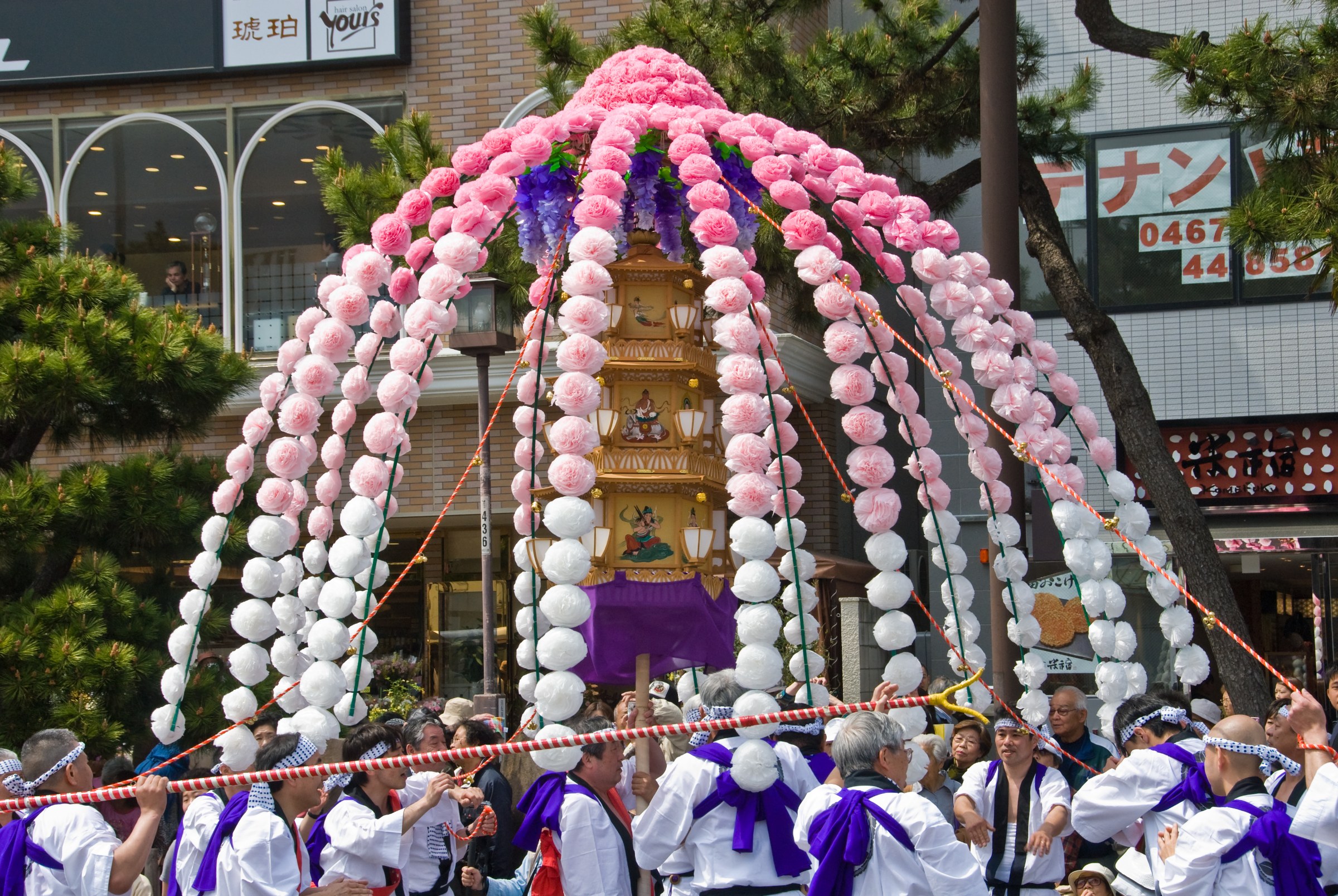
The Kamakura Festival (鎌倉まつり) is Kamakura’s spring festival, held since 1959. Organized by the Kamakura City Tourist Association (鎌倉市観光協会), it runs from the second Sunday to the third Sunday of April, centered on Tsurugaoka Hachimangu Shrine (鶴岡八幡宮). On the first Sunday, a parade travels along Wakamiya-oji Avenue (若宮大路) and the Shizuka no Mai (静の舞) dance is performed at the Maiden dance hall (舞殿). On the last Saturday and Sunday, nodate (野点) outdoor tea seats are set up, where matcha green tea is served in the open air.
Dates and Times
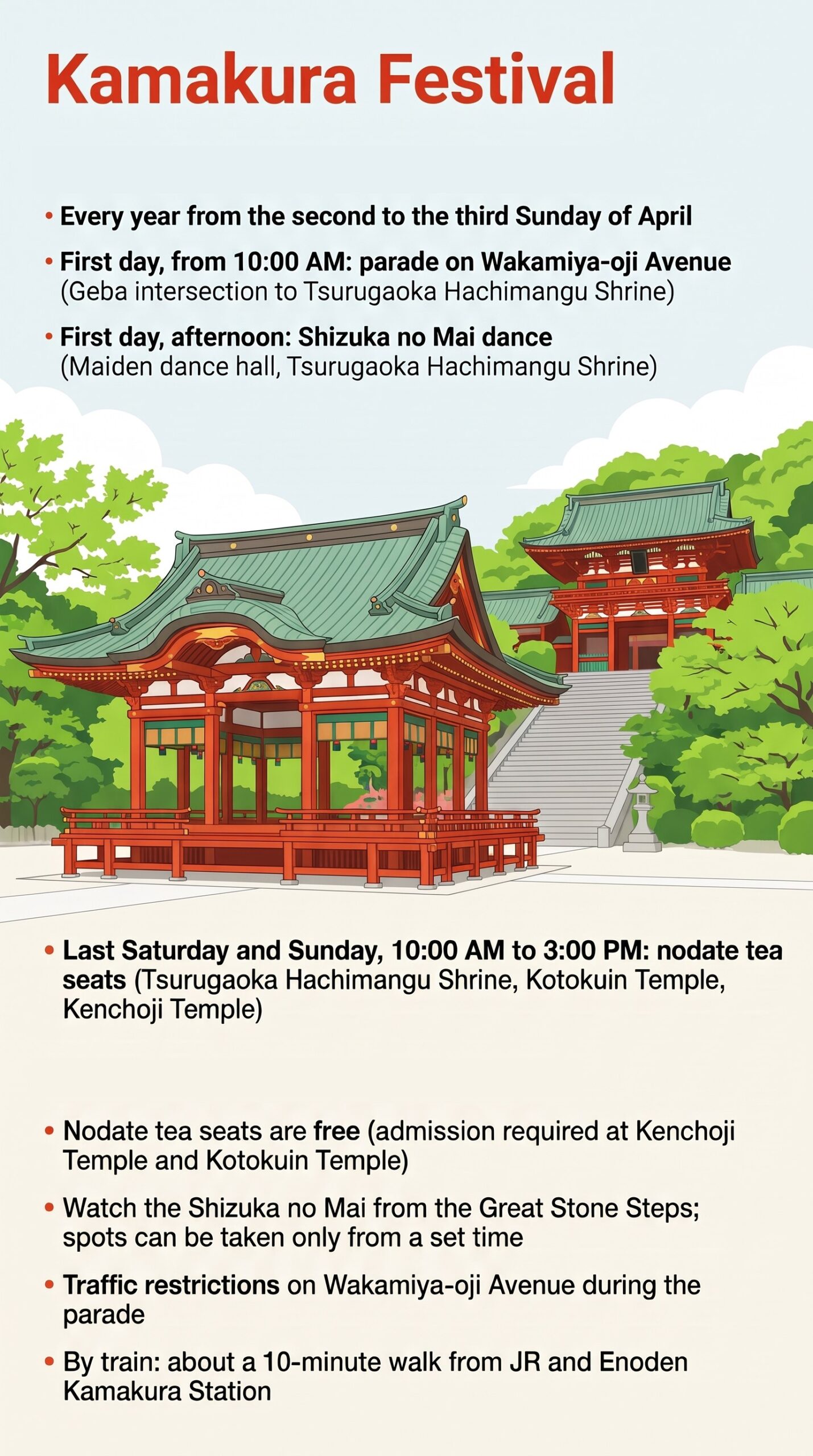
The festival runs from the second Sunday to the third Sunday of April. On the first Sunday, the parade usually starts at 10:00 AM, followed in the afternoon by the opening ceremony and the Shizuka no Mai, with a commentary on the dance beforehand. On the last Saturday and Sunday, the nodate tea seats are usually open from 10:00 AM to 3:00 PM. On the afternoon of the last Sunday, separately from the festival, Tsurugaoka Hachimangu Shrine holds the yabusame (流鏑馬) horseback archery of its Sukeisha Taisai (崇敬者大祭) on the archery track in the shrine grounds. Times change from year to year, so check that year’s schedule on the Kamakura City Tourist Association’s Kamakura Festival page (in Japanese).
Highlights
The Parade on Wakamiya-oji Avenue
The parade opens the festival. It sets off from the Geba intersection (下馬四つ角) on Wakamiya-oji Avenue and travels about 1 km to the grounds of Tsurugaoka Hachimangu Shrine. Local ohayashi (お囃子) festival music groups and mikoshi (神輿) portable shrine teams are joined by warriors in armor, yosakoi dancers, marching bands and other community groups, and the lively music and spirited calls ring out along the avenue.
The Shizuka no Mai at the Maiden Dance Hall
The Shizuka no Mai recreates the story of Shizuka Gozen (静御前) at the Maiden dance hall. According to the Azuma Kagami (吾妻鏡), a chronicle of the Kamakura period, Shizuka Gozen was a shirabyoshi (白拍子), a dancer who performed in men’s court dress. After parting in Yoshino from Minamoto no Yoshitsune (源義経), who had fallen out with his elder brother Minamoto no Yoritomo (源頼朝), she was captured and sent to Kamakura. Asked by Yoritomo and his wife Hojo Masako (北条政子) to dance at Tsurugaoka Hachimangu Shrine, she sang of her longing for Yoshitsune, angering Yoritomo, and Masako is said to have calmed his anger. The Maiden dance hall stands on the site of the corridor of the Wakamiya (若宮) shrine where Shizuka Gozen danced.
On the day, a dancer in shirabyoshi costume performs to the music of the players seated on both sides of the stage. The dancer is a Japanese classical dance artist, with the cooperation of the Kamakura Performing Arts Federation (鎌倉芸能連盟), and the school and dancer change from year to year.
Nodate Tea Seats
At the nodate tea seats, matcha is served at tea seats set up in temple and shrine grounds. In most years, an Omotesenke (表千家流神谷会) tea group hosts a seat in the grounds of Tsurugaoka Hachimangu Shrine on the last Saturday, and the Urasenke Tankokai Kamakura Branch (裏千家淡交会鎌倉支部) hosts one behind the Great Buddha at Kotokuin Temple (高徳院) on the last Sunday. In recent years, the Mushakoji Senke (武者小路千家) school has also held an indoor seat in a hall at Kenchoji Temple (建長寺). Joining is free, and no knowledge of tea etiquette is needed. Admission is required at Kenchoji Temple and Kotokuin Temple.
Visiting Tips
- The Shizuka no Mai is watched from the viewing area set up around the Maiden dance hall and from the Great Stone Steps (大石段). On the day, the steps become a kind of grandstand
- You cannot save a spot on the Great Stone Steps until a set time before the performance. After that, the steps become one-way, going up to the main shrine (本宮), so do not stop partway
- Ropes separate the worshippers’ path from the viewing area. Follow the staff’s directions. Spreading picnic sheets and entering the planted areas are not allowed
- During the parade, car traffic is usually restricted between the Geba intersection and the San-no-Torii gate (三の鳥居) until around noon. Do not cross Wakamiya-oji Avenue, and watch without stepping off the sidewalk. Sitting on the Dankazura (段葛) raised walkway or entering the planted areas to watch is not allowed
- The nodate seats are limited, and when crowded you wait your turn as guided by the staff. Once the tea service begins, you cannot join companions, and you should stay seated until it ends
- On rainy or stormy days, the nodate venue may change or the tea seats may be canceled
- The area around Kamakura Station and Wakamiya-oji Avenue is very crowded on festival days. Come by train and take your trash home
Access | Visiting During Your Stay at Toshi’s Place
Tsurugaoka Hachimangu Shrine and Wakamiya-oji Avenue are about a 10-minute walk from the east exit of JR Kamakura Station (鎌倉駅) and from Kamakura Station on the Enoden (江ノ電) line. If you stay at Toshi’s Place, take the Enoden from Hase Station (長谷駅) or Wadazuka Station (和田塚駅) to Kamakura Station and walk along Wakamiya-oji Avenue, and you can spend an unhurried day from the morning parade to the afternoon Shizuka no Mai. On the nodate Sunday, you can walk from Hase Station to the tea seat at Kotokuin Temple.
Summary
From the second to the third Sunday of April, the Kamakura Festival colors spring in Kamakura with its parade, the Shizuka no Mai and the nodate tea seats. For the shrine’s everyday highlights, see Tsurugaoka Hachimangu Shrine, and for New Year visits, see Hatsumode at Tsurugaoka Hachimangu Shrine. For the annual festival held on April 2, ahead of the Kamakura Festival, at Moto Hachiman in Zaimokuza, see Reisai Festival at Yui Wakamiya Shrine.
Basic Information
| Item | Details |
|---|---|
| Name | Kamakura Festival |
| Japanese name | 鎌倉まつり |
| Dates | Every year from the second Sunday to the third Sunday of April |
| Main events | Parade (first day, morning, Wakamiya-oji Avenue), Shizuka no Mai (first day, afternoon, Maiden dance hall of Tsurugaoka Hachimangu Shrine), nodate tea seats (last Saturday and Sunday, usually 10:00 AM–3:00 PM, Tsurugaoka Hachimangu Shrine, Kotokuin Temple and Kenchoji Temple) |
| Venue | Tsurugaoka Hachimangu Shrine, Wakamiya-oji Avenue and other sites |
| Address | 2-1-31 Yukinoshita, Kamakura, Kanagawa (Tsurugaoka Hachimangu Shrine) |
| Fees | The nodate tea seats are free to join (admission is required at Kenchoji Temple and Kotokuin Temple) |
| Notes | Traffic restrictions on Wakamiya-oji Avenue during the parade. Set times for taking spots on the Great Stone Steps for the Shizuka no Mai. The nodate venue may change or be canceled in rain |
| Access | About a 10-minute walk from the east exit of JR Kamakura Station and from Enoden Kamakura Station |
| Organizer / Contact | Kamakura City Tourist Association, 0467-23-3050 |
| Official website | Kamakura Festival (Kamakura City Tourist Association, in Japanese) |