Gochinza Kinensai Festival at Tsurugaoka Hachimangu Shrine (鶴岡八幡宮 御鎮座記念祭)
- Next
- Wed, Dec 16, 2026
- Usually
- Every year on the evening of December 16. The mikagura begins around 5:30 p.m.
- Venue
- Tsurugaoka Hachimangu Shrine Maiden Pavilion north courtyard
What Is the Gochinza Kinensai?
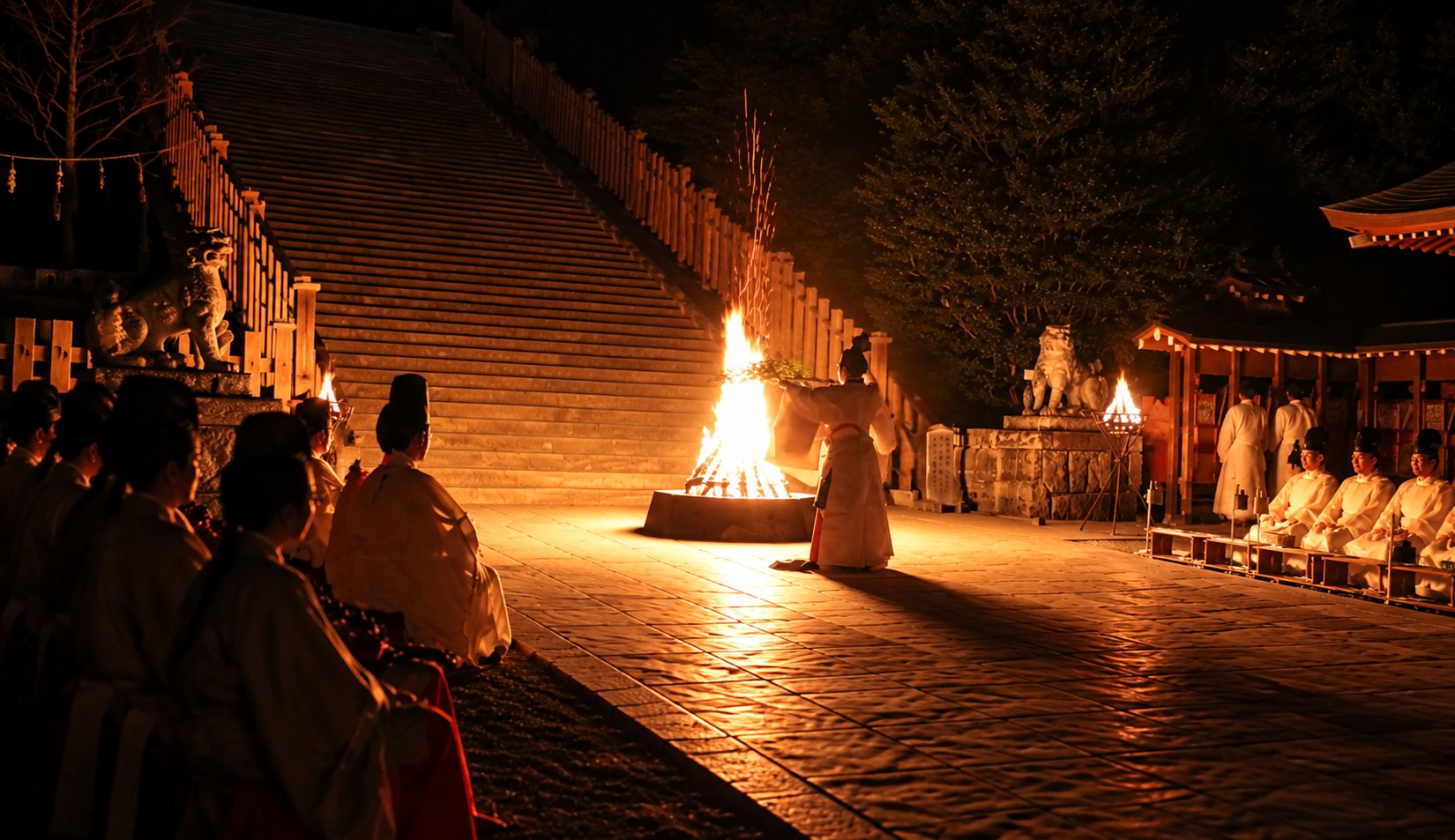
The Gochinza Kinensai (御鎮座記念祭) is a festival held every year on the night of December 16 at Tsurugaoka Hachimangu Shrine (鶴岡八幡宮). All the lights in the shrine grounds are turned off, and mikagura (御神楽) is performed by the light of bonfires alone. Mikagura are sacred songs and dances offered to the deities in the rituals of Shinto (神道), Japan’s indigenous religion. At Tsurugaoka Hachimangu Shrine, this mikagura is said to have been passed down for more than 800 years.
Date, Time and Schedule of the Evening
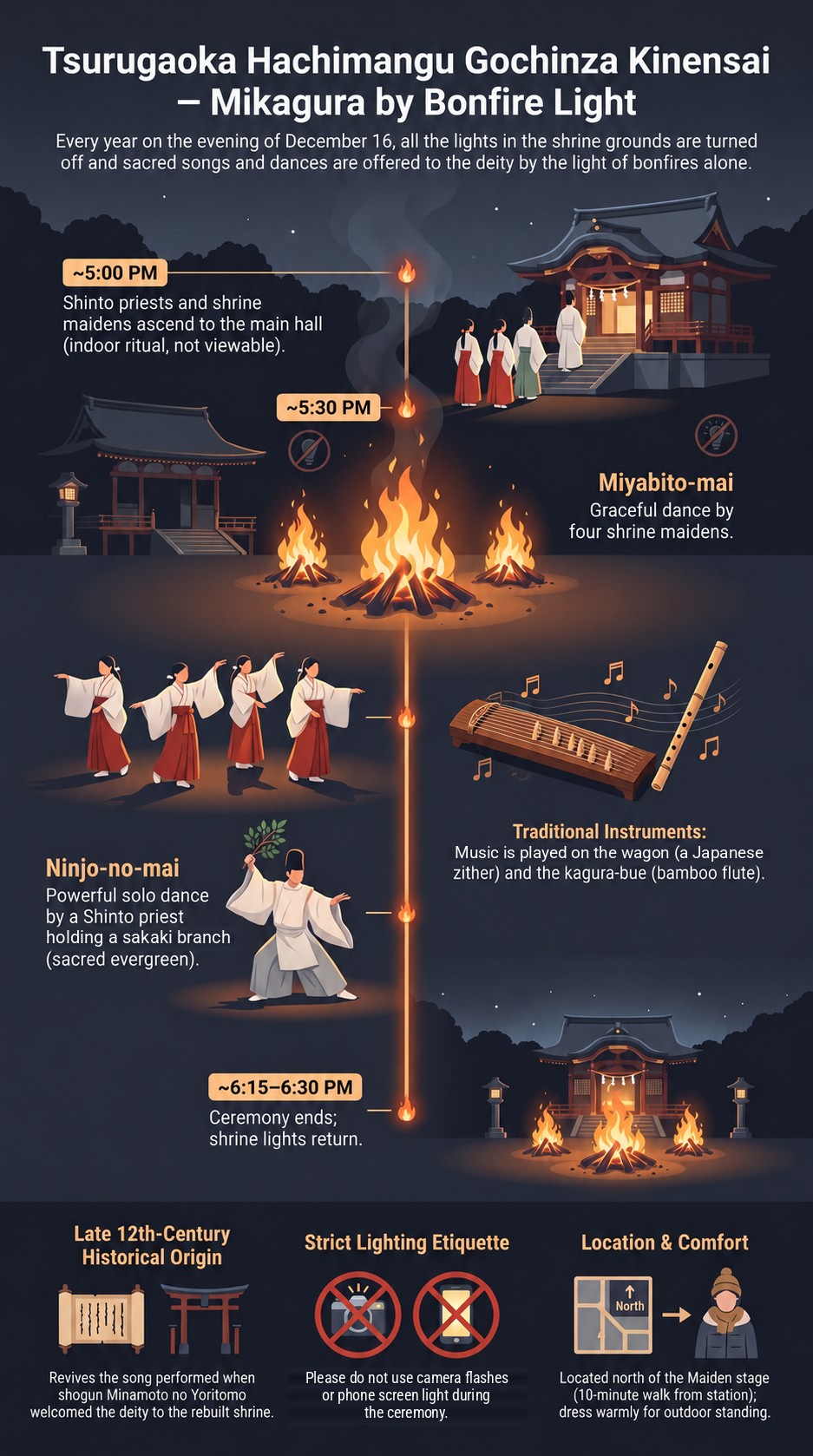
The Gochinza Kinensai takes place every year on December 16, and the mikagura begins at around 5:30 PM.
At around 5:00 PM, Shinto priests and shrine maidens (miko, 巫女), women who serve in Shinto rituals, go up to the Main Shrine (本宮) at the top of the Grand Stone Staircase (大石段). The ritual at the Main Shrine is held inside the building and cannot be viewed. At around 5:30 PM, all the lights in the grounds go out, the bonfires are lit, and the songs and dances begin. According to accounts by people who have attended, the ceremony ends at around 6:15 to 6:30 PM.
Origin | Recalling the Night the Deity Moved to a New Hall 800 Years Ago
The origin of this festival goes back more than 800 years, to the Kamakura period. Minamoto no Yoritomo (源頼朝), the first shogun of the Kamakura shogunate, rebuilt the shrine buildings of Tsurugaoka Hachimangu after they burned down, and in the late 12th century held a ceremony to welcome the deity into the new hall. This ceremony is called sengu (遷宮). According to Azuma Kagami (吾妻鏡), a historical chronicle of the time, musicians invited from Kyoto sang a song called “Miyabito no Kyoku” (宮人曲) on the night of the sengu. December 16 is that day converted to the modern calendar. Today’s mikagura revives this song.
Highlights | Two Dances in the Bonfire Light
When the lights go out, the murmur of the crowd fades and the grounds fall silent. The music is played on the wagon (和琴), a traditional Japanese zither, and the kagura-bue (神楽笛), a bamboo transverse flute. First, four shrine maidens perform the Miyabito-mai (宮人舞), their costumes swaying gently in the firelight. Then a priest in white robes, holding a branch of sakaki (榊), a sacred evergreen, performs the Ninjo-no-mai (人長の舞) alone. Many visitors have written that, unlike the graceful dance of the shrine maidens, it is a large and powerful dance.
Viewing Tips and Photography Etiquette
The mikagura is performed in the courtyard on the north side of the Maiden Pavilion (舞殿), a stage built for offering sacred dances. Anyone may enter the shrine grounds freely. According to people who have attended, in some years the front area is reserved for invited guests, and general visitors usually watch standing around it. You will be standing outdoors for more than an hour, so dress warmly.
If you take photos, please do not use a flash or the light of your smartphone screen. The ritual is conducted by bonfire light alone, so any extra light disturbs both the ceremony and the people watching around you.
Access | Visiting During Your Stay at Toshi’s Place
Tsurugaoka Hachimangu Shrine is about a 10-minute walk from Kamakura Station, served by the JR Yokosuka Line and the Enoden. The shrine grounds are normally open from 6:00 AM to 8:00 PM. The mikagura ends after 6:00 PM, so if you stay overnight in Kamakura, you can leave the grounds slowly in the afterglow of the bonfires without worrying about train times home. At Toshi’s Place, fully unstaffed smart hotels with fully equipped kitchens and room-only stays, even the walk back to your room through Kamakura on a winter night becomes part of the trip.
Summary
The mikagura of the Gochinza Kinensai is a once-a-year ritual performed by bonfire light alone, with every light in the grounds turned off. The song sung on the night of the sengu more than 800 years ago comes back to life and resonates through the quiet winter night.
Basic Information
| Item | Details |
|---|---|
| Name | Gochinza Kinensai (Tsurugaoka Hachimangu Shrine) |
| Japanese name | 御鎮座記念祭 |
| Date | The night of December 16, every year |
| Time | Around 5:00 PM: ritual at the Main Shrine (held indoors; cannot be viewed) Around 5:30 PM: mikagura begins Around 6:15–6:30 PM: ceremony ends (according to attendees’ accounts) |
| Location | Courtyard on the north side of the Maiden Pavilion, Tsurugaoka Hachimangu Shrine |
| Address | 2-1-31 Yukinoshita, Kamakura, Kanagawa 248-8588 |
| Viewing | Anyone may enter the shrine grounds freely. In some years the front area is reserved for invited guests (according to attendees’ accounts) |
| Notes | Do not use a flash or the light of a smartphone screen. Dress warmly, as you will stand outdoors for more than an hour |
| Shrine Hours | 6:00 AM – 8:00 PM |
| Access | About a 10-minute walk from Kamakura Station (JR Yokosuka Line, Enoden) |
| Official Website | https://www.hachimangu.or.jp/matsuri/ |